


National, 19th December 2025: WeNaturalists today released a nationwide report highlighting urgent challenges in India’s clean-air innovation ecosystem. Based on more than 1.2 million environmental observations and insights from over 300 climate innovators, NGOs, and researchers, the study finds that systemic hurdles including fragmented air-quality datasets, shrinking early-stage funding, and regulatory delays are slowing the development and deployment of clean-air technologies across over 70 cities, including Delhi, Mumbai, Bengaluru, Chennai, Kolkata, Pune, Indore, Surat, and Lucknow.
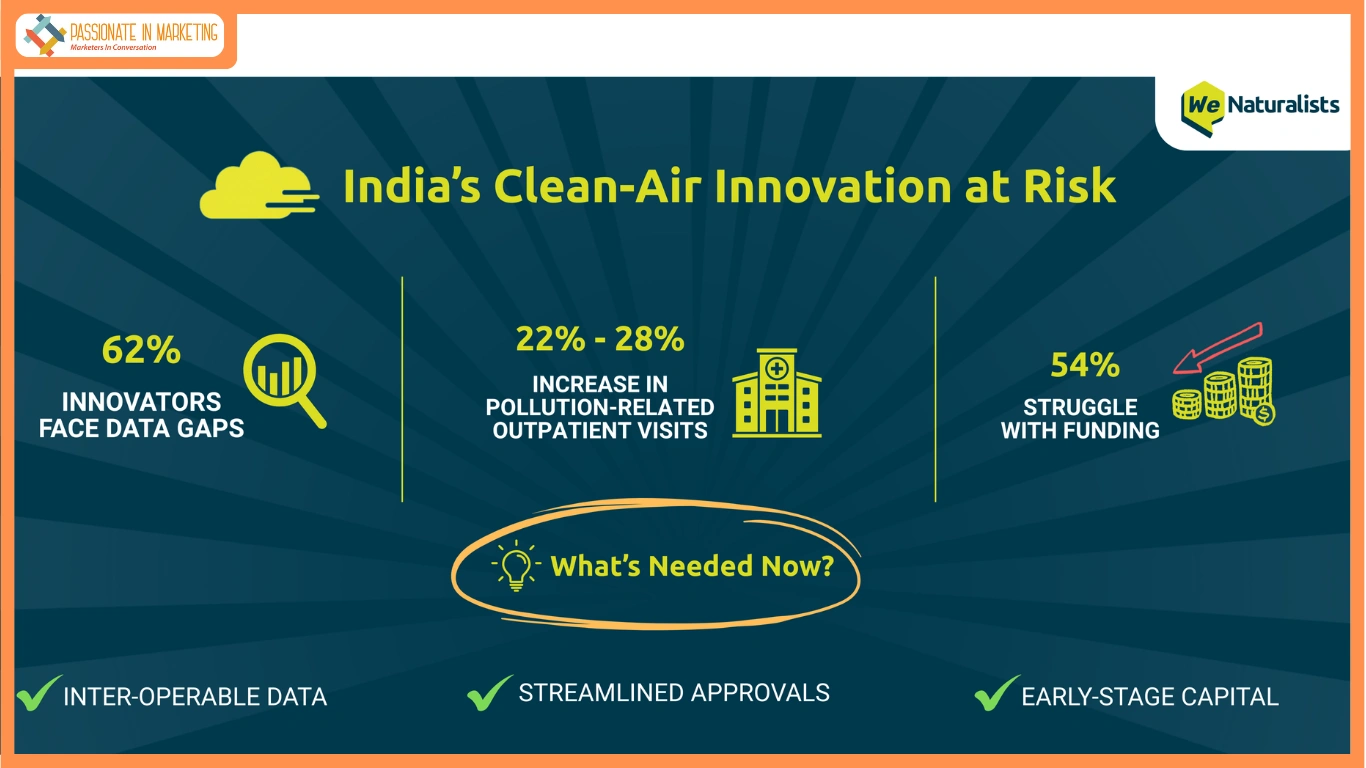
According to the report, 62% of innovators lack access to reliable or standardised AQI and emissions data across states and regions, making it difficult to design, test, or validate solutions. Funding remains a critical barrier, with 54% of innovators reporting shortages of early-stage risk capital, particularly for hardware-led and monitoring technologies. Regulatory approvals further compound these challenges, with over 40% of innovators experiencing timelines of 6–18 months for piloting or deployment.
Public concern is rising alongside these structural challenges. Citizen queries on air pollution have surged 37% in the last quarter, driven largely by inconsistencies in AQI readings, which in multiple cities show 30–70% variation between government monitors, private devices, and community sensors. The health impact is evident: hospitals and clinics in Delhi, Jaipur, Nagpur, and Bengaluru report 22–28% increases in pollution-related outpatient visits. Additionally, 35% of healthcare workers surveyed in high-pollution cities report increased exposure risk and health strain due to poor air quality, highlighting the urgent need for protective measures and targeted monitoring.
Despite these obstacles, WeNaturalists identifies strong growth potential in industrial emissions monitoring, hyperlocal sensor networks, indoor air-quality solutions for schools and hospitals, AI-driven climate-health advisory tools, and predictive pollution-alert technologies. Innovators note that scaling these solutions across Tier 1, 2, and 3 cities is possible with interoperable data systems, streamlined regulatory processes, and clear pilot frameworks.
“As a country, we have the ideas, the talent, and the urgency but innovators still lack foundational support,” said Amit Banka, Founder & CEO of WeNaturalists. “Without reliable datasets, simplified approvals, and access to early-stage risk capital, India risks slowing down clean-air innovation at a critical time.”
WeNaturalists urges policymakers, investors, and urban administrations to collaborate on a cohesive national clean-air innovation framework, including open-access environmental data, dedicated funding for climate hardware, defined pilot zones, and integrated environmental and healthcare data to support early-warning systems, public-health preparedness, and protection for frontline healthcare workers.

