


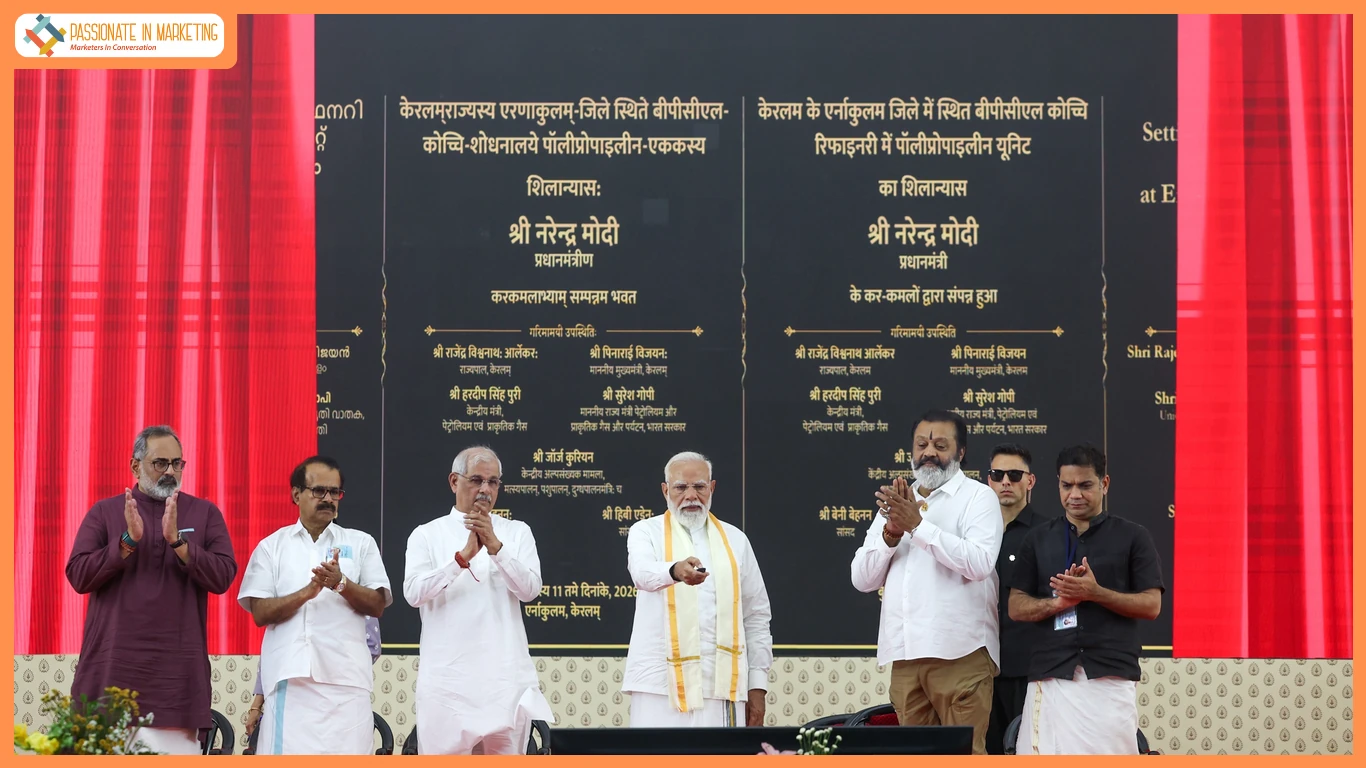
Kochi, March 11, 2026: Hon’ble Prime Minister, Shri Narendra Modi, laid the foundation stone for Bharat Petroleum Corporation Limited’s (BPCL) Polypropylene (PP) Project at the Kochi Refinery in Ernakulam district of Kerala today. The project marks a significant step in strengthening India’s petrochemical ecosystem and advancing the Government of India’s vision of Atmanirbhar Bharat by enhancing domestic polymer production capacity.
With an investment of ₹5,514 crore, the Polypropylene Project will establish a 400 Kilo Tons Per Annum (KTPA) Polypropylene Unit along with associated facilities for the production of six grades of homopolymer polypropylene. These grades will cater to diverse sectors including packaging, automotive components, medical devices, home appliances, textiles, and household products. The project is scheduled for completion by 31st October 2027.
The upcoming Polypropylene Unit will play a pivotal role in strengthening India’s domestic polymer production capabilities and reducing dependence on imports. The availability of locally produced polypropylene will enable industries, particularly packaging manufacturers, automotive component producers, and MSMEs, to access raw materials closer to their manufacturing bases. This proximity is expected to significantly reduce transportation and logistics costs, improve production efficiencies, and enhance the overall competitiveness of local industries.
A reliable and steady supply of high-quality polypropylene from the BPCL Kochi Refinery will further support the growth of downstream industries in the region. In this regard, the Kerala Industrial Infrastructure Development Corporation (KINFRA) is developing a Petrochemical Park adjacent to the refinery, which will leverage the assured feedstock from BPCL to attract investments from polymer processors and other downstream manufacturing units.
BPCL has integrated strong environmental and sustainability considerations into the project design. The Polypropylene Unit will deploy state-of-the-art UNIPOL® technology by M/s W. R. Grace & Co., recognized globally for its efficient gas-phase process and lower carbon footprint compared to conventional liquid-phase technologies. The process design minimizes energy consumption and reduces raw material waste, thereby supporting BPCL’s commitment to responsible and sustainable industrial development.
Additionally, a green belt covering approximately 34 acres has been planned as part of the project to enhance ecological balance around the refinery complex. Polypropylene itself is a non-toxic, odourless and non-irritant polymer, and the production process generates minimal waste. Any minor polypropylene spill can be safely collected and reused as a low-value product, further minimizing environmental impact.
As part of its Corporate Environment Responsibility (CER) commitment, BPCL has earmarked ₹38.41 crore for initiatives aimed at improving the quality of life of communities in and around the project area. These initiatives will focus on community development, environmental improvement, and enhancing the living standards of local residents.
The project is also expected to generate significant employment opportunities. During the peak construction phase, approximately 2,500 to 3,000 skilled and unskilled workers will be engaged at the project site. Once operational, the Polypropylene Unit is expected to create around 300 direct and indirect employment opportunities, while also generating substantial indirect employment across sectors such as transportation, warehousing, polymer processing, and auxiliary services.
The Polypropylene Project at BPCL Kochi Refinery is poised to catalyse industrial growth, attract downstream investments, and strengthen the regional manufacturing ecosystem, while contributing meaningfully to India’s self-reliance in petrochemical products.
Through strategic investments such as this, BPCL continues to play a vital role in supporting the nation’s industrial development and driving sustainable economic growth.

