


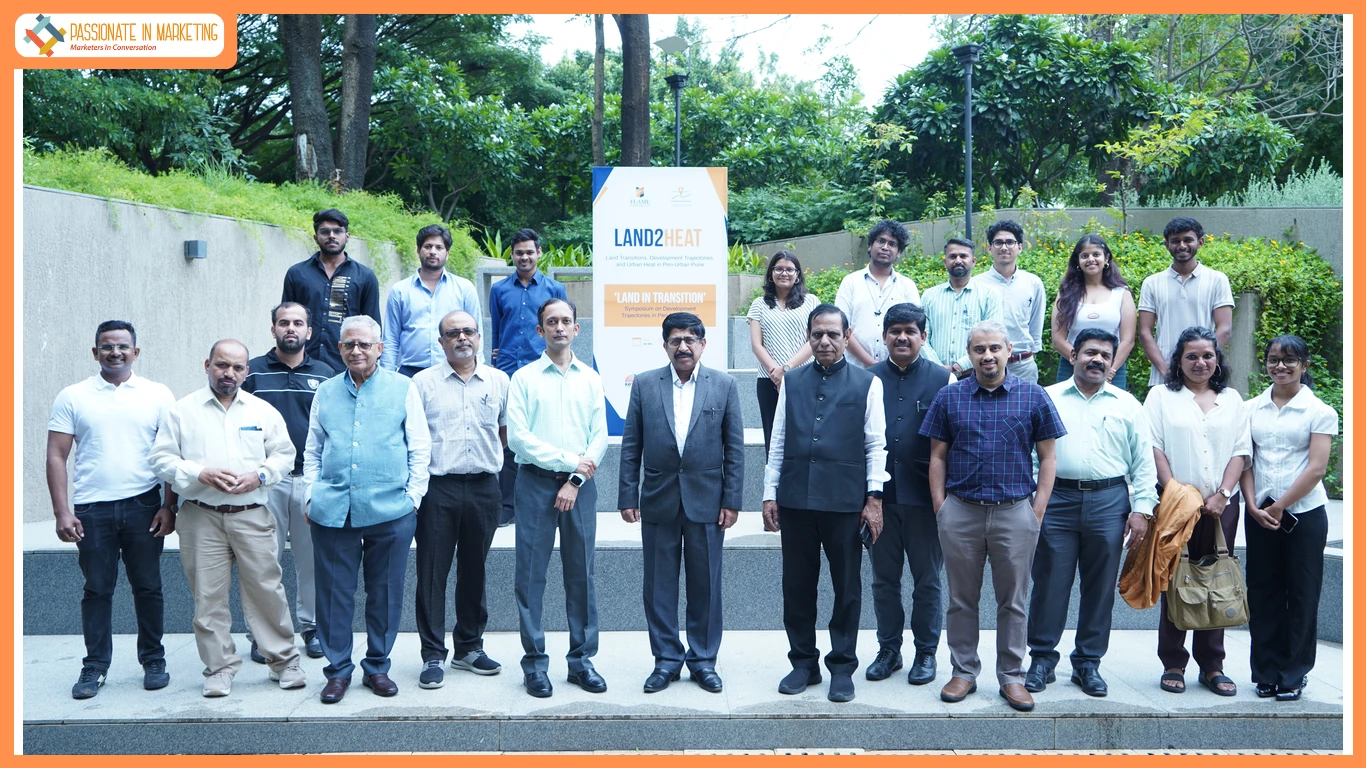
Pune, 22 July 2026: FLAME University, in collaboration with Landstack and the H T Parekh Foundation, hosted ‘Land in Transition’, a one-day symposium on development trajectories in peri-urban Pune, at the FLAME campus. The symposium examined how land governance, planning, and real estate practice shape rising urban heat and climate resilience in Pune’s rapidly transforming periphery: a question that sits at the intersection of land administration, urban planning, and climate action.
The event brought together a rare cross-section of stakeholders in one room: senior government and former revenue administrators, urban planners, real estate industry leaders, and CREDAI representatives, civil society organisations including PRAYAS and MEER, local elected representatives, and academic researchers. Speakers included Prof. M. A. Venkataramanan, Pro Vice-Chancellor, FLAME University; Prof. Prasad Pathak, Dean – Research, FLAME University; Dr. Pranab Choudhury, Co-founder & CEO, Landstack; Mr. Shekhar Gaikwad, YASHADA Centre of Excellence; Mr. Pralhad Kachare, former Deputy Commissioner, Revenue Department, Government of Maharashtra; and Dr. Ramakrishna Nallathiga, NICMAR University.
Key Takeaways
- Urban heat is a growing but under-recognised risk. While flooding dominates public and policy attention, heat stress in peri-urban Pune is intensifying, yet no coherent policy on urban heat currently exists at any level of governance.
- Peri-urban areas sit in a governance grey zone. Development Plans can take six to seven years to prepare, while implementation typically remains low, and fast-growing corridors outstrip the administrative and fiscal capacity of village-level institutions.
- Land administration can be a climate resilience tool. The symposium proposed a framework for its evolving role, moving from Revenue to Reform, Record, Resource, and finally Resilience, with land records, transactions, and mutation processes serving as levers for heat-resilient development.
Voices from the Symposium
Speaking on the symposium, Prof. M. A. Venkataramanan, Pro Vice-Chancellor, FLAME University, said, “The Land in Transition symposium reflects the kind of interdisciplinary and collaborative dialogue that FLAME University seeks to foster, bringing together knowledge, policy, practice, and lived experience to engage with complex challenges facing society. As Pune’s periphery undergoes rapid transformation, questions of land, governance, urbanisation, and climate resilience can no longer be examined in isolation. By convening administrators, planners, real estate developers, industry leaders, civil society, and researchers, this symposium has created an important platform to move beyond fragmented conversations and explore how land governance can become an instrument of more resilient and sustainable development. FLAME is pleased to be a part of this effort and to help advance a dialogue that connects research with the realities of a rapidly changing region.”
Also sharing his thoughts was Dr. Pranab Choudhury, Co-founder & CEO, Landstack, who said, “How our cities take shape reflects not only residents’ aspirations, but the land itself: its administration, its infrastructure, and its transaction patterns. Reforming land administration, with climate change built into it, is central to the future of both our cities and our land governance.”
The Way Forward
The organisers announced that this dialogue will continue beyond the symposium. As a next step, the collaborating institutions will take the conversation to the ground, engaging directly with citizens, administrators, and other stakeholders across peri-urban Pune to document their lived experiences and understand their perspectives on heat and land. These on-ground engagements will inform a longer-term research and policy agenda on heat-resilient land governance for the region.
About the Organisers
FLAME University is the pioneer of interdisciplinary education in India. It is driven to be one of India’s most respected and reputed centers of learning—the premier destination of choice for higher education in the nation for learners and teachers—to push the design and nature of studies and to create a societal up-gradation phenomenon, particularly in the fields of interdisciplinary education and leadership. FLAME has been set up with an idealistic vision and a social commitment to contribute to society nobly. With more than 180 quality full-time faculty members, the university offers an unparalleled educational experience. The student-teacher ratio is 15:1, unmatched at the higher education level in India. Spread on 70 acres of green expanse with aesthetically designed infrastructure, the campus currently consists of five faculties: Faculty of Liberal Education, Faculty of Business, Faculty of Communication, Faculty of Computing and Data Sciences, and Faculty of Design, Art & Performance. FLAME University has been established as a state-private university vide the FLAME University Act 2014 (Maharashtra Act No. II of 2015), now Maharashtra Private Universities (Establishment and Regulation) Act, 2023 (Maharashtra Act No. VIII of 2024) of the Government of Maharashtra. It is recognized by the University Grants Commission (UGC) under Section 2(f), and degrees awarded by the university are recognized under Section 22 of the UGC Act, 1956. FLAME University has been awarded the highest NAAC accreditation, A++.
Landstack is an institute working on land governance, policy, and data-driven land administration reform.
The H T Parekh Foundation supports research and initiatives in sustainable urban development and social equity.

