


Marketing can generate attention, clicks, and enquiries, but those results only matter if businesses can turn interest into ongoing customer conversations. For many brands, WhatsApp has become one of the channels where that next stage happens.
The challenge is that conversations quickly become difficult to manage once campaigns produce larger lead volumes. A WhatsApp CRM connects messaging with customer records, ownership, follow-up activity, and team collaboration, helping businesses move prospects beyond the first enquiry instead of leaving valuable conversations scattered across individual inboxes.
Marketing Does Not End When the Customer Sends a Message
A click-to-WhatsApp campaign may successfully encourage someone to start a conversation, but that first message is only the beginning.
A prospect may ask about pricing, product availability, delivery, specifications, or minimum order quantities. Some are ready to buy immediately, while others need several conversations before making a decision.
If those interactions remain inside ordinary chat histories, marketing teams may know how many enquiries they generated without knowing how many became qualified leads or sales.
That creates a gap between marketing activity and revenue.
A Practical WhatsApp CRM Execution Framework
Businesses can close that gap by giving every WhatsApp enquiry a simple, repeatable path.
Step 1: Capture the Lead Source
Start by recording where the conversation came from.
Was it a Meta campaign, influencer collaboration, website CTA, trade show, Google Maps outreach, or organic social post?
Without source information, it becomes difficult to connect later sales results with the marketing activity that generated them.
Step 2: Qualify and Categorize the Enquiry
Not every message deserves the same sales effort.
Teams can classify prospects by factors such as:
- product interest;
- location;
- B2B or consumer enquiry;
- purchase intent;
- expected order size;
- sales stage.
This gives salespeople a clearer idea of which conversations need immediate attention.
Step 3: Assign an Owner
Every qualified lead should have someone responsible for the next action.
Clear ownership reduces duplicate replies and prevents promising inquiries from disappearing because everyone assumes another employee is handling them.
For teams operating several WhatsApp accounts, this step becomes especially important.
Step 4: Define the Follow-Up
The first response should not be the end of the workflow.
Teams can define simple follow-up rules, for example:
New enquiry → qualification → quotation → follow-up → negotiation → won/lost
A lead that receives pricing today might need another message three days later. A B2B prospect waiting for internal approval may need a longer follow-up interval.
The objective is to make the next action visible instead of leaving it to memory.
Step 5: Review the Outcome
Marketing and sales teams should periodically review what happened after the original conversation.
Useful metrics include:
- number of WhatsApp enquiries;
- qualified leads;
- response rate;
- follow-up completion;
- quotations sent;
- opportunities progressed;
- Sales generated by source.
This turns WhatsApp from an isolated messaging channel into a measurable part of the customer journey.
Example: From a Campaign Inquiry to an International Sales Lead
Imagine a manufacturer promoting industrial parts in Southeast Asia. A prospect replies to a campaign via WhatsApp asking about pricing. Instead of trapping this message in one inbox, the team logs it in a CRM, tags the lead, and assigns it to a regional rep.
The rep sends a catalogue, and the CRM later prompts a follow-up. Using translation tools, the rep answers technical questions, sends a quote, and enters negotiations.
Even if it doesn’t close immediately, the business retains critical data: campaign source, ownership, product interest, and next steps. This transforms a simple message into a manageable sales opportunity.
AI Can Reduce Repetitive Conversation Work
Many marketing and sales teams repeatedly answer the same questions about shipping, availability, product details, business hours, or standard purchasing procedures.
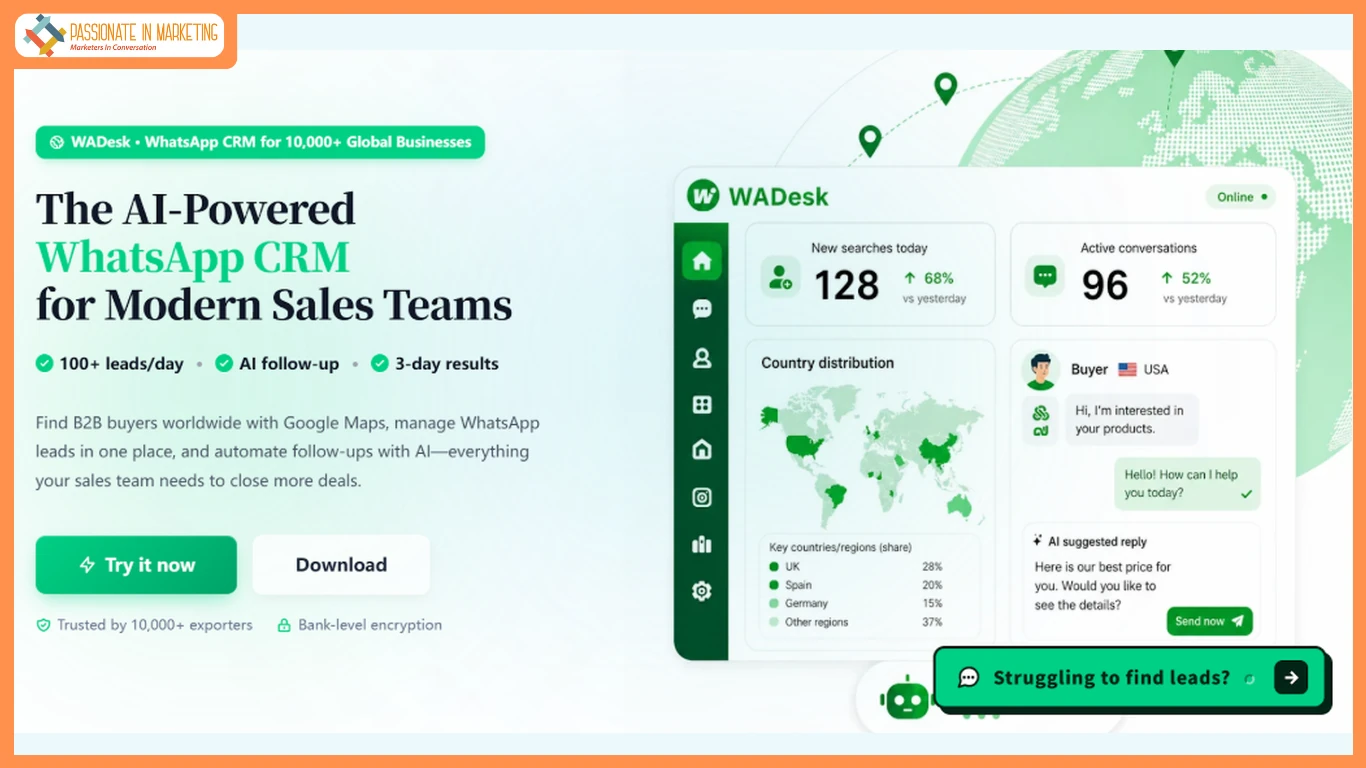
An AI WhatsApp CRM such as WADesk can support reply suggestions, automated responses, knowledge-based chatbots, and scheduled follow-ups while keeping customer conversations and lead information in the same workspace.
Automation is most useful for predictable tasks.
Salespeople should still handle qualification, negotiation, complex product questions, and other conversations where judgement matters.
International Campaigns Add More Complexity
Cross-border marketing introduces language, time-zone, and account-management challenges.
Employees may otherwise need to copy incoming messages into a translation tool, prepare a reply, translate it again, and return to WhatsApp.
WADesk includes real-time translation for incoming and outgoing messages, alongside multi-account management and international sales features.
Marketing and Sales Need Shared Customer Context
A common problem is that marketing generates the lead while sales owns everything afterward.
Without shared context, teams may struggle to answer basic questions:
Which campaigns produced qualified prospects?
Which leads received a quotation?
Who is responsible for the next follow-up?
Where are promising conversations being lost?
A WhatsApp CRM creates continuity between acquisition and sales by keeping source information, ownership, conversation history, and follow-up records together.
It also makes customer handovers easier when employees change roles or leave the company.
Measure Progress, Not Just Message Volume
A campaign that produces 500 WhatsApp conversations is not automatically better than one that produces 100.
The more useful question is what those conversations became.
A successful WhatsApp strategy should connect marketing metrics with downstream outcomes such as qualified leads, follow-ups, quotations, opportunities, and sales.
That information can also improve future campaigns.
If one source consistently brings high-intent prospects while another generates mostly low-value questions, marketers can adjust targeting and budget accordingly.
Final Thoughts
WhatsApp can shorten the distance between marketing and customers, but generating a conversation is not the same as generating revenue.
The stronger strategy is to give each enquiry a clear path:
capture the source, qualify the lead, assign ownership, define the next follow-up, and measure the outcome.
A WhatsApp CRM provides the structure behind that process, while AI can reduce repetitive work around replies, translation, and follow-up.
For businesses using WhatsApp across marketing and sales, the opportunity is not simply to generate more messages. It is to build a repeatable system that gives each promising conversation a better chance of becoming a customer.
**The opinions expressed in the article are solely the author’s and don’t reflect the opinions or beliefs of the portal**

