


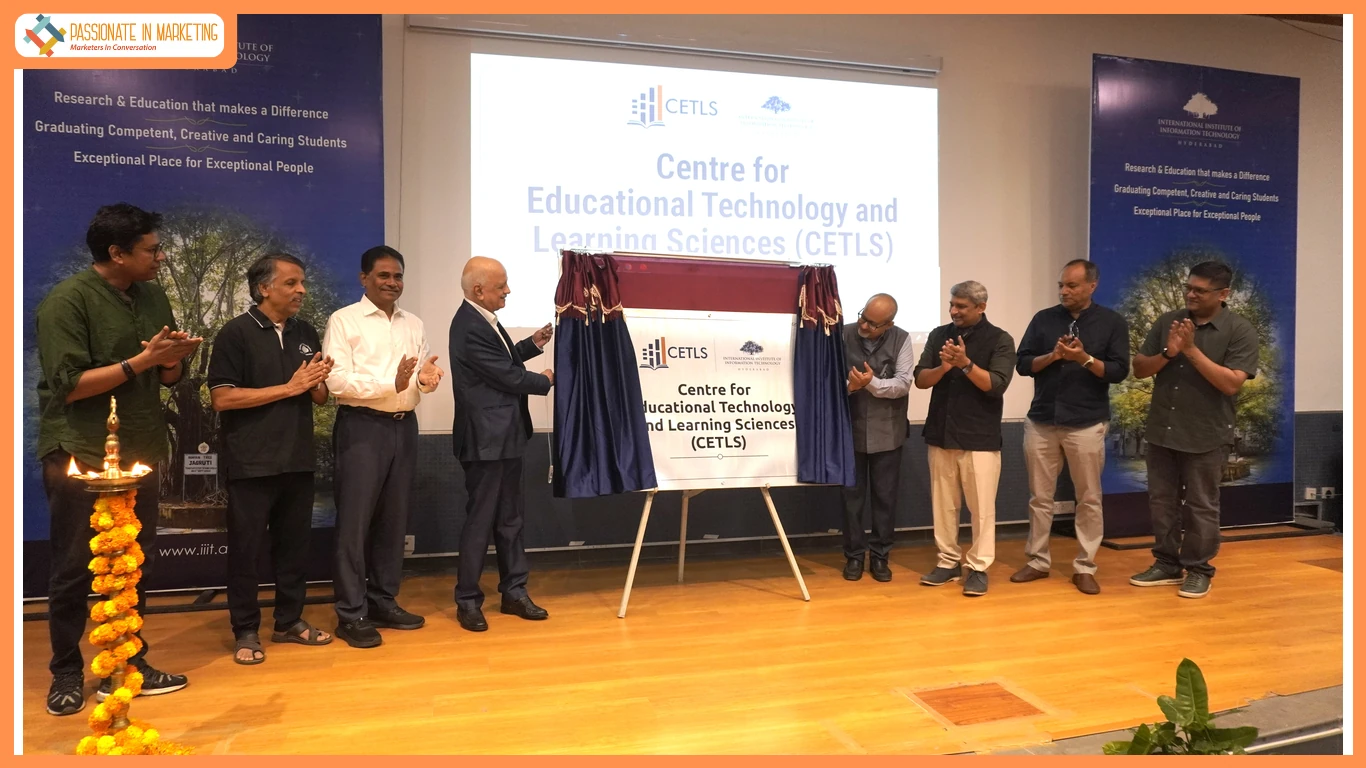
Hyderabad, September 5, 2026: The International Institute of Information Technology Hyderabad (IIIT Hyderabad) today launched the Centre for Educational Technology and Learning Sciences (CETLS), a new interdisciplinary research Centre focused on understanding how people learn in an age increasingly shaped by Artificial Intelligence (AI).
- Chandrashekhar, former President, NASSCOM, launched CETLS in the presence of Prof. Sandeep Shukla, Director, IIIT Hyderabad; Srini Raju, Governing Council Member; Prof. P.J. Narayanan, former Director, IIIT Hyderabad; Prof. Vasudeva Varma, and around 100 guests, faculty members and education practitioners. Srini Raju formally unveiled the logo of the newly established Centre.
CETLS will bring together learning sciences, cognitive science, psychology and technology to study learning across the lifespan—from K-12 and higher education to the workplace and later life.
The centre will explore how emerging technologies, particularly AI, can be designed not merely to make learning easier, but to make it deeper, more meaningful and more effective.
A key focus of CETLS will be the distinction between using AI to complete a task and using AI as part of the learning process.
While AI can provide instant explanations, solutions and summaries, the Centre will investigate how learning environments can be designed to encourage learners to question, experiment, practice, reflect and develop their own understanding, rather than simply consume machine-generated answers.
It will also explore the concept of “slow learning”—learning that allows time for experimentation, reflection and productive struggle. Rather than eliminating every difficulty from the learning process, CETLS will investigate how technology can create the right balance between challenge and support, enabling learners to develop deeper understanding and mastery.
Launching the Centre, R. Chandrashekhar, former President, NASSCOM, said AI was fundamentally altering education and that society needed to learn how to navigate the transformation.
“Every powerful technology introduced over the years has carried both risks and benefits. AI is no exception. While there are enormous opportunities, there are also challenges that need to be understood and addressed. Before we fully harvest the benefits of AI, we need to understand its implications. CETLS is a timely and futuristic initiative, and I am confident that it will make an important contribution to understanding how AI can improve learning outcomes in a substantially cost-effective manner,” he said.
Prof. Raj Reddy, Chief Mentor, CETLS; Moza Bint Nasser University Professor of Computer Science and Robotics, Carnegie Mellon University; and Founding Chairman, IIIT Hyderabad, who addressed the gathering virtually, said the emergence of AI requires a fundamental re-examination of education.
“With the emergence of AI, all known forms of education—from KG to PG—need to be re-examined. If abundant knowledge is already available on the web and AI can make that knowledge even more accessible, we need to ask what should be taught in classrooms and how it should be taught,” he said.
Prof. Reddy questioned whether traditional models of classrooms, examinations and certification would remain adequate in an AI-enabled world.
“There are talented people in remote areas who may not have access to guidance. AI has the potential to provide one-to-one learning support to such learners. One-to-one learning is superior in many contexts, and AI could make such personalized support possible at scale,” he said.
He emphasized that critical and skeptical thinking would become increasingly important.
“AI can go wrong. Therefore, learners need a skeptical mindset and must be able to question and challenge what AI produces. We need to focus more on skills than on book learning. The way we evaluate and certify learning also needs to be reviewed,” he added.
According to Prof. Reddy, education in the future is likely to place less emphasis on memorizing facts and figures and greater emphasis on solving real-world problems, addressing everyday challenges and developing the ability to think independently.
Outlining the objectives of CETLS, Prof. Sandeep Shukla, Director, IIIT Hyderabad, said the centre would study the impact of AI on learning and education over the short, medium and long term.
“Our goal is to understand the impact of AI on learning and education for the short term, medium term and long term. This is an important and timely concern because AI is already being used in everything—from research and ideation to education, report creation and even addressing long-standing mathematical problems,” he said.
He said CETLS would examine a fundamental question: How should learning change in an AI-native world?
“This is not simply about introducing AI into education. We need to understand how AI changes learning itself, how curricula should evolve, how research will change and how people should be prepared for a workplace where AI is likely to be as commonplace as computers and smartphones are today,” Prof. Shukla said.
He added that learning across the lifespan, including senior citizens and third-age learners, would also be an important area of study for the Centre.
With CBSE already beginning a structured rollout of Artificial Intelligence and Computational Thinking education, CETLS will examine how AI education should evolve as children move from school to higher education and eventually into the workplace.
The question is not merely how to teach children to use AI, but what children should learn when AI can increasingly provide answers.
The Centre will explore whether education should place greater emphasis on critical thinking, creativity, problem-solving, experimentation, communication and the ability to work intelligently with AI, rather than relying predominantly on memorization.
The implications of AI extend far beyond the classroom.
AI is already being explored in areas ranging from drug discovery and antibiotic research to aircraft design, healthcare, agriculture, space research and materials science. These developments illustrate the potential of AI to augment human ability to search, analyses, design and discover.
For example, traditional drug discovery can require the screening of thousands or even millions of compounds, followed by extensive laboratory testing. AI-based approaches are increasingly being explored to narrow these possibilities and identify promising candidates.
Similarly, Airbus has reported the use of AI and optimization techniques in aircraft engineering and design to explore weight reduction and performance improvements.
These examples are not being cited as conclusions of CETLS, but illustrate the larger question the centre intends to investigate: How will learning need to change when AI becomes an integral part of scientific discovery, engineering and innovation?
AI could also transform personalized education.
Khan Academy’s AI-powered platform, Khanmigo, has demonstrated the potential of AI to function as a personalized learning companion, providing guidance adapted to a learner’s needs while also supporting teachers.
Such developments point towards a future in which every learner could potentially receive individualized support, while teachers continue to perform the essential human roles of mentor, facilitator and guide.
The potential is particularly significant in large classrooms, where one teacher may not always be able to provide individual attention to every student.
CETLS will investigate how such AI-enabled personalization can be designed to deepen learning rather than encourage dependence on AI-generated answers.
“Technology has made information incredibly accessible. The next challenge is to ensure that this access translates into learning,” said Prof. Vasudeva Varma, who leads CETLS.
“We want to understand what an optimal learning experience looks like for different kinds of learners and then build the technology to enable it. The objective is not technology for technology’s sake, but to understand learning first and then use technology to improve it,” he added.
CETLS will work across four broad areas: K-12 Education: Exploring experiential and practical approaches to learning, and ways AI can strengthen children’s thinking rather than encourage passive consumption of information.
Higher Education: Investigating personalized learning approaches, including AI-enabled learning companions that can identify learning gaps, ask questions and encourage deeper understanding.
Executive Education: Developing new approaches to upskilling and reskilling as technology rapidly changes the nature of work.
Third-Age Learning: Studying how learning can continue into later life and how educational environments can be designed around the cognitive, social and intellectual needs of older adults.

