


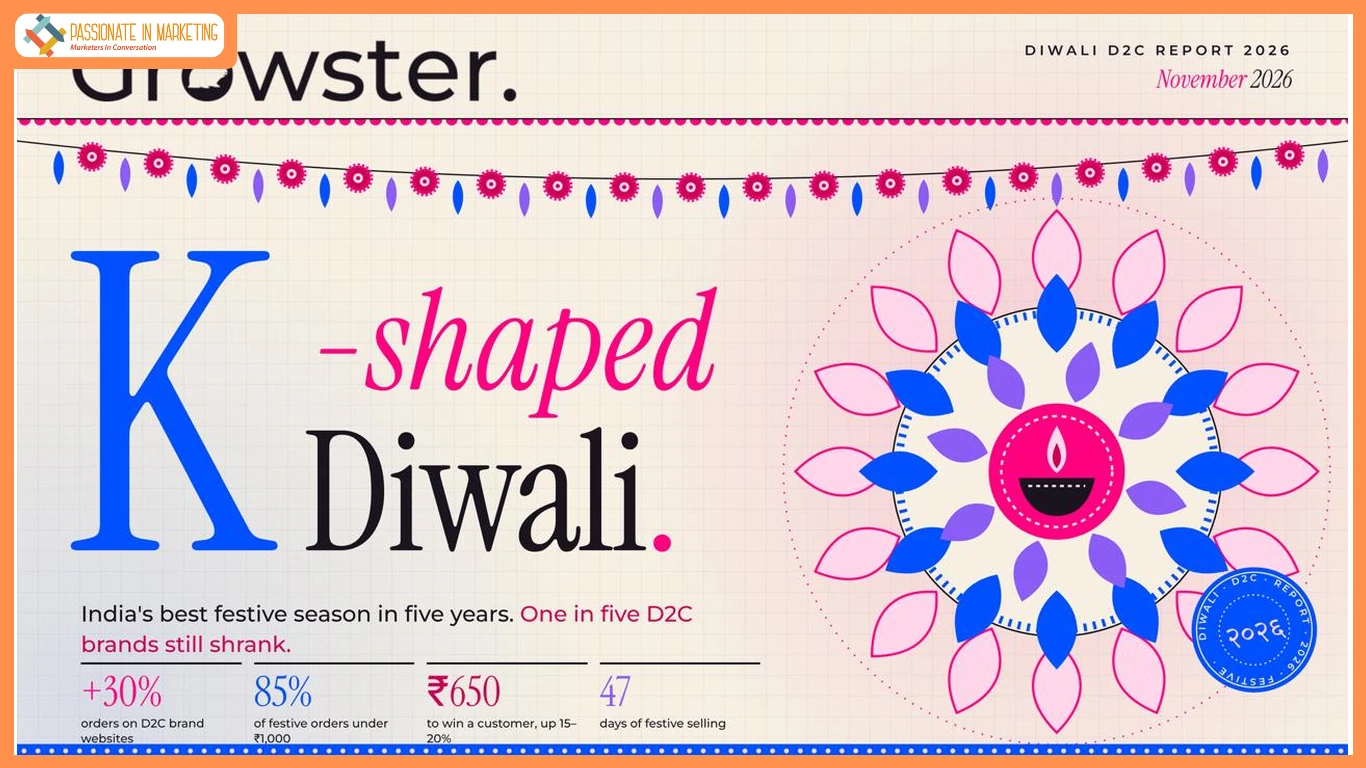
New Delhi, November 12, 2026 – Diwali 2026 looks like a big win for D2C brands. Unicommerce data shows brand-website orders grew 30%, against 8% for marketplaces. ClickPost reports D2C sales value up 45%. But the two datasets disagree on how much each customer spent. ClickPost’s group of about 400 brands saw average order value rise about 14%. Unicommerce’s wider data shows it fell about 3%, with 85% of all festive orders under ₹1,000.
Growster’s analysis suggests there were two Diwalis. Premium brands in jewellery, skincare, and wellness sold bigger baskets. Mass-market brands sold smaller baskets, mostly in Tier 3 towns, while paying 15–20% more to win each customer.
In ClickPost’s early-sale data for 200 D2C brands, the typical brand grew shipments about 19%. About a third grew more than 50%, and the best nearly doubled. But more than one in five shrank by over 25%. Spending is also concentrated: Qoruz finds the top 10–15% of brands take nearly 65% of festive creator budgets.
Kearney estimates the cost of winning a D2C customer rose 15–20% to ₹600–650. For mass-market brands, whose baskets shrank about 3%, acquisition cost per rupee of sales rose roughly 19–24%. For premium brands, whose baskets grew about 14%, the rise was only 1–5%. (Growster calculation from the cited reports.)
Ad prices also climbed. Datum Intelligence forecasts ad spend on commerce and retail media up 27%, against 13–17% for festive advertising overall. A ₹650 customer who places a sub-₹1,000 first order loses the brand money unless they come back.
The season ran 47 days (20 September to 5 November), with more than ten high-volume days in late October alone. Delivery kept up, with average D2C delivery time falling to about 2.5 days. The harder part was advertising: the same people saw the same festive ads for weeks, at festive prices. Last year, Meta ad impressions cost about 50% more from Navratri to Diwali than in August.
Growster’s hypothesis is that the brands that did best had enough fresh ads to stay relevant all season. Growster will test this against its own client data in its post-season report.
Tier 3 towns made up 45% of D2C shipments in ClickPost’s group, and Tier 2 another 22%. Delivery is ready for them, but ads often are not. Regional-language ads drew 38% more festive engagement than English ones (Admerly), and 51% of festive creator collaborations happen outside Diwali week itself (Qoruz).
“Everyone is reading this Diwali as a D2C win, and on average it was. But averages hide the brand that grew 50% and the one that shrank 25% in the same season. Both paid the same festive ad prices. Our read is that the difference came down to having a fresh, relevant ad for every peak day, in the languages Tier 3 India actually shops in. Media budgets for commerce ads went up 27% this year; creative volume didn’t go up with them. That is the gap our predictable creative volume framework is built to close,” said Harshit Arora, CEO, Growster.
Growster advises brands to plan their ads for the whole season rather than one big day, and to make different ads for low-priced and premium products, since one message cannot serve both kinds of shoppers. It also recommends creating ads in local languages instead of dubbing a single version, and judging spend by acquisition cost against basket size, not return on ad spend alone. The wedding season opens on 21 November, the next test of the same pressure.
About Growster
Growster is an NCR-based independent creative agency that helps brands build predictable, scalable performance marketing outcomes through high-volume, high-quality creative production. The agency’s Predictable Creative Volume framework has been deployed with brands including GoMechanic, Rubans, Bella Vita, SNITCH, VIRGIO, and Nishorama, helping them increase revenue, strengthen brand awareness, and build creative systems that can sustain performance at scale.

