


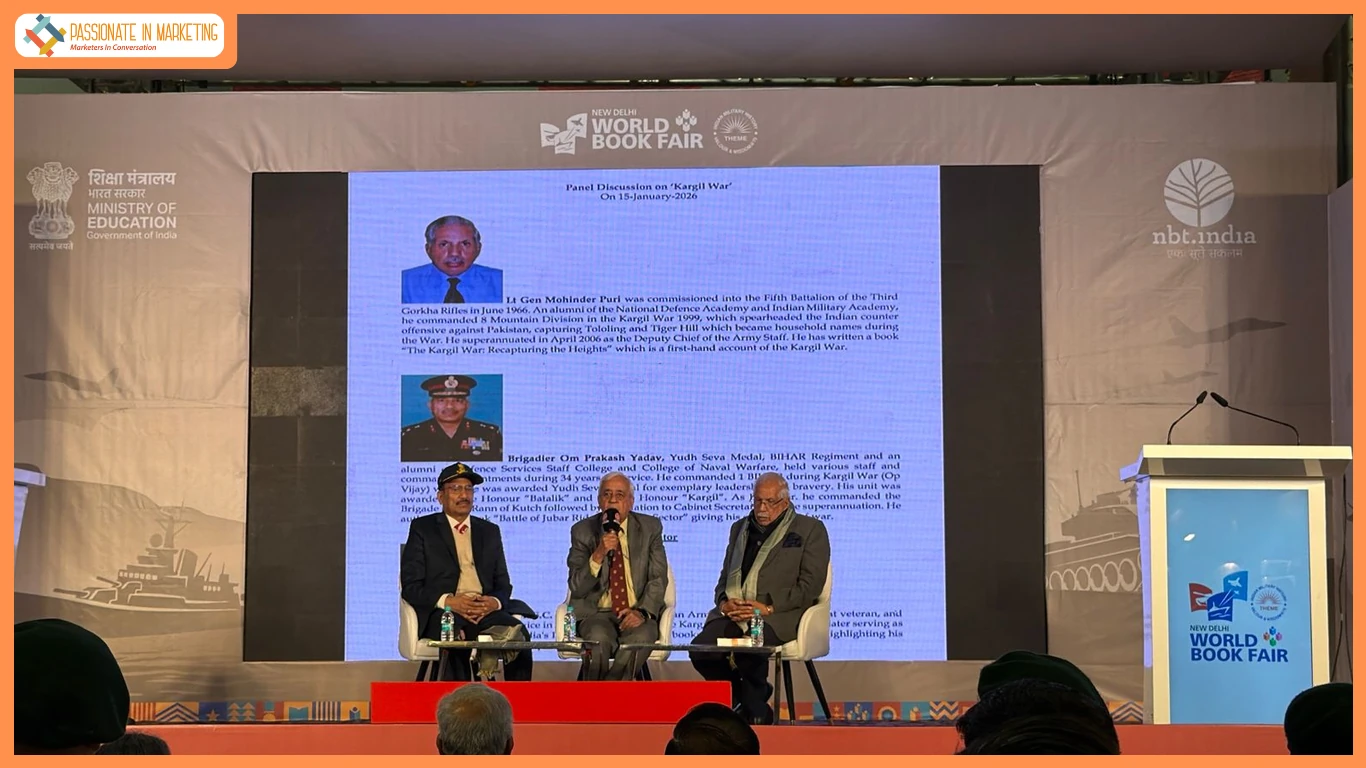
New Delhi: “A soldier does not die when he is hit by a bullet on the battlefield; he dies when the nation forgets him,” Col S C Tyagi said while moderating a panel discussion organised to pay tribute to the martyrs of the Kargil War at the New Delhi World Book Fair 2026 on Thursday.
Senior Army veterans on Thursday revisited defining moments of the Kargil War at the New Delhi World Book Fair 2026, offering rare first-hand accounts of combat, leadership and sacrifice during a panel discussion paying tribute to the martyrs of the 1999 conflict.
During the discussion, Lt Gen Mohinder Puri and Brigadier Om Prakash Yadav shared their wartime experiences, recalling the difficult decisions taken under extreme conditions to protect the nation.
Recalling his deployment, Lt Gen Puri said the biggest challenge was the harsh terrain and climate. “We were deployed at a much lower altitude but had to cover nearly double the distance. Movement in the mountains was extremely difficult, and we were carrying heavy loads. Despite this, we managed to reach the location. Collecting intelligence and launching the attack thereafter was another major challenge,” he said.
Puri said the first attack was launched on the night of June 12 and Tololing was captured the next morning. “However, we were unaware that the enemy was monitoring our movement and preparing to retaliate. Soon after we reached Tololing, the Pakistan Army began shelling. As the Prime Minister was scheduled to visit our headquarters, we had to temporarily pull back,” he added.
Brigadier Yadav shared a similar experience, recalling how his battalion travelled nearly 60 km at night with vehicle lights switched off.
Narrating a particularly moving incident, Yadav said one soldier who was injured refused evacuation, citing his inability to slow down his unit. “We had to leave him behind and move ahead. On the fourth day, I declared him presumed dead. However, on the 10th day, we noticed movement near a stream. Thinking he was an enemy soldier, we approached him to capture him alive. It turned out to be our own soldier whom we had left behind 10 days earlier. He was extremely weak, his wounds had worsened, yet he was still carrying two rifles to fight the enemy,” Yadav said.
Tyagi also shared an anecdote from the post-war period. “After the war, I asked a commander if he was happy after capturing an entire mountain. He replied, ‘I am happy, not arrogant. I regret the loss of my soldiers’ lives.” Tyagi said, this reflects how a commander views his battalion.
The speakers also said their experiences have been documented in their respective books, which were showcased during the discussion.

