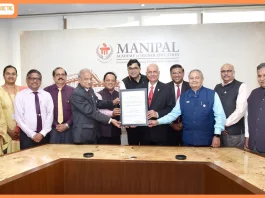
Mumbai, February 12, 2026: QR678®, through its research and development arm TECCRO®, has signed a strategic Memorandum of Understanding (MoU) with the Indian Institute of Technology Bombay (IIT Bombay), to develop next-generation skin treatments and regenerative healing therapies. The two will collaborate on advanced dermatology, trichology, regenerative medicine, and translational clinical research.
The partnership marks a major milestone in QR678®’s long-term mission to eliminate baldness in India by 2050 through science-led, clinically validated, and scalable innovation. By combining deep engineering research with structured clinical translation, the collaboration aims to accelerate breakthrough solutions in hair regeneration and skin restoration.
IIT Bombay contributes extensive expertise in biomaterials, biosciences, biotechnology, bioinstrumentation, biomedical engineering, and data science. Complementing this, TECCRO® – The Esthetic Clinics Clinical Research Organisation – anchors the collaboration through its end-to-end clinical stewardship of the QR678® platform, encompassing multi-center clinical trial execution and comprehensive research documentation. Notably, a core team of 11 PhD holders from QR678® Research Team will participate in the research programme alongside IIT Bombay faculty and experts, strengthening the scientific depth and interdisciplinary rigor of the initiative.
TECCRO®’s capabilities are further reinforced by its intellectual property leadership, a robust publication record with over 100 peer-reviewed scientific papers, and validated real-world treatment outcomes generated through patient care at The Esthetic Clinics®. Together, these capabilities enable the systematic translation, validation, and scaling of QR678®-led research from laboratory innovation to patient impact.
Under this MoU, TECCRO® and IIT Bombay will collaborate on joint national and international research grants, co-authored scientific publications, technology transfer, product commercialisation, and the development of IP-led start-ups. It will further enable TECCRO® to continue research on the QR678® platform on the IIT Bombay campus, leveraging shared access to advanced research infrastructure and clinical evaluation platforms.
Dr. Debraj Shome, Clinician Scientist and Research Mentor, TECCRO®, said, “This collaboration represents a critical step in building a strong bridge between engineering innovation and clinical reality. Our long-term goal is ambitious yet clear, to eliminate baldness in India by 2050 through rigorous science, scalable therapeutics, and measurable patient outcomes. This partnership will also significantly strengthen our India-led intellectual property pipeline, enabling both institutions to file more patents from India and catalyse IP-driven enterprises. By building globally competitive healthcare technologies from India, we contribute not only to patient care but also to the nation’s innovation economy and long-term economic growth. With the Indian CRO market witnessing strong momentum, projected to grow at a CAGR of 9.5 per cent to USD 11.58 billion by 2033, we are uniquely positioned to lead this expansion through research excellence and clinical validation.”
Key Areas of Collaboration
Advanced Human Tissue Models
A major focus of the collaboration will be the development of human in-vitro model systems, including 3D bio-printed skin and hair models. These systems will help simulate real biological conditions such as wound healing, pigmentation disorders, and hair growth cycles, supporting research in alopecia, regenerative aesthetics, and cosmetic dermatology.
Organ-on-Chip and Precision Medicine
The partnership will explore Organ-on-Chip technologies that replicate human biological environments on micro-engineered platforms. These models are expected to improve drug screening accuracy, toxicity testing, and therapeutic evaluation, while reducing reliance on animal testing.
Biomedical Engineering and Translational Devices
Leveraging IIT Bombay’s engineering strengths and TECCRO®’s clinical ecosystem, the collaboration will work on diagnostic devices, non-invasive imaging systems, microfluidic tools, nano-delivery platforms, and dermatology-focused medical technologies designed for clinical deployment.
Stem Cell and Regenerative Therapies
Research will also focus on stem cell-derived therapies, exosomes, biomimetic peptides, and regenerative biologics for skin and hair restoration, with emphasis on safety, consistency, and long-term outcomes.
Personalised and Patient-Centric Care
By integrating clinical data with biomaterials science and cellular biology, the collaboration aims to advance personalised treatment strategies that improve outcomes while minimising side effects.