
Mumbai, November 24, 2025: India has emerged as one of the most dynamic real estate private credit markets in Asia-Pacific, claiming 2nd position and accounting for 36% of regional fundraising between 2020 and 2024, according to Knight Frank’s Horizon Report: The Rise of Real Estate Credit in Asia-Pacific – Bridging the Gap. The report highlights that India’s private credit assets under management (AUM) have grown exponentially from USD 0.7 bn in 2010 to USD 17.8 bn in 2023, underscoring the market’s rapid institutionalisation and rising investor confidence. Supported by regulatory reforms, diversified funding structures, and sustained demand for flexible financing, India is expected to contribute 20–25% of the region’s projected USD 90–110 bn growth in private credit by 2028.
In the report, Knight Frank notes that India’s private credit expansion has been driven by developers’ increased reliance on non-bank capital amid evolving regulatory frameworks and a tighter banking environment. Institutional investors, including family offices and global private equity firms, have been quick to capitalise on the segment’s attractive risk-adjusted returns, particularly across residential development, refinancing, and special situation financing.
Shishir Baijal, Chairman and Managing Director, Knight Frank India, said, “India’s emergence as a leading private credit market within Asia-Pacific reflects the country’s strong economic fundamentals, regulatory evolution, and deepening institutional participation. Developers are increasingly turning to structured and alternative financing to bridge capital gaps and meet rising urban housing demand. What makes India particularly attractive is the balance between growth and governance, where capital providers see both opportunity and resilience. As interest rates globally remain elevated, private credit offers a compelling avenue for investors seeking higher yields with tangible underlying assets.”
According to the report, the Indian private credit landscape is also evolving beyond traditional development finance. Structured debt, last-mile funding, and special situation funds are playing a larger role in unlocking stalled projects and supporting developers amid cyclical liquidity challenges. This diversification has reinforced the market’s stability and attracted a broader base of institutional investors.
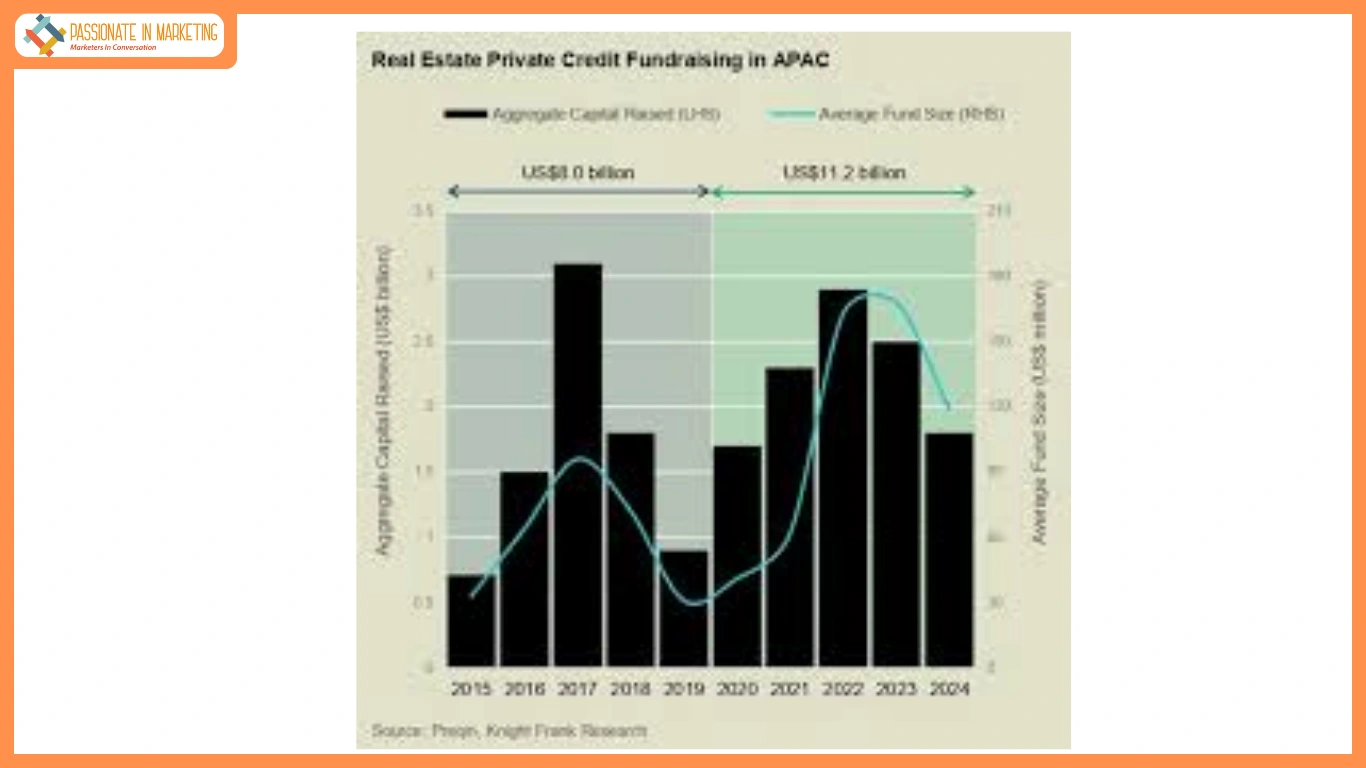
Asia-Pacific real estate private credit raised US$11.2 billion between 2020 and 2024, marking a 40% increase that signals the region’s growing prominence in alternative lending, according to Knight Frank’s Horizon Part III: The Rise of Real Estate Credit in Asia-Pacific — Bridging the Gap.
Over the next three years, Knight Frank projects US$90 to US$110 billion in private credit growth across Australia, Hong Kong SAR, India, and South Korea. Australia is expected to drive almost 50% of this expansion, with India contributing 20-25%, based on anticipated real estate debt growth and private credit’s expanding market share through 2028.
While the region currently represents 5% of global private credit fundraising, institutional investors and family offices increasingly recognise Asia-Pacific’s attractive risk-adjusted returns and diverse opportunity set, creating significant expansion potential.
Despite this under-representation, the region shows clear momentum. Average fund sizes in Asia-Pacific have consistently exceeded US$100 million since 2022, reflecting stronger capital commitments and rising real estate project funding requirements.
Australia leads regional activity, capturing 40% of the US$11.2 billion raised between 2020 and 2024. Private credit now accounts for an estimated US$50 billion or 16% of total commercial real estate lending in the country, as conservative bank policies push more borrowers toward specialist private credit funds. South Korea accounts for 11% of the regional total, while Japan represents 5%, with the remaining 8% spread across other markets.
Simon Mathews, director, capital advisory, global capital markets, Knight Frank, says, “Private credit is becoming an increasingly prevalent financing option for developers and investors across Asia-Pacific, offering speed, flexibility, and solutions, in place of or complementing traditional lending sources. Our research shows that while banking relationships continue to anchor the market for core investments, non-bank lenders are increasing their market share for opportunistic business plans, in markets such as Australia, India, Hong Kong SAR, and South Korea.”
Structural Dynamics Shaping the Region
Unlike Western markets, where banks face deposit shortfalls and higher regulatory costs, most developed Asia-Pacific economies operate as net savers with ample bank deposits. This fundamental difference means private credit complements rather than replaces traditional banking.
In Hong Kong SAR and South Korea, non-bank lenders are filling specific gaps left by banks retreating from risk, with family offices and institutional capital providing funding for distressed refinancing and growth-focused projects.
The report highlights increasing participation from ultra-high-net-worth individuals and family offices, with global family office assets estimated at US$3.1 trillion. Knight Frank’s inaugural Family Office survey found 37% of respondents intend to increase indirect real estate exposure over the next 18 months, while BlackRock’s 2025 Family Office survey shows nearly one-third want to increase private credit allocations — the highest of any asset class.
Private credit providers target returns of 3 to 6.5% above benchmark rates in core strategies, with higher-risk approaches potentially delivering double-digit returns. The higher interest rate environment has strengthened the investment case for private credit as an asset class.
Christine Li, head of research, Asia-Pacific, Knight Frank, says, “The primary advantage of private credit over traditional funding sources is flexibility. Private credit lenders typically have a higher risk appetite, allowing greater loan-to-value ratios and requiring fewer pre-sales commitments compared to banks. This enables developers to capture higher returns as values often improve closer to project completion.”
Key investment themes emerging
- Development financing: Private credit fills gaps left by banks that have reduced appetite for development loans due to regulatory pressures like Basel III, especially in Australia and other advanced APAC markets
- Bridge and refinancing solutions: Increasingly used in markets with valuation corrections or where banks are reluctant to refinance at par, notably in Hong Kong SAR and Australia
- Value-add strategies: Capital flowing into office conversions, ESG upgrades, and scenarios requiring bespoke financing where traditional loans are not easily secured
- New economy assets: Focus on emerging segments such as data centres, logistics, and build-to-rent residential, which receive private credit allocations due to strong growth profiles and complex funding requirements
While acknowledging risks including regulatory evolution, liquidity constraints, and concentration exposure, the research suggests private credit will continue expanding its market share across Asia-Pacific. However, growth patterns will differ from Western markets due to the region’s relationship-driven banking culture and strong deposit bases.
The report positions Asia-Pacific’s private credit market as entering a maturation phase. Opportunities are expected to be selective and driven by cyclical dislocations, market stress, or borrowers’ needs for flexible capital solutions.
Simon adds, “With global interest rates remaining higher for longer, the case for private credit has strengthened, as debt funds continue to deliver attractive risk-adjusted returns. The last time interest rates were comparable was before the global financial crisis, positioning real estate credit to offer some of the most attractive risk-adjusted returns in over a decade.”