Global, Indian and Rajasthani roots music legends, stars and performers came together from across continents to take the experience of festival attendees up by yet another notch.
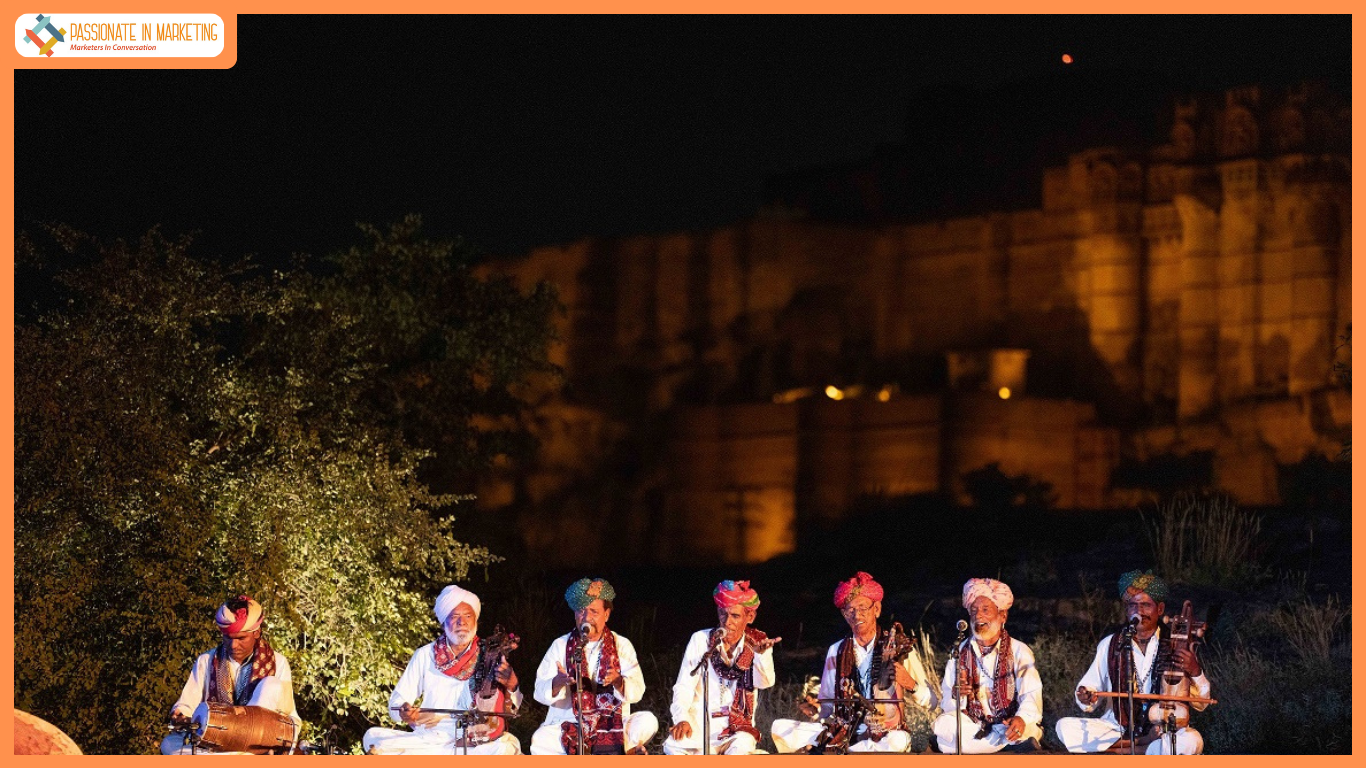
It was that time of the year when roots music from around the world descended on Mehrangarh Fort in Jodhpur, its mellifluous echoes heard in the blue city around it and beyond. For the first three days of Jodhpur RIFF 2025, musicians and performers from Colombia, Poland, Finland, UK, Portugal, Bhutan, India and the state of Rajasthan came together to make magic as the fort of the sun readied itself to welcome the year’s brightest full moon.
This festival celebrating traditional roots music began this year’s innings on the 2nd of October with a hat doff to the future— it’s free Bal Mela for school children, with folk forms like Kathputli, Ghoomer, Kachchi Ghodi, Bhapang, Behrupiya, Khari Dance, and Bakri ki Mashal on display, in all their glory. The children were especially taken in by performances of budding young Rajasthani musicians and a traditional Rajasthani circus comprising the best artists still performing acrobatics, magic, music, dance and Bhawai. In an era of phone addiction for a digitally native generation, this was edutainment in the flesh, in real time.
The City Concert on October 2 presented a free whirlwind tour of the festival to come, for locals and tourists alike. Cheers grew across Jaswant Thada’s parking lot as audience members were transported from Uzbekistan (Gulzoda Khudoynazarova) to the UK (Rosa Cecilia) to Canada (Luke Wallace), Finland (Emilia Lajunen), Kazakhstan (Layla Tazhibayeva), Italy (Ars Nova Napoli and Suonno D’Ajere), Madagascar and Reunion Island (Davy Sicard). From India, Aditi Bhagwat enthralled onlookers with her Lavani. From Rajasthan they sampled the songs of Mohinidevi and the Kalbeliyas, the wonder of Feroze (Dholak) and Ghewar (Kamaicha) Khan Manganiyar leading their students in performance, Jakir Khan and Ranswaroop demonstrating the magic of the Bakri Ki Mashak (a wind instrument made of goatskin, resembling a bagpipe), Idu Khan Langa’s evocative Algoza recital, matched by the mastery of the Sarangiya Langas, the masters of Badhnava, with their vocals and string instruments and a crescendo reached by a performance of Agni Bhawai, drummed up to a frenzy by Rajasthan’s dhol drummers.
Sunrise on the 3rd of October was ushered in at the Jaswant Thada by a legend— Mahesaram Meghwal at JRIFF Dawns With The Meghwals of Marwar (custodians of spirituality and folklore via song). With rich timbre of voice, accompanied by the fretless strings of the tandura, the cymbals of the manjira, and the rhythmic beats of the dholak, Mahesaram, with his sequential bhajans, which told so many stories, led listeners from the state of excitement which naturally accompanies the festival’s first dawn concert, to a state of transcendental calm. This was followed by the first Jodhpur RIFF dance bootcamp, which allows participants to actually experience a performance form for themselves. On the 3rd of October this was the Lavani, daring as well as intricate, a song and dance form practised in Maharashtra and Madhya Pradesh. Participants’ guide into this world was the internationally acclaimed kathak and lavani exponent Aditi Bhagwat.
This year’s festival also introduced participants to something completely new: En Route, an immersive audio based experience which engages only one audience member at a time and welds together music, poetry, sounds and voices of the city and fort, streets and courtyards to create a journey in which the real and the imagined converge. Meanwhile, other performance experiences during the festival — occurring throughout the fort, throughout the day — included the Terah Thaali, Kalbeliya, Khari Dance, Tamak, and Bakri ka Mashak, the voices of a new generation of young Langa musicians proving to be a particular draw for visitors.
JRIFF Dawns with the Sounds of Bhutan on the 4th of September brought to Jaswant Thada Bhutanese singer, musician, composer, researcher and archivist Sonam Dorji, with Drangyen, Flute and Dobtsi, and the rest of his talented Druk folk ensemble YakVibe — comprising Sobit Singh on Lubang, bass guitar, keyboard and Aungli, Pinaki Chakraborty on drums, chabdrung and shakers and Ganga Ram on Auroo, guitar and Metobobchu — who brought the meaningful music of the Himalayas to audiences perched on a hill overlooking the city. This was followed by acclaimed Finnish folk musician Emilia Lajunen, whose performance a leading Finnish newspaper has likened to “a village full of haunted fiddlers”. The curiosity with which audiences greeted Lajunen quickly metamorphosed into trance, as this graduate and teacher at the prestigious Sibelius Academy took to her instruments — the 5-string fiddle, the biancospino, the kontrabasharpa and nyckelharpa — to create music full of emotion, rooted in the traditions of a far off landscape.
The JRIFF Bootcamp II on the 4th was held with Tarini Tripathi, a third generation, multi award winning Kathak dancer who has incorporated dance into her career as a fitness trainer as well. Tripathi’s popular bootcamp allowed participants to experience Kathak not just as a classical form but also a way of life.
In Residence I, on September 4, saw Sonam Dorji return, this time to interact with audiences on the subject of the history of music in Bhutan. Dorji, who grew up in the Bhutanese farming village of Kaktong, has founded the Music of Bhutan Research Centre (MBRC) which has documented over 170 elder musicians, retrieved and remastered 1968 royal court recordings and produced the first book profiling Bhutanese musicians. “Traditional music, “ he says. “Teaches us who we have been for centuries, and—even as we face unprecedented social and technological changes—it teaches us who we still are.”
Strings & Beats at Mehrangarh’s Zenana Courtyard kicked off on the 4th of October with powerful acts by Rajasthani living legends Lakha Khan Manganiyar (a Padma Shri awardee and fabled exponent of the Sindhi Sarangi) and Barkat Khan Chattangarh (renowned for his renditions of raag Khamaj and Jangra Shaili). Lakha Khan is known to have said about folk music, “Classical always remains in control while we, who have learnt on our own, take liberties. At times we go out of tune but at times we discover something new as well.” Their brilliant performances comprised a diverse array of melodies, ranging from playful to soulful, brilliant baritones and the haunting sound of the Sindhi Sarangi, making it seem as if the desert itself had come to play at Mehrangarh Fort this evening.
This was followed by ‘Inayat’ comprising a rare jugalbandi between exceptional Kathak dancer Tarini Tripathi and incredible masters of the Langa community Sadiq, Asin and Zakir Khan Langa (SAZ, a trio which creates new music and lyrics, while maintaining continuity with the Langa folk traditions, under the guidance of Jodhpur RIFF Festival Director Mr. Divya Bhatia). Tripathi’s tatkars and chakkars were at one with Zakir’s khartal, Sadiq’s Dholak and Asin’s masterful voice and playing of the Sindhi Sarangi (Asin is the recipient of the Aga Khan Music Award), much to the delight of audience members— many of whom were clapping in rhythm with ‘Inayat’ by the end of the set.
Next came the sons and students of the legendary Padma Shri Awardee, the Late Shri Sakar Khan ji— Ghevar, Feroze and Darre Khan Manganiyar, playing the kamaicha, the dholak and the kamaicha respectively. The brothers’ performance, cheered by listeners, epitomised both excellence as well as continuity.
Karolina Cicha and Company followed. Karolina is a Polish singer, composer and multi-instrumentalist, who is known for her exploration of the traditional music of Poland’s minorities. Her versatile sound went from lightfooted to deeply affecting in an instant, bringing to life songs by Polish gypsies, Jewish poets writing at the advent of World War II, lovers, musicians, Tartars and other groups. Her performance contained both curiosity and joie de vivre and as her last song reached its crescendo some audience members began to dance.
Helder Moutinho, one of the most distinguished Fado singers in the world, followed. Also an interpreter, composer and poet of the Portuguese Fado musical tradition, Moutinho was accompanied, among other masters, by Ricardo Parreira, one of the world’s most renowned Portuguese guitarists. Together they conjured up musical wizardry which belongs to the realm of maestros, generating tune and song with clinical precision, taking audiences through carefully calibrated shades of feeling which might have seemed too nuanced to express in any language other than music.
SAZ returned to the stage after this act with another collaborator: famous saxophonist Rhys Sebastian (Saxontoast), the talented Amandeep Bhupinder on guitar and Merlyn D’Souza — India’s leading woman composer and pianist — on the keyboard. Fusing Rajasthani folk and jazz, The Cool Desert Project reinvented Rajasthani classics which had audiences up and dancing to the tune of this band.
The final act at Mehrangarh’s Zenana Courtyard, for the evening of October 4, was Jatayu — Sahib Singh on guitars, Manu Krishnan on drums and vocals, Kashyap Jaishankar on bass, Shylu Ravindran on Kanjira and Mridangam, Wesley Crispus, and Jarryd Rodrigues — a Tamil Nadu band who boldly infused Carnatic music with jazz and rock, incorporating konnakol (Carnatic vocal percussion) in an inspiring vein, to create a mix which sounded raw yet refined, sonic, yet sublime, drawing resounding applause from the audience.
The night’s party at Club Mehran, held in Salimkot, began with the audience dancing to Rosa Cecilia’s blend of Latin jazz, neo soul and disco. Cecilia’s lyrics touch upon a range of political subjects, from queer love to suppression passion, from postcolonialism to patriarchy. The accomplished and talented group Ars Nova Navoli took over from her, bringing to euphoric audiences in Mehrangarh the street music of Naples — Sicilian serenades, Neapolitan classics, Calabrian tarantellas and more — from their folk repertoire of Campania (a region in Italy). And, finally, Colombian DJ, singer and songwriter Killabeatmaker (Hilder Brando Osorno) made his Indian debut, combining afro-colombian and andean indigenous music with global club sounds like afro-beat and amapiano. He was joined by Guadalupe Giraldo (tambora, gaita, vocals) and Julian Herrera as well as Rajasthani folk artists. Together this set kept crowds on their feet till it was time to ready oneself for the next day’s dawn concert.