

What if your logo didn’t just sit politely in the corner, but stepped onto the stage—pirouetting on a loading screen, humming during a reel intro, or bouncing with the rhythm of a TikTok beat? Motion turns marks into characters.
With AI generators, like Dreamina, as your creative co-pilot, you can choreograph a living identity fast—storyboarding textures and lighting with Dreamina’s AI photo generator before you ever keyframe a single curve.
The kinetic promise: when a mark learns to move like music
Static logos communicate what you are; animated logos can communicate how you feel. Movement suggests temperament: a brand can glide (graceful), strobe (rebellious), morph (curious), or breathe (human). The first sprint is imagining your mark as a performer—what’s its warm-up stretch, signature move, and final bow?
Short test loops are your audition tapes. A 1–2 second wobble can say “playful.” A subtle lens-flare pulse whispers “polish.” Motion becomes your microcopy, readable at a glance and felt in the body.
Micro-choreographies that make a macro-impression
Small loops stack into a language. Consider building a repertoire of tiny, reusable moves that compose campaigns without reinventing the rig every time.
- Entrance: The entrance is a subtle scale-in or disguised revelation that resembles the opening of curtains.
- Accent: an echo stroke, a glitter, or a soft bounce to fit social media posts.
- Dialogue: case of split-and-merge when the wordmark and symbol “talk.”
A neat slide-out that leaves a little brand colour behind is good-bye. For designers, editors, and community managers, these motions serve as a set of beats that serve as your motion style guide.
Where performance meets platform: tailoring loops for each screen
The same logo can’t dance the same way everywhere. Context is a choreographer.
- Stories & Shorts: quick hits—1.2–1.5 s loops that read at thumbnail scale.
- Web headers: adjusted for dwell time, with slower arcs and parallax.
- In-product moments: micro-rewards—checkmarks that wink, tooltips that nudge.
- Email & presentations: ultra-lightweight Lottie/SVG for crispness and speed.
It takes half art and half user experience to figure out how long a motion will last. Anchor timing decisions with rhythm from the speed and timbre of your brand’s audio palette.
The emotional metronome: pacing that speaks personality
A brand that sprints everywhere feels impatient; one that drifts can seem indecisive. Pick a base tempo—say, 96 BPM for calm optimism—and let it guide easing curves and beat-aligned transitions. Then season with contrast: a quick pop after a long glide, a pause before a reveal. Strategic silence (stillness) is the best dance partner your logo has.
Texture is choreography in disguise
Motion alone isn’t enough. Texture—grain, shadow, refraction—changes the emotional register. A matte bounce says “friendly.” A refractive prism stretch whispers “premium.” A paper tear-away reveals hints at craft. Think like a cinematographer: if the logo is the actor, texture is the wardrobe, and lighting is the director. Prototype swatches, then bake your favorites into a motion library.
If you’re hunting for unexpected symbol variations, Dreamina’s AI logo generator can surface fresh silhouettes and negative-space tricks you can later animate into reveals, transitions, and expressive blinks.
The sticker lifecycle of moving marks
Your animated identity doesn’t have to live only on screens. Export frames from favorite moments—the mid-morph, the motion echo—and turn them into a limited set of physical keepsakes. Dreamina’s sticker maker can convert those frames into die-cut memorabilia that extends the story to laptops, bottles, and road cases. The movement is implied by the series: collect frame A, frame B, frame C; arrange them, and flipbook magic appears in people’s hands.
Motion etiquette: be expressive, not exhausting
We love a flourish, but empathy matters. Respect the task at hand:
- Use motion to reduce cognitive load (guide attention), not to steal it.
- Cap loops in UI; give users an off-ramp from perpetual animation.
- Keep color transitions accessible; avoid vibrational combos that strain eyes.
- Match file format to the environment for speed and clarity.
Your logo should feel like a good host—arriving with energy, leaving with grace.
The logo ballet, quick: Dreamina, three fast motions
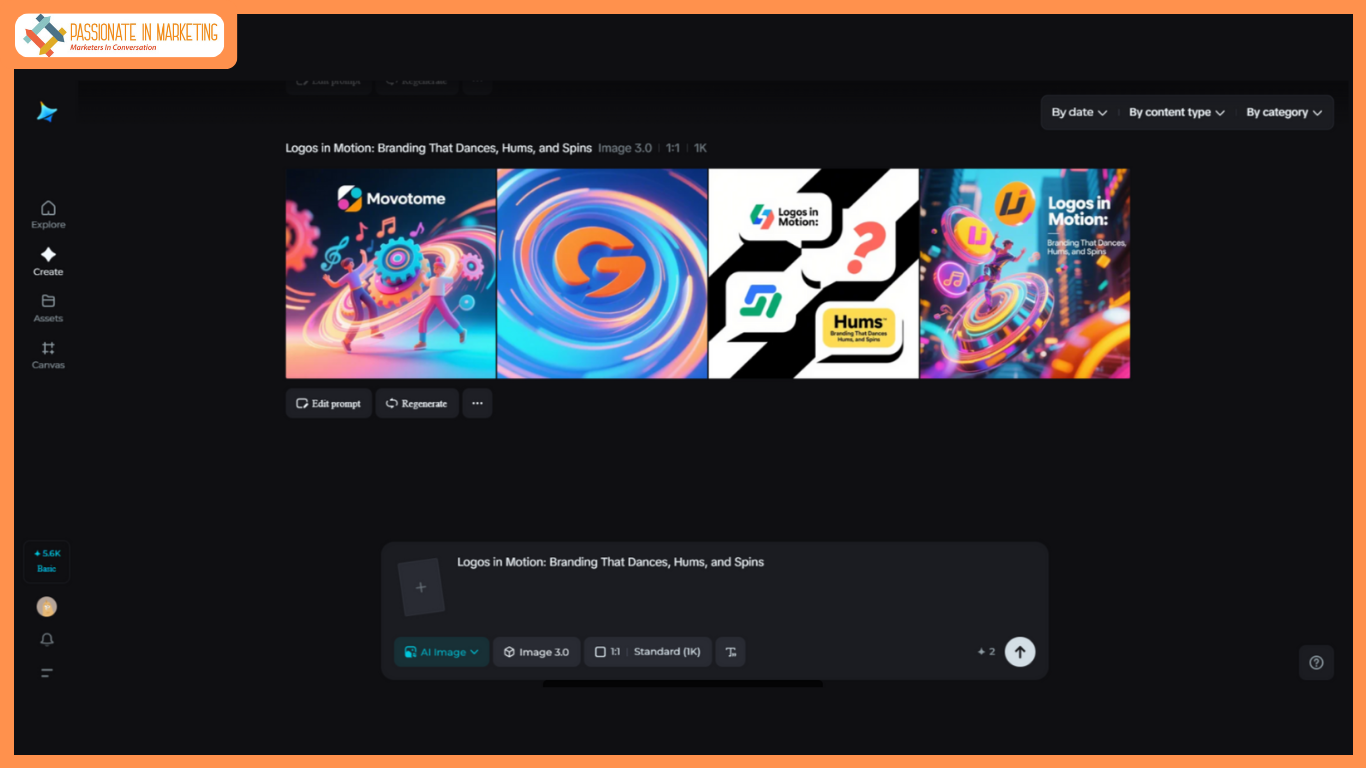
Step 1: Write a descriptive text prompt
Go to Dreamina and specify the use case, character, pace, and textures of the performance you want.
Example: Design a motion-ready logo idea that “Glides then Pops,” 96 BPM beat, gentle paper grain, prismatic highlight at the top, two lockups (icon-only and wordmark), and states for entrance, accent, and exit appropriate for reels and headers.
Step 2: Set parameters and generate
Select a model aimed at sharp edges and print-like textures. Choose a size that fits the export pipeline, choose the aspect ratio for your first stage (1:1 for avatars, 16:9 for reels, and 1920×1080 for web banners), and test at 1k for quick ideation or 2k for final mastering. Click on Dreamina’s icon to create variations; assess readability, negative space, and rhythm cues.
Step 3: Customize and save
Use Dreamina’s advanced features to clean up anchor points, grow to include safe buffers for movement, remove stray artifacts that disrupt arcs, and retouch highlight/shadow for enhanced depth. When the frames look cohesive throughout entrance-accent-exit, click Download to export assets for your animation tool of preference.
Campaign choreography: building stories from a single move
One signature move can power a whole quarter. Imagine a soft “bloom” reveal—logo petals spiral open, then settle. From that core, derive:
- A reels opener: two-second bloom synced to a sound sting.
- A website header: slower bloom with parallax dust.
- Packaging GIF: micro-bloom as a seal that “seats” on the box.
- Event screen: bloom that expands into a visualizer for live audio.
Same motion DNA, different costumes. This is how you get consistency without sameness.
Collaborating across crafts: animators, editors, writers, devs
Motion thrives when everyone gets a say. Copywriters can build taglines that “land” on the beat. Editors can cut B-roll around the logo’s accent. Developers can implement hover states that mirror the signature move. A shared motion spec—tempo, easing curves, amplitude—lets cross-functional teams improvise without breaking choreography.
Prototyping rituals that keep you brave
Treat motion like jazz: quick riffs before you record an album. Start every exploration with three low-stakes experiments:
- Speed study: five loops at different tempos; pick the one that breathes.
- Easing study: try linear, ease-in out, and overshoot; feel the personality shift.
- Texture study: matte, grain, glass; choose which whispers your brand truth.
Set a 30-minute timer. Trust your first read—does this move feel like your brand or like a stranger wearing your clothes?
Closing curtain call
A moving logo isn’t decoration; it’s dramaturgy. It sets the tone, guides attention, and turns passive viewing into a felt experience. When you choreograph with intention—and keep the beats short, the textures thoughtful, and the empathy high—your identity doesn’t just appear. It arrives.
With Dreamina as your stage manager, you can sketch the arc, audition textures, and export a performance that scales from a phone’s status bar to a stadium screen. Now dim the lights, cue the bloom, and let your brand take a bow.
**’The opinions expressed in the article are solely the author’s and don’t reflect the opinions or beliefs of the portal’**

