


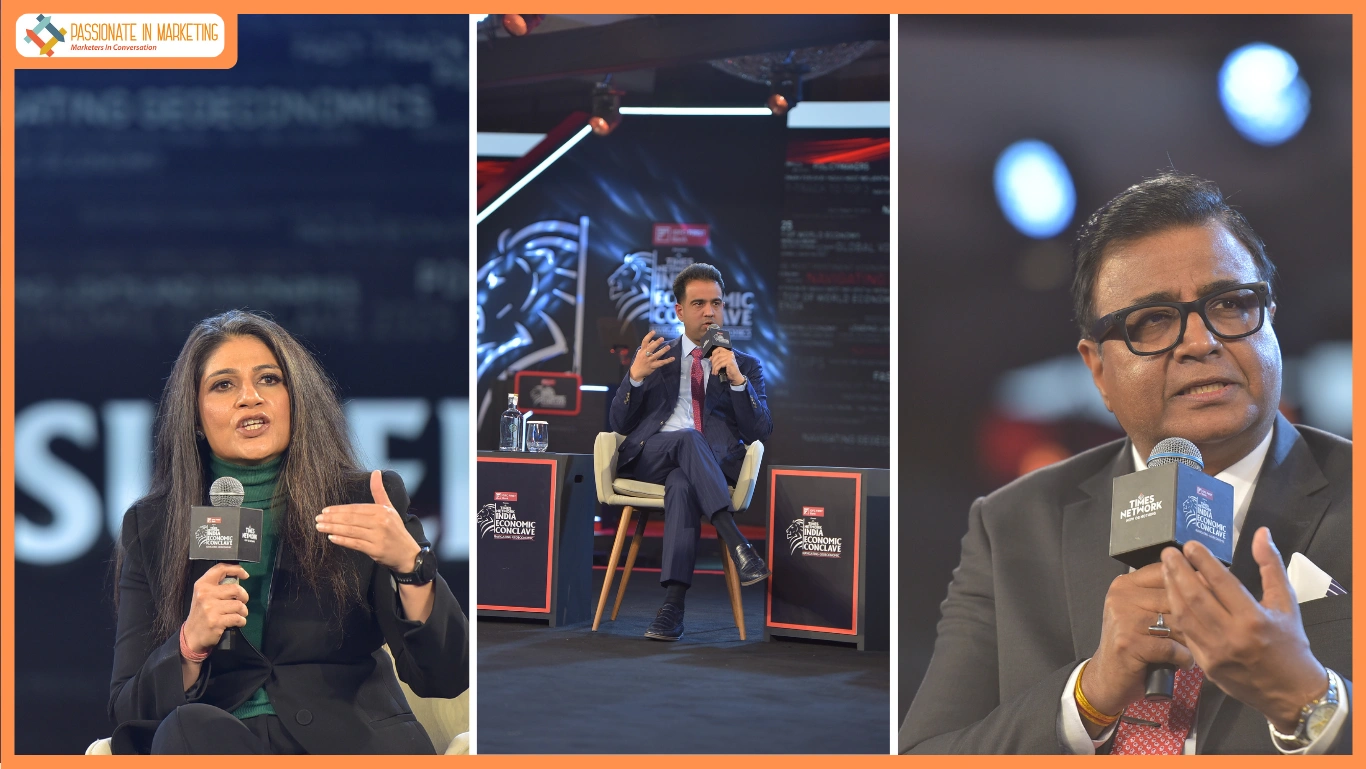
New Delhi, 24 December 2025: Leaders from government, industry, and global economic institutions convened at the Times Network’s 11th India Economic Conclave (IEC 2025). The conclave, themed “Navigating Geoeconomics,” provided a premier platform to examine India’s growth, strategic autonomy, and global positioning in an increasingly multipolar world.
The forum featured high-impact sessions and panel discussions on economic resilience, trade and capital flows, infrastructure and manufacturing, digital and services-led growth, and emerging priorities such as artificial intelligence, cybersecurity, climate transition, mobility, and defence preparedness—collectively charting India’s roadmap for economic leadership
Maruti Suzuki, India’s largest carmaker, is yet to enter the electric vehicle segment with its own offering aimed at addressing key bottlenecks associated with EV adoption. Speaking at IEC 2025, Partho Banerjee, Senior Executive Officer, Marketing and Sales, Maruti Suzuki India Limited, shared insights on the future of e-mobility in India.
In a fireside chat, Banerjee, said, “While there is a good influx of new electric cars in the market, Maruti Suzuki is more focused on addressing the concerns of its loyal customers, rather than early adopters of the technology. While the EV segment sees over 17-18 models gaining traction, its penetration remains at just 4% amid our monthly sales of nearly 4 lakh cars; Maruti Suzuki prioritises addressing the practical concerns of our loyal customer base over chasing early adopters, ensuring sustainable mobility aligns with India’s broader economic vision.”
He assured that Maruti Suzuki is currently working on addressing all issues surrounding EV ownership before launching the new e-Vitara electric SUV in the country. The car brand had announced its strategy to tackle the issue of ‘range anxiety’ amongst first-time EV buyers and have already set up 2,000 exclusive EV charging points nationwide, covering over 1,100 cities. In addition to this, Maruti Suzuki has also partnered up with 13 Charge Point Operators (CPOs) in a bid to offer a large charging ecosystem to its e-Vitara customers. Overall, the carmaker plans to achieve its goal of 1 lakh EV chargers across the country by 2030 by leveraging both CPO and dealer partner networks.
GST 2.0 and (Amendment of Insurance Laws) Bill, 2025 are significant steps in the right direction for India’s insurance industry, said Sumit Madan, Managing Director and CEO of Axis Max Life Insurance, while speaking at IEC 2025. He highlighted that the ultimate beneficiaries of these reforms will be customers. Commenting on the insurance bill, Madan said it is expected to benefit a large section of the Indian population. “The provision for 100% foreign direct investment will encourage more players to enter the market. Increased competition will ensure that companies like ours remain on our toes to deliver better products and services to customers,” he said.
He added that the proposed changes would help address gaps in the insurance ecosystem, promote greater transparency and strengthen customer-centric practices across the sector. Terming the removal of GST on life insurance positive, he added “We have seen demand pick up following the GST relief. While government policy plays a crucial role, insurance companies also have an important responsibility in communicating and promoting insurance effectively. Recognising life insurance as a product worthy of a zero-GST bracket is a momentous decision.”
Prabhpreet Singh Gill, Chairman, Pay10 Global and Eastern Fortune Investments mentioned how bilateral ties such as those with Oman are crucial for Indian domestic players, adding that recent RBI changes in cross-border payment licenses will enable small and medium enterprises to expand internationally. “India’s UPI payment system has set a strong domestic example, with efforts underway to adapt the model for global markets by engaging with regulators and expanding international presence.”
Prabhpreet Singh Gill, Chairman, Pay10 Global and Eastern Fortune Investments, said, “We are currently operating in around 10 countries, and over the last couple of months—perhaps even a quarter—it has been a challenging period, particularly for payments. Every country today is focusing on strengthening its domestic payments ecosystem and becoming financially independent. Sentiments differ across regions, but each country is doing its best to overcome these challenges.
To navigate this, it is critical to open up opportunities for Indian domestic players to sell their products and services through bilateral corridors. From a payments perspective, cross-border licensing is extremely important. RBI’s 2025 regulations on aggregate cross-border licences are a step in the right direction, as they empower businesses—especially MSMEs—to expand beyond India and operate in other markets.
Capital requirements and localisation norms are challenges—for instance, the UAE requires around 35 million dirhams in capital—but India’s success with domestic payment schemes gives Indian companies strong credibility abroad. The fear of rejection is something businesses must overcome. The only way to find out is to apply.
India is a large market, but market share is still concentrated among five to seven players. There is significant opportunity both domestically and internationally, especially in inbound remittances, which are largely controlled by non-Indian entities today. UPI’s international success ultimately depends on adoption in the host country. While it is convenient for Indian travellers to use UPI abroad, it must also make commercial sense for merchants—through faster settlements and better pricing—compared to cards or other international schemes. If domestic schemes across countries become interoperable, it strengthens financial sovereignty and reduces dependence on a handful of global payment networks.”
In a fireside chat titled, ‘Unlocking Solar Superpower’ Preeti Bajaj, CMD, Luminous Power Technologies explained why solar energy stands out as the most efficient power source. She highlighted its widespread usage, growing affordability, and the abundance of sunlight as India’s natural advantage. “What we learnt about India is that we love affordability, we like accessibility and we also love availability. Solar has lowered the cost of technology. And the beauty of solar if that its free of cost. Lithium ion is also a vulnerability and an opportunity. If someone has devised a piece of technology, then the decision for India is how far do we want to go and what does it offer? Or we layer the software power we have for making products for energy tech. This is a choice you make when you are not the first mover. There is no reason to rely on only one type of battery storage technology. If the solution that works for our countrys captive audience can be expanded, it can be taken to the next technological level. Adopt the new for the circumstances and power conditions.”
IEC 2025 concluded by reinforcing its role as a premier platform bringing together policymakers, industry leaders, economists and innovators to shape India’s economic leadership amid a rapidly evolving global landscape.
For more information, visit www.indiaeconomicconclave.com

