



Introduction
What defines trust in investing today? Is it the reassurance of a long-standing relationship with a financial advisor, or the speed and control offered by a smartphone app? As digital platforms expand rapidly across Tamil Nadu’s urban centres, how are investors balancing the need for capital preservation with the appeal of convenience? And which key life milestones education, marriage, home ownership, and retirement, are shaping the direction of household capital allocation?
To explore these evolving dynamics, MaxEd, a leading Market Research and Consumer Analytics firm, conducted a comprehensive consumer study across Chennai, Coimbatore, Madurai, and Trichy. The research captures a pivotal moment where high-speed fintech adoption intersects with deeply rooted cultural preferences for tangible service, personal reassurance, and long-term financial security.
The Safety Anchor
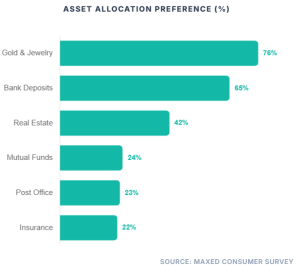
In the major cities of Tamil Nadu, financial planning is less about aggressive speculation and more about wealth preservation. For the urban TN investor, volatility is not just a statistical variance; it is perceived as a direct threat to the family’s social standing and future security.
Gold and Jewellery remain the undisputed leaders in the household balance sheet, cited by 76% of respondents. This isn’t merely traditionalism; it is a sophisticated “liquidity hedge” that has historically outperformed local market perceptions of safety.

Even in metropolitan hubs like Chennai, where stock market awareness is higher, Bank Deposits (65%) still command twice the participation rate of Mutual Funds (24%).
The “Family Milestone” Economy
In urban TN households, investment capital is almost always pre-labeled. There is very little “idle wealth”; every rupee is allocated to a specific future event.
A Culture of Responsibility
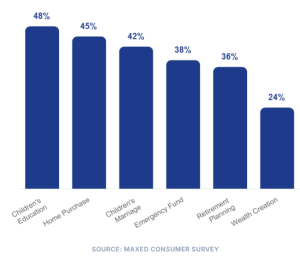
The data reveals that Children’s Education (48%) and Children’s Marriage (42%) are the primary drivers of investment. In Tamil Nadu’s social fabric, fulfilling these obligations is the definitive measure of financial success.
Interestingly, Property Acquisition (45%) ranks exceptionally high, particularly in Tier 2 cities, where land remains the ultimate symbol of creditworthiness and stability.
Regional Trust Networks
Trust vs. Digital Influence
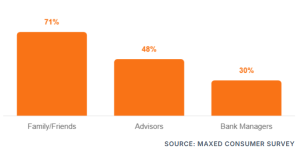
Despite the rise of “Fin-fluencers,” the most powerful advisory tool in major TN cities remains the inner social circle. 71% of investors rely on family and friends for financial guidance.
This “Dinner Table Advisory” model means that the cost of acquisition for new products is high, as they must be vetted by trusted community members before mass adoption can occur.
Selection Criteria
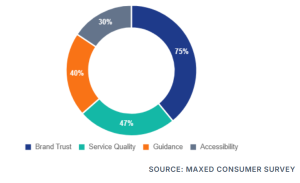
When it comes to selecting a provider, Trust and Experience (75%) are non-negotiable. Urban investors in Tamil Nadu are less influenced by zero-commission offers or tech-driven branding appeal, and more by the perceived stability of the institution.
Accessibility and ease of approach (30%) rank significantly higher than research support, reinforcing that proximity and relationship comfort matter.
The “Phygital” Expectation
TN urban investors are technologically proficient but psychologically grounded in physical reality. They exhibit a “Verify Offline, Transact Online” behavior.
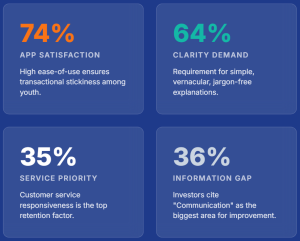
While 74% are satisfied with digital platform usability, the presence of a local branch acts as a “Trust Insurance” against digital fraud or process errors.
Overcoming Friction
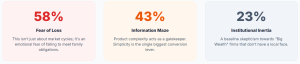
Why does urban TN hesitate to invest in modern assets? The study identifies three key psychological “walls” that financial providers must dismantle.
Conclusion: Towards ‘Trust-first’ Engagement
The MaxEd study underscores a critical paradox in Tamil Nadu’s urban centres: while digital adoption is at an all-time high, the “Trust Deficit” for purely virtual institutions remains significant. For the Tamil Nadu investor, wealth is not just a digital balance; it is a legacy built on physical presence and community validation.
To succeed in this market, financial institutions must pivot from a “Digital-First” to a “Trust-First” model. This involves leveraging the efficiency of apps for transactions while maintaining a localized “human touch” for advisory and dispute resolution.
The path forward lies in Hyper-Localization, translating complex financial products into the language of family milestones (Education, Marriage, Property) and utilizing existing social networks to build credibility.

