


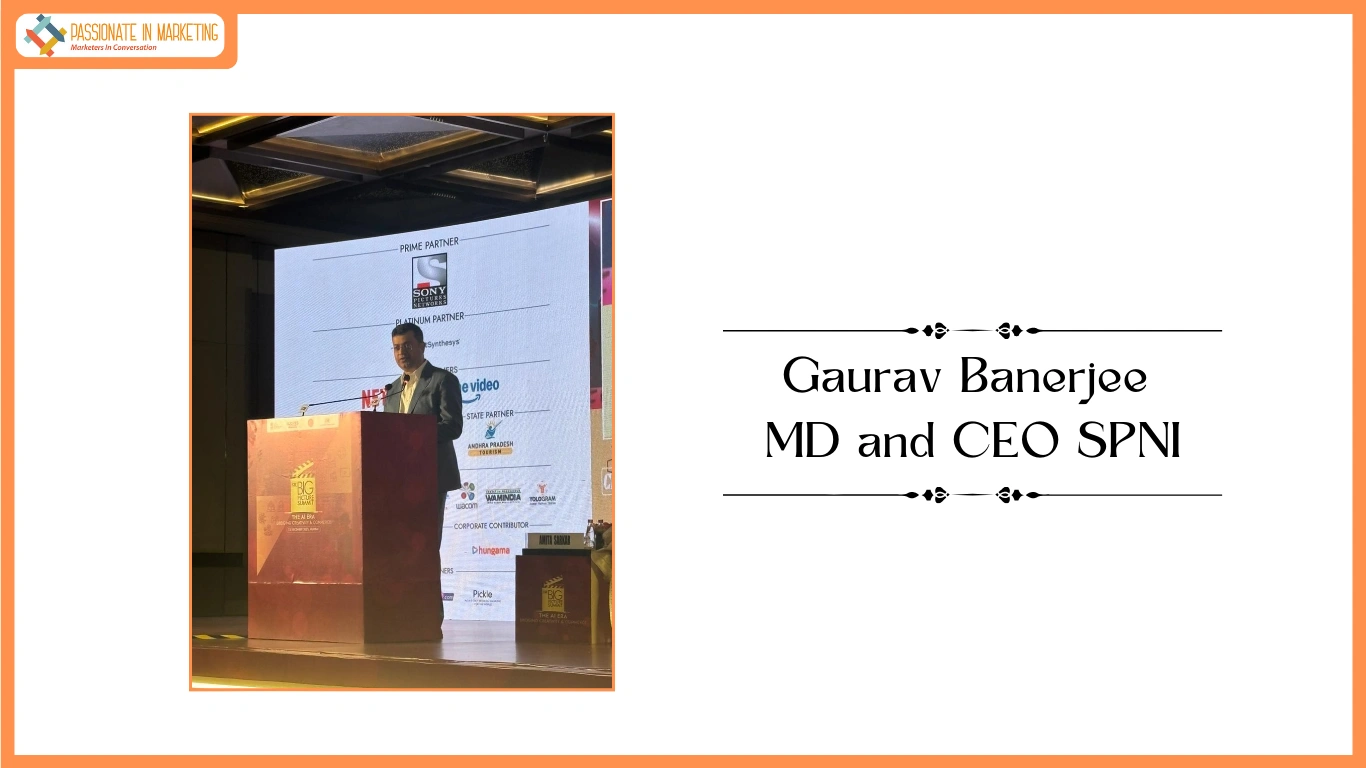
l. A Moment of Profound Transformation
This summit has always been a space where India’s Media & Entertainment sector steps back, reflects and reimagines the future. But this year is special because we are meeting at a moment of profound transformation.
Every once in a generation, an industry gets a narrow window when talent, technology, culture, ambition and confidence align.
For India’s creative economy, that moment is now.
Our CII White Paper reminds us:
The global M&E industry will reach $3.5 trillion by 2030.
India is projected to grow 2.6X faster than the world.
And yet, when we see today, we are just 2% of the global value.
This is not a limitation, it is our extraordinary opportunity. A phenomenal headroom to grow dramatically.
A $100 billion Indian M&E industry is within reach.
But it requires clarity, coherence, conviction, and above all, ambition.
ll. The Core Challenge: A Mindset Shift from Domestic to Global
Indian culture is travelling faster than ever before.
Our music tops charts in North America.
Our creators reach global audiences from small towns.
Our films find resonance far beyond our borders.
We are a nation of 1.4 billion stories, and the world wants to listen.
But we must be honest:
Our ambition has been shaped as well as limited by the comfort of a large domestic market.
For decades, success meant succeeding within India.
But in a world where stories can cross borders instantly, we must ask:
Why should our market be only India? Why not the world?
The creative industry in South Korea asked itself this same question in the late 90s. And as a result, K-dramas and films started gaining significant popularity in other Asian countries, such as China and Japan, marking the beginning of the Hallyu or the ‘Korean Wave’. This was because the government and the M&E industry came together and started viewing the cultural industry as a valuable economic export.
They didn’t have a huge domestic market.
So they built for the world.
And they kept going:
K-Pop.
Parasite.
Squid Game.
K-Dramas.
Gaming.
A continuous, deliberate wave of global creativity.
They didn’t just export content, they exported confidence.
A belief that their stories could travel everywhere.
India needs that same global ambition.
Because today’s audiences, especially younger ones, are telling us loudly that they want fresh, bold, original stories. They are open to new experiences.
Look at Mahavtar Narasimha.
A break from formula. Animated content not just for kids.
A big canvas.
A new voice.
And audiences embraced it.
The real constraint on our growth is not the market, it is the ambition we place on ourselves.
III. What We Must Build: Talent, Institutions and New Creative Benchmarks
If India wants to lead globally, we must understand how the world’s most successful creative-innovation ecosystems were built.
What made Silicon Valley what it is today?
It was not an accident. It was constructed:
It grew out of Stanford and Berkeley powering ideas and talent, a culture that celebrated risk and experimentation, public–private partnerships that scaled early innovation, and clusters where networks mattered more than hierarchies.
Its real superpower was simple: extraordinary talent density.
India’s closest comparative model is the IPL, a system that discovered, trained, and showcased talent at every level, from grassroots to global.
We now need to build the IPL of Creativity.
Where India stands — and where we must go
When we look at global creative economies, one pattern is clear: the countries that lead have invested deeply in specialised creative-arts education.
The United States has dozens of globally recognised film, design and media schools; China, with more than 3,000 higher-education institutions, has rapidly expanded its animation, gaming and digital-arts programmes over the last decade.
India, too, has made progress. Today, we have more film, design and media programmes than we did ten years ago. But as our ambitions grow, our capacity must grow even faster.
To unlock our next chapter, we need:
- The next generation of specialised creative institutions
Centres of Excellence dedicated to writing, animation, gaming, VFX, design, post-production, and creative entrepreneurship across all languages, and not just Hindi or English. - Stronger industry–academia partnership
Where training is practical, contemporary, immersive, and directly connected to real industry needs. - Regional creative clusters
Where talent, technology, creators, and businesses can work in close proximity, a model proven worldwide. - Public–private partnerships with urgency
Government enabling and industry energising, working together to rapidly expand capacity.
These are not gaps, they are opportunities to lead.
As global demand for Indian storytelling rises, our responsibility is to scale the number of world-class creators we nurture every year.
Institutions are how nations build capacity.
Talent is how nations build influence.
lV. Responsible Innovation in the AI Decade
This summit is setting the tone for the AI Decade: a decade full of promise and uncertainty.
AI has the potential to reshape workflows, and improve efficiency, scale, and speed.
But let me emphasise this:
AI will not define creativity. Human imagination will. India’s natural strength lies in its people, not its tools.
I am looking forward to hearing from our industry leaders and experts today about both the opportunities and the challenges presented with AI, and how we can pursue those opportunities responsibly and ethically.
V. Conclusion: A Bigger Benchmark for India
Let me close with this central idea:
India cannot define success by domestic scale alone.
We must define success by global influence.
If we raise our ambition,
If we build institutions with seriousness,
If we nurture creators across languages,
And if we think boldly, not just about the India we are, but the India we can be,
Then India will not just grow.
India will lead.
Thank you, and welcome to the CII Big Picture Summit 2025.

