


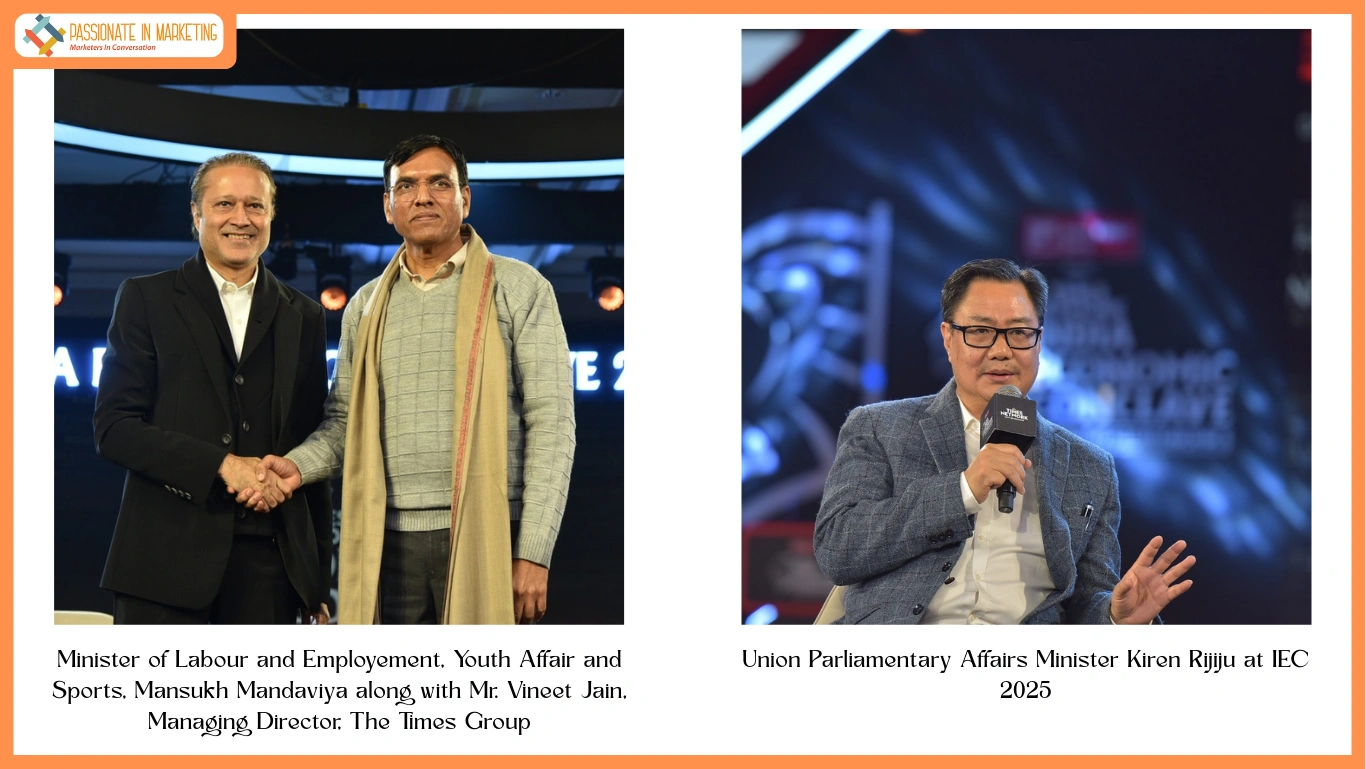
Chennai, 19 December 2025: At the Times Network’s 11th India Economic Conclave (IEC 2025) Minister of Labour and Employement, Youth Affair and Sports, Mansukh Mandaviya detailed the PM Narendra Modi government’s rationale for replacing 26 pre-Independence labour laws with four consolidated labour codes, saying the reforms were designed to strengthen India’s workforce and support long-term economic growth. He said the labour force would be a central pillar as India marks 100 years of Independence in the year 2047. With more than 40 crore workers engaged in manual labour, wage work and nation-building activities, Mandaviya said the government views workers as a priority segment that directly contributes to shaping the country’s future.
According to the Minister, successive governments failed to substantially improve labour welfare or create conditions that allowed industries to grow at scale. Highlighting the link between industrial growth and employment generation, Mandaviya said policy-making must recognise the interdependence between the two. He argued that industries cannot function without workers, and workers cannot find jobs unless industries expand – a balance that, according to him, the new labour codes seek to address.
Referring to the Modi government’s approach, Mandaviya said the administration shifted to a development-centric model focused on “reform, perform and transform. These codes were passed by Parliament in 2019-20 within a span of two years.”
Mandaviya acknowledged that implementation did not happen immediately, but said the PM later pushed for their early rollout. During this period, he said, there was significant debate and criticism around the labour codes. He said he personally held extensive discussions with trade unions to understand their concerns and the reasons behind opposition to the reforms. According to Mandaviya, many state governments eventually recognised that the labour codes were worker-centric and amended their local laws to incorporate the new provisions. The Prime Minister had made it clear that the labour codes should be implemented uniformly across the country to ensure a common legal framework for workers and employers.
Explaining key features of the labour codes, Mandaviya said they are designed to protect workers’ rights. He highlighted provisions ensuring equal wages for men and women, describing wage parity as a fundamental women’s right. He also said the four labour codes provide assurance of minimum wages for workers across the country, reinforcing the government’s claim that the reforms are aimed at creating a fair, modern and worker-focused labour framework suited to India’s evolving economy.
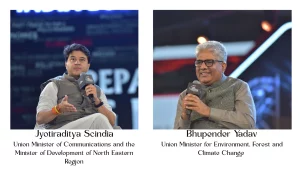
Speaking at the Conclave, Jyotiraditya Scindia, Union Minister of Communications and the Minister of Development of North Eastern Region, said India is at a defining moment in its economic journey. He questioned the narrative being pushed by the Congress leader Rahul Gandhi during his visit abroad and hit out at him over his remarks on declining manufacturing in India, saying such statements undermine the country’s achievements and are out of sync with its growth trajectory.
Scindia rejected the suggestion that India’s economic progress, particularly in manufacturing, is on the decline, asserting that the country’s growth story is something citizens should take pride in. “One has to be proud of what India has become,” he said.
Scindia’s remarks came after Rahul Gandhi said on Wednesday that manufacturing in India is declining and that the country needs to build strong, meaningful manufacturing ecosystems to drive growth and employment.
Throwing light on the current deteriorating air quality in India, particularly in the Delhi-NCR region, Scindia called for scientific, long-term solutions instead of short-term fixes. He added that as India rapidly emerges as a global hub for talent and innovation, it must urgently address the recurring winter spike in Air Quality Index (AQI) levels. Describing air pollution as one of the gravest threats to public health, the minister said the issue cannot be trivialised or postponed. “This is the most dangerous thing in life. But whatever we have inherited, we will correct it. And we will have to do it. There is no other way,” he said. At the same time, he cautioned against expecting immediate results, noting that air pollution is the outcome of multiple, layered and long-standing factors.
He added that the problem involves both generic and non-generic causes, requiring a combination of short-term adaptation and long-term mitigation measures. The Union Minister emphasised that addressing pollution is no longer optional and must be tackled from multiple angles. “What we call the environment — adaptation and mitigation — both of those angles we will have to look at. That is not an ‘if’ issue. It has to be done,” he said.
Union Parliamentary Affairs Minister Kiren Rijiju was quizzed on the defence of Rahul Gandhi missing the parliamentary session equating with that of the Prime Minister’s official tour abroad. To this, he stated, “Rahul Gandhi and Prime Minister are incomparable. Prime Minister is going for national duty, Rahul Gandhi is going for private duty. It’s not a parliament delegation, it’s not a parliament trip, it’s not even a Congress trip. He has gone for his own meetings.”
On the present issue of extreme pollution, Rijiju emphasized that all the members of the house, including Opposition should come together to discuss the debates which are listed for the day, to come up with good suggestions. However, when Parliament had listed business to discuss pollution, Opposition created another drama to avoid the discussion.
Union Minister for Environment, Forest and Climate Change Bhupender Yadav addressed concerns over air pollution and inter-state coordination as GRAP Stage 4 now in force, the national capital continues to battle toxic air well into the month of December. Responding to a question on coordination among neighbouring BJP-ruled states, particularly when stubble burning and firecracker use are currently not major contributors, Yadav said earlier governments had failed to act when they had the opportunity.
“The governments did nothing during their turn. Meteorologically, Western Disturbances arrive in December. We are implementing multiple measures, and the results of these efforts will become visible over the coming years,” he said.
When asked why India has not been able to curb pollution in the same manner as China, the minister said similar approaches are being followed globally. “The same steps were taken there as well. In London, strong action was taken against coal-based gas. We have conducted a comparative study of measures adopted by various countries and have implemented an action plan accordingly. All stakeholders are working together, and positive signs will be visible,” Yadav added.
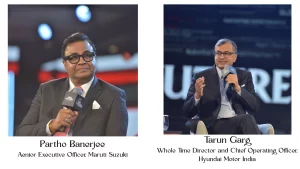
Tarun Garg, Whole Time Director and Chief Operating Officer, Hyundai Motor India, reflected on the brand’s 30-year journey in India and shared interesting anecdotes on the design inspiration behind the Santro hatchback, the success story of the Creta mid-sized SUV and the recent IPO that in Garg’s words has made Hyundai ‘Truly Indian’.
On what inspired the original Santro’s iconic tall-boy design, “Hyundai decided that we have to give respect to India. What I mean is that, for example, Indian women wear sarees and Hyundai was very sensitive towards that. So ingress into the car and coming out of the car became very important, and that is when the tall-boy design Santro came in, and it became an instant hit. So it was a very local solution, not that we just brought in a global car and tried to push it into India.”
Garg spoke about the carmaker’s Make-in-India roots and how Hyundai has been exporting from the country is a cornerstone of the India business model and strategy.
Addressing several questions around EV adoption, Partho Banerjee, Senior Executive Officer, Marketing and Sales, Maruti Suzuki India Limited, mentioned, while there is a good influx of new electric cars in the market, Maruti Suzuki is more focused on addressing the concerns of its loyal customers, rather than early adopters of the technology. “Today, there are more than 17 to 18 models in the EV segment, including the ones that are doing some numbers. But the EV penetration of the total industry is just 4 percent. So, it does not make too much of a difference in a country like ours, where we are selling close to 4 lakh cars every month.”
 Other prominent speakers and panelists through the day included Tarun Garg, MD & CEO Designate, HMIL on the future of mobility; Sanjeev Sanyal, Member, PMEAC on unlocking growth amid shifting geoeconomics; Purushottam Kaushik, Head, Centre for the Fourth Industrial Revolution, World Economic Forum on riding the Fourth Industrial Revolution; Sai Sundarakrishna, Chief Innovation Officer – Healthcare & AI, Amrita Vishwa Vidyapeetham on frugal AI and India’s next digital leap; Prasannna Mohile, Head – Public Policy, Pernod Ricard India on Make in India – Make for the World; a panel featuring students of Amrita Vishwa Vidyapeetham on Bharath’s Tectonic Shift: Youth, Disruption &
 Destiny; A. Balasubramanian, MD & CEO, Aditya Birla Sun Life Mutual Fund on India’s capital momentum story; Pawan Goenka, Chairman, IN-SPACe on accelerating the space economy; Deep Prakash Pant, Sr. Director & Head of GCC Practice, NTT Data on GCCs as hidden gems of the service economy; Preeti Bajaj, CMD, Luminous Power Technologies on unlocking India’s solar superpower; Shashank Chaudhary, I.A.S , Addl Chief Executive Officer. Govt. of Uttar Pradesh on powering India’s growth story; and Prabhpreet Singh Gill, Chairman, Pay10 Global and Eastern Fortune Investments on India’s fintech power play and the future of global payments, followed by a panel discussion on the need for a progressive parliament.
IEC 2025 concluded by reinforcing its role as a premier platform bringing together policymakers, industry leaders, economists and innovators to shape India’s economic leadership amid a rapidly evolving global landscape.
IEC 2025 is presented by IDFC FIRST Bank, with strategic support from Amrita Vishwa Vidyapeetham (Knowledge Partner), World Gold Council (Gold Investment Partner), Radico (Celebration Partner), Axis Max Life Insurance (Insurance Partner), Adani (Associate Partner), Government of Uttar Pradesh (Growth Partner), and NBCC (Infrastructure Partner).

