
24 June 2025, New Delhi: As part of the St. Petersburg International Economic Forum (SPIEF) 2025, the Valdai Discussion Club hosted a roundtable titled “Sustainability in a World of Uncertainty: Universal Security Through Stronger States.” The session brought together global experts and leaders to discuss the future of state sovereignty, national security, and sustainability amid geopolitical and technological shifts.
This second roundtable in the series explored how countries can stay resilient and secure in a rapidly evolving world. It focused on redefining sovereignty in the 21st century, addressing cyber threats, algorithmic governance, and the need for robust digital infrastructure.
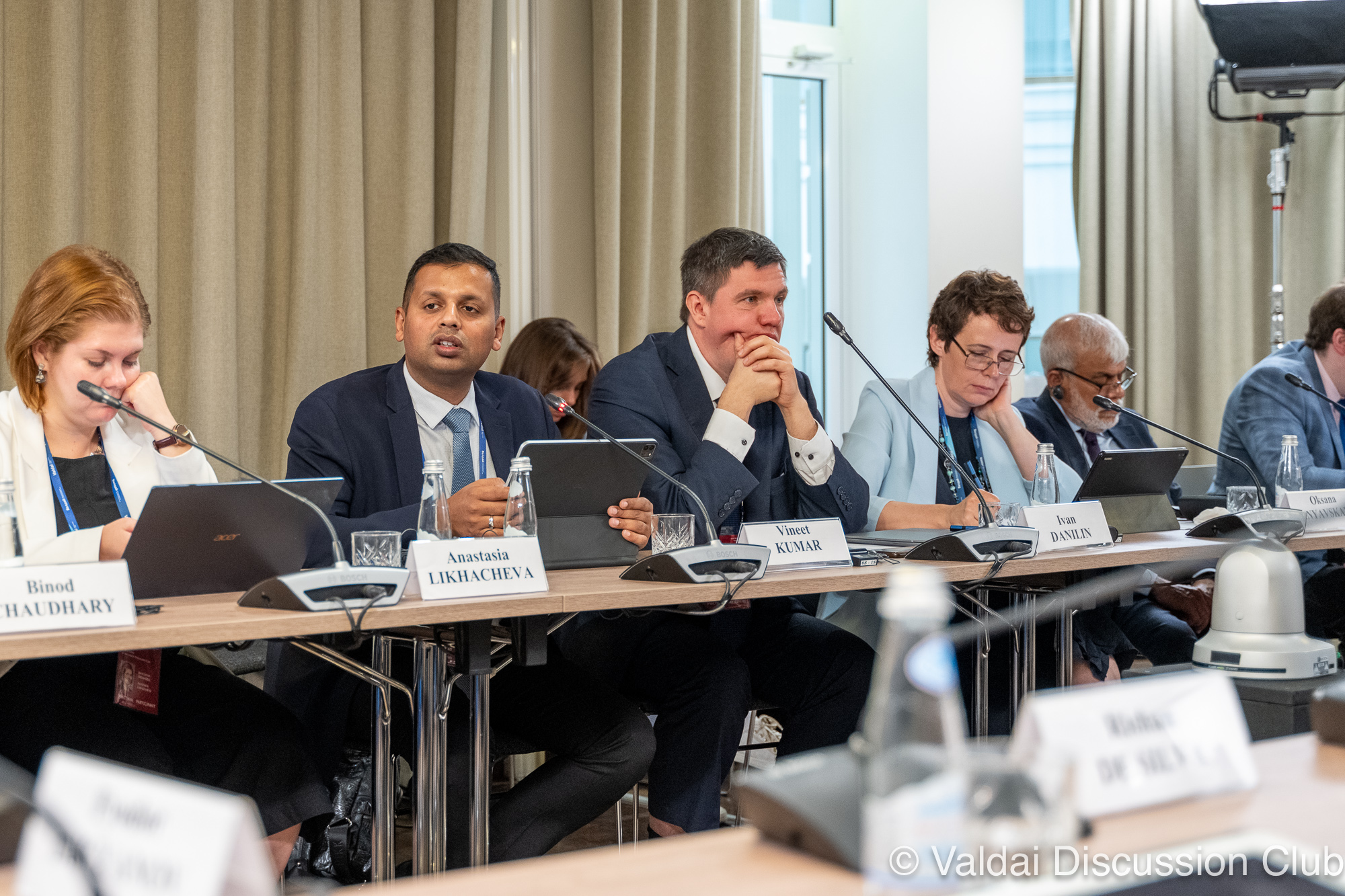
The session, moderated by Fyodor Lukyanov and opened by Chairman Andrey Bystritsky, emphasized the role of universal security and stronger states in ensuring global stability. It emphasized essential elements for development, the overlap of internal and external processes, and technology’s role in shaping economies. Environmental issues, social cohesion, and cultural shifts were also discussed, with insights from speakers like Ranil Wickremesinghe, Founder, Geopolitical Cartographer and Former President of the Democratic Socialist Republic of Sri Lanka; Feng Wei, Vice-Chairman, China Institute for Innovation and Development Strategy; Roger Köppel, Editor-in-Chief, Die Weltwoche; Binod Kumar Chaudhary, Chairman, Chaudhary Group; and Roman Chekushov, State Secretary – Deputy Minister of Industry and Trade of the Russian Federation.
Representing India at the session, Vineet Kumar, Founder and Global President of CyberPeace Foundation, addressed the rising global dependency on cyberspace and noted, “every institution and economy depends on digital infrastructure, yet we remain vulnerable to cyberattacks, algorithmic manipulation, and online abuse.”
He highlighted the urgent need to prioritize cyber resilience as a key pillar of national security. Calling for global norms on cybercrime, responsible AI, and hybrid warfare, he stressed the need for international cooperation, especially among nations of the Global South. “Cybersafety is not just the absence of cyber conflict,” he said, “but the presence of digital trust, dignity, and diplomacy.”

Appended Highlights of Vineet Kumar’s Talk at the Roundtable Session
- Cyberspace is the new battleground
Digital space has become the frontline for political, technological, and ethical conflicts, with every institution and economy now dependent on it for survival and growth. - Cyber threats are global and growing
With nearly 6 billion people online, the same connectivity that empowers also exposes societies to increasing cyberattacks, especially on national infrastructure. - Cyber resilience is essential to sovereignty
True sovereignty now includes the ability to protect a nation’s digital infrastructure and social fabric from persistent cyber threats. - The Global South must not be left behind
Countries like India, Nepal, and Sri Lanka must participate in shaping global cyber norms and technologies, not just adopt them. - Digital responsibility is a shared duty
Countries, Governments, corporations, schools, and communities must work together to foster responsible behaviour online and promote cyber hygiene. - Algorithmic governance poses new risks
The misuse of digital platforms and algorithms can undermine democracy and must be addressed with transparency and regulatory oversight. - Children and vulnerable groups need urgent protection
Emerging technologies are enabling CSAM, Cyber Slavery, and AI based abuse, which demands coordinated international action. - Cybersafety means more than absence of conflict
It includes digital trust, digital dignity, and digital diplomacy – values that should define international cooperation in cyberspace. - International cooperation is crucial for cybercrime investigations
There is a long delay in data access and jurisdictional cooperation; cross-border frameworks are needed to tackle cybercrime effectively. - A global cyber convention is needed
He called for a unified international platform to define rules for online behaviour, responsible AI, and digital conflict resolution, ensuring inclusion for developing nations.