


CP Gurnani, Co-Founder and Vice Chairman, AIONOS, said

“As we close the year, it’s clear that real progress isn’t driven by isolated breakthroughs, but by consistent intent. 2025 marked a turning point as AI moved from experimentation to enterprise execution. As we enter 2026, the convergence of AI, quantum computing, edge intelligence, and human-centric design will define a new era, one where technology scales not just businesses, but human potential. For leaders, the mandate is clear: move beyond adopting new tools and focus on aligning technology with business goals, trust, and long-term impact.”
Agendra Kumar, Managing Director, Esri India, said,

“In 2025, India’s geospatial journey saw tremendous acceleration, with GIS emerging as core digital infrastructure. The rapid expansion of the geospatial analytics market signals that spatial intelligence is now deeply embedded across governance, infrastructure development, climate action, and enterprise decision-making. The convergence of GIS with AI, drone and satellite imagery, GeoAI, IoT, and big data is enabling faster, more precise, and more proactive outcomes across sectors. This shift is helping organizations move from reactive responses to predictive and scenario-driven planning, whether in urban development, agriculture, disaster management, or public service delivery. Looking ahead to 2026, living digital twins will further accelerate this transformation by providing connected, real-time views of physical assets throughout their life cycles, while detailed imagery analysis and immersive technologies such as AR and VR will reshape how teams interpret and act on spatial insights in the field. GIS is no longer limited to mapping. It is becoming a mainstream platform that connects data, systems, and people, laying a strong foundation for India’s next phase of digital, resilient, and sustainable growth.”
Amit Kumar, Co-Founder and COO, Suhora Technologies, said

“2025 has been a defining year for India’s downstream space ecosystem. As launch capacity improves and satellite constellations scale up, the real value creation is now shifting closer to applications, analytics and decision making. From agriculture and climate monitoring to infrastructure planning and national security, satellite data is steadily moving from being a niche input to a mainstream business and governance tool. What is encouraging is the growing maturity of demand, where enterprises and governments are no longer asking if space data can help but how quickly it can be operationalised. For companies like Suhora, this has reinforced the importance of building reliable intelligence layers on top of Earth observation data, focused on accuracy, speed and relevance. As we move into 2026, the opportunity lies in translating India’s space capabilities into everyday insights that solve real world problems at scale.”
Mr. Pankaj Malik, CEO & Whole-time Director, Invenia-STL Networks, said

“2025 was a year of purposeful digital transformation where the conversation shifted from mere expansion to agile performance. As we look to 2026, the industry will double down on building secure, scalable, and intelligent digital foundations. Smarter automation, stronger network resilience, and cloud architectures designed for speed and performance will define the next phase of growth. At Invenia-STL Networks, we’re partnering with enterprises to strengthen their digital core and lead an increasingly dynamic landscape. The companies that invest early in security, performance, AI adoption, and operational clarity will lead the next wave of India’s digital acceleration.”
Ganesh Gopalan, Co-Founder & CEO, Gnani.ai, said

“Enterprises are no longer satisfied with AI that waits for instructions. They are demanding systems that understand context, anticipate intent, and act with confidence inside real operational environments. That shift became unmistakable in 2025 and fundamentally changed the conversation around what enterprises will expect from AI in 2026. 2025 also set the foundation for the next phase of enterprise AI adoption. Agentic AI moved from concept to capability, generative models shifted from experimentation to production impact, and enterprises began standardizing on AI systems that can reason, orchestrate, and act autonomously. As we look to 2026, this momentum accelerates. Agentic systems will become the default operating layer for customer operations, risk, and service workflows. Small Language Models and speech-to-speech architectures will drive higher precision, lower latency, and stronger compliance in regulated environments. Multimodal and real-time voice AI will unlock new interaction models, while sovereign and responsible AI frameworks will move from policy discussions to hard deployment requirements. With strong tailwinds from initiatives like the India AI Mission and growing global demand for trusted, production-grade AI, 2026 will not be about whether enterprises adopt agentic AI. It will be about who can deploy it at scale, securely, and with measurable outcomes. 2026 will be the year AI agents move from conversation to action and become embedded into core enterprise workflows.”
Vasudha Madhavan, Founder and CEO, Ostara Advisors, said

“2025 proved that climate tech and climate funds have firmly shifted from aspiration to execution, reflecting a growing global commitment to solutions with measurable impact. It was also a year that reinforced the need to align innovation with long-term resilience. As we step into 2026, I expect biofuels to become a critical decarbonization lever, lithium ecosystems to grow more circular, urban mobility to evolve closer to low-carbon systems, and data centers to start moving towards energy efficiency. India will also drive the mandate for carbon emission monitoring and reporting for high-emission industries. Circularity and resource efficiency will start to evolve into central pillars of climate strategy, while climate adaptation technologies gain rapid traction. The year ahead marks a decisive transition from experimentation to wider deployment of multiple innovations from resilient energy storage to carbon-negative materials. Policy, Technology and capital are now positioned to drive lasting change toward a low-carbon, climate-secure future.”
Sriram Kannan, Founder & CEO, Routematic, said

“2025 was a strong year for Routematic, marked by consistent growth and measurable environmental impact. As India’s GCC ecosystem expanded and enterprises scaled multi-shift operations, employee commute became a strategic focus, accelerating the shift toward AI-led, data-driven commute solutions. Smarter routing, cleaner fleets, and employee well-being are now central to how organisations think about transport, with employee commute emerging as one of the most practical ways to reduce Scope 3 emissions and strengthen ESG outcomes. As India progresses towards its net-zero goals, growing GCC demand, will further accelerate the need for safe, technology-enabled, sustainable, shared employee commute. Looking to 2026, I am genuinely optimistic about what lies ahead for Routematic and the industry, as AI, shared mobility and EV adoption come together to create scalable, future-ready impact for modern workplaces.”
Hardeep Dayal, President – Commercial, Bhartiya Urban, said

“For India’s commercial real estate, 2025 was a reset year, with a clear return-to-office push followed by renewed leasing momentum in core markets. And as occupiers revived physical work environments, demand sharply shifted towards well-placed, efficient workplaces that reduce commute friction and contribute to employee wellbeing. It was also a year of transition from standalone offices to integrated, mixed-use campuses that combined workspaces with daily amenities and social infrastructure. In 2026, leasing activity is expected to be supported by GCC expansion and technology-led enterprises while India will continue to benefit from its skilled workforce and innovation depth. Offices will, increasingly, be assessed not as cost centers but as productivity enablers, culture hubs and long-term talent retention tools.”
Matthew Foxton, India Regional President & Executive Vice-President, Branding & Communications, IDEMIA Group, said

“2025 marked a decisive acceleration in digital innovation, with payments, connectivity, and digital ecosystems becoming more seamless, secure, and interconnected than ever before. As we look ahead to 2026, cryptography and cybersecurity will define the digital economy, as trust becomes fundamental to every real-time transaction and software-driven system. Next-generation cryptographic libraries, advanced hardware security modules, and crypto agility will enable security to operate seamlessly from edge devices to cloud platforms processing billions of transactions, while safeguarding keys and data as the industry transitions toward quantum-resistant standards. Together, these capabilities will underpin trusted payments, secure communications, resilient digital infrastructure, and national cybersecurity in the post-quantum era”
Dr. Sanjay Gupta, Vice Chancellor, World University of Design, said
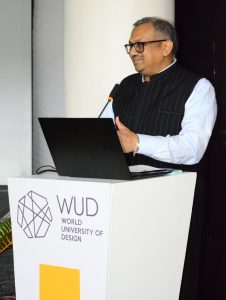
“The future will not be built by those who just follow a long-established syllabi, but by those who have the courage to question, dismantle and redesign them. At World University of Design, 2025 was not a year of incremental progress or cosmetic innovation, it was a year of deliberate disruption. We reaffirmed ourselves to the belief that education must evolve from the transfer of information to the cultivation of imagination, agency and critical intelligence. We are stepping into 2026 with the conviction that the future of our students depends on what they will dare to reimagine, what systems they will challenge, what conventions they will outgrow, and what futures they will author. In a world defined by volatility, artificial intelligence and accelerating complexities, WUD stands committed to nurturing designers who refuse passive compliance, who see uncertainty as a creative frontier, and who transform bold ideas into frameworks for more intelligent, equitable and humane ways of living.”
Dr. Yajulu Medury, Vice Chancellor, Mahindra University, said

“In 2025, we observed a significant shift toward skill-based learning, advanced AI integration, multidisciplinary approaches, and stronger collaboration between industry and academia. Key trends included hyper-personalised blended learning, research-driven and innovation-led higher education along with internationalisation to boost global competitiveness. As India positions itself as a knowledge leader in the global economy, we anticipate more decentralised learning and increased investment in Education 5.0. Our approach at Mahindra University remains holistic, student-centric, and interdisciplinary, fostering knowledge exchange through global partnerships and prioritising experiential learning to prepare students for industry.”
Dr. Anirban Ghosh, Head – Centre for Sustainability, Mahindra University, said

“In 2025, the sustainability sector transitioned from aspirational commitments to operational priorities. Notable trends included an increased emphasis on biodiversity and social equity within environmental, social and governance (ESG) frameworks; expanded adoption of artificial intelligence–driven insights; integration of circular economy principles; decarbonisation of supply chains; and an accelerated shift towards renewable energy. The urgency of climate change has further propelled the transition to a low-carbon economy, facilitated by advanced technologies and initiatives such as the emergence of a biodiversity credit market. Looking ahead, we anticipate continued progress in resource management, environmental stewardship and emissions reduction, alongside greater investment in artificial intelligence, climate adaptation and resilient infrastructure. At Mahindra University, we remain committed to a comprehensive approach that advances environmental education and equips students to address sustainability challenges through practical, solution-oriented learning.”
Monica Pirgal, CEO, Bhartiya Converge, said
 2025 marked a clear shifting point for India’s GCC landscape from giant, cost-focused delivery centers to smaller, high-impact, innovation-led GCCs. Increasingly, firms are setting up agile centers of 100–500 professionals working at the forefront of AI, cloud, cybersecurity, product engineering and R&D, where speed-to-value, IP ownership and strategic influence matter more than scale alone. Supported by India’s deep digital talent pool, a maturing Tier-2 ecosystem and faster go-live timelines, this model has become both commercially attractive and operationally efficient. As we move into 2026, this momentum will accelerate, driving demand for full-service partners who can seamlessly integrate strategy, talent, compliance and operations. The next phase of GCC growth in India will be defined not by size, but by precision, agility and long-term value creation.

