


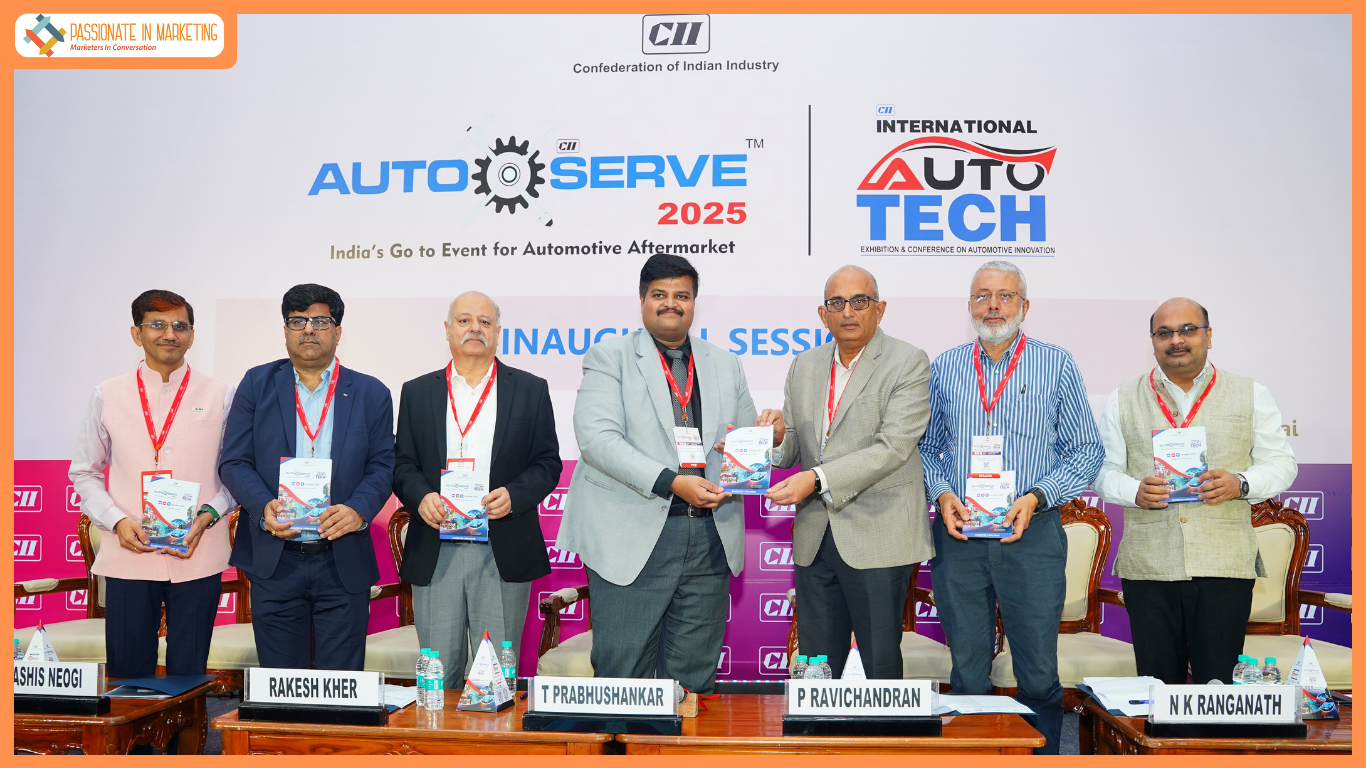
Chennai, 10 October 2025: “Our strength lies in our manufacturing base and in our ability to evolve continuously. Tamil Nadu has always been a responsive and entrepreneur-friendly state that actively supports industrial growth and innovation. The State has the largest number of factories and MSMEs in India, and that ecosystem is built on trust between government, industry and people,” said Dr T Prabhushankar, IAS, Managing Director, Metropolitan Transport Corporation (Chennai) Limited, Government of Tamil Nadu, in his inaugural address at the Confederation of Indian Industry (SR) organized 11th edition of CII AutoServe 2025 today.
The Conference on Automotive Aftermarket 2025”, with the theme: “Driving the Next Decade: Innovation, Integration, and Intelligence in the Automotive Aftermarket” and “International Auto Tech Conference” with the theme “Accelerating Innovation: Smart, Sustainable, and Software-Driven Mobility brought together senior leaders from government, industry and academia to discuss the road ahead for a smarter, more sustainable aftermarket ecosystem.
Dr Prabhushankar stated the Government of Tamil Nadu continues to work towards making business easier and more transparent by creating an enabling environment that allows entrepreneurs to focus on innovation, job creation and sustainable growth. “We cannot afford to stagnate; we must innovate constantly and collaborate to build a stronger aftermarket ecosystem that supports both quality and livelihoods,” he added.
Dr Prabhushankar emphasized that the aftermarket plays a crucial role in public service delivery and employment generation. He said forums like CII AutoServe bring together stakeholders across manufacturing, technology and services to drive regulation, standardization and digital transformation. He encouraged participants to channel discussions into actionable recommendations that would make India’s aftermarket more organized, sustainable and future-ready.
Mr P Ravichandran, Deputy Chairman, CII Southern Region & President, Danfoss Industries Pvt Ltd, said, “Our focus must be on strengthening manufacturing competitiveness, deploying AI and automation across MSMEs, and building a deep culture of innovation and circular economy. We must reimagine speed as the new currency of competitiveness and create entrepreneurial ecosystems that can build new value for India’s mobility future.”
Mr Debashis Neogi, Chairman, CII International AutoTech Conference & Managing Director, Renault Nissan Technology & Business Centre India highlighted on India’s automotive industry undergoing a major transformation, emerging as the third-largest passenger car manufacturer, second-largest two-wheeler producer, and largest three-wheeler market in the world.
He stressed on how rapid advancements in autonomous driving, connectivity, and electrification are redefining vehicles as “internet on wheels,” supported by a strong IT and automotive ecosystem contributing nearly 15% to India’s GDP.”
“India’s aftermarket touches millions of livelihoods and deserves the same recognition and structure as the core automotive industry. We must organize, standardize and digitize this vast ecosystem—where every mechanic, workshop and supplier becomes part of a trusted, quality-driven network. A strong right-to-repair framework, skill development and digital integration can transform this sector from being largely unorganized to becoming one of India’s most powerful employment and safety engines. The time has come to give the aftermarket its due place in the nation’s growth story,” said Mr Ramashankar Pandey, Social Defence Fellow (Indian Administrative Fellowship) & Director (NED), Paracot Products Ltd in his address.
Mr Rakesh Kher, Chairman, CII Automotive Aftermarket Conference & CEO – Aftermarket and Group Chief Strategy Officer, Uno Minda Ltd, said, “India is already sitting on an automotive aftermarket potential of roughly ₹100,000 crore — the lifeline of mobility for millions. Over the past decade, the industry has witnessed sweeping transformation: printed catalogues have given way to digital platforms and e-commerce; mechanical repairs have evolved into diagnostics, telematics and OBD-based servicing; supply chains have expanded into automated warehouses reaching Tier I to Tier III cities; and GST reforms have brought transparency that is steadily formalizing this once-fragmented market. With BIS standards, ESG practices, remanufacturing initiatives, and a new wave of branding and consumer awareness, the aftermarket is entering an era of organized, technology-driven, and sustainable growth.”
Mr N K Ranganath, Past Chairman, CII Tamil Nadu, said, “In 2023, the aftermarket was worth approximately $ 13 billion and by 2030, it’s expected to reach $ 21.6 billion which is an average CAGR of 7% and that’s what the industry grows at in India. Also, passenger sales are expected to grow from about 5 plus million units in 2024 to over 8.3 million units in 2030. So, this naturally fuels the demand for parts, accessories and services,”.
The three-day event features over 75 exhibitors, with Japan as the Country Pavilion, participation from 11 sectoral associations and 10 media partners. The event includes live demonstrations and panel discussions on AI, IoT, EV maintenance, and remanufacturing, and is expected to attract over 12,000 business visitors from India and overseas.

