


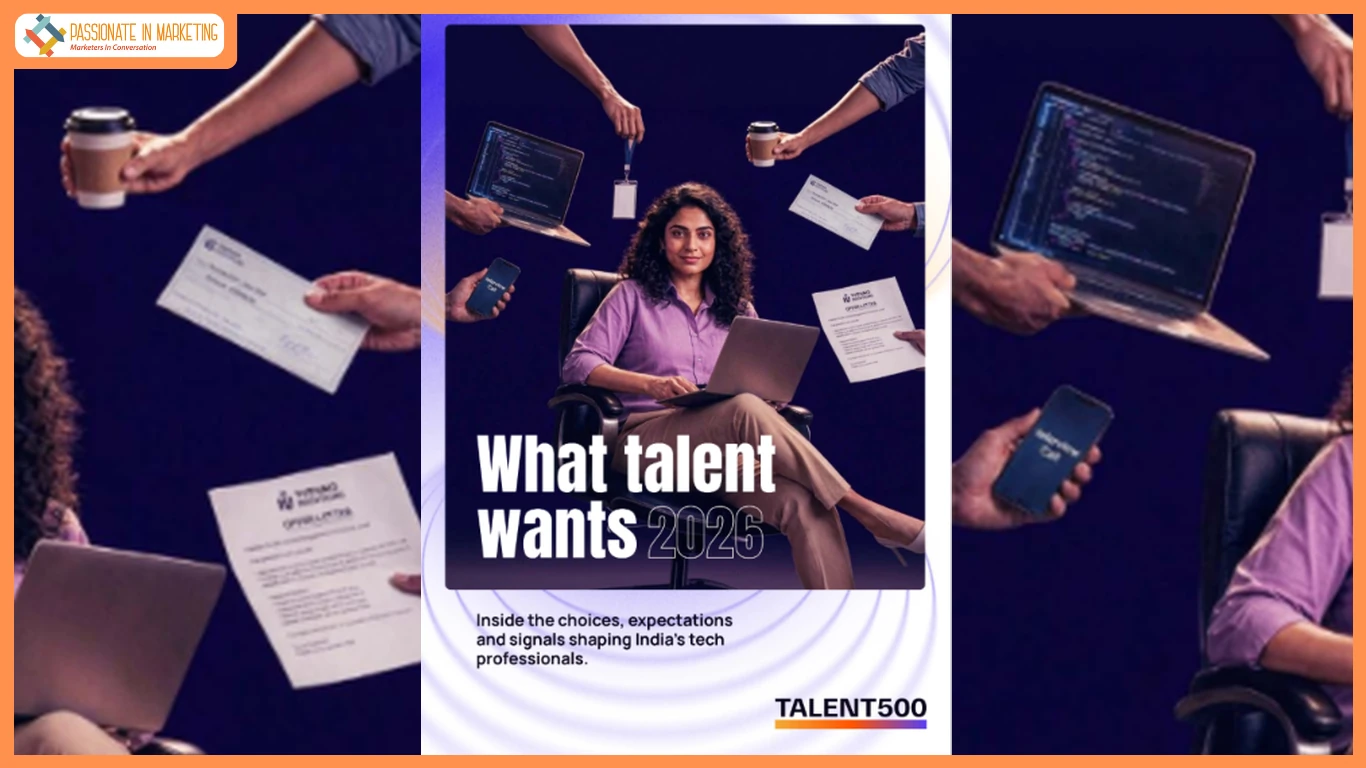
Bengaluru, India, October 15, 2026: Coinciding with the traditional October hiring surge, Talent500, a part of ANSR, the market leader in enabling organisations to build, manage and scale global teams through Global Capability Centres (GCCs), today released What Talent Wants 2026, a new report decoding the choices, expectations and signals shaping India’s tech professionals. A key finding identifies the AI upskilling gap as the largest expectation-delivery mismatch in the workplace today, across six workplace attributes tested in the study. 71% of professionals say hands-on AI upskilling matters to them, yet only 29% say their current employer delivers it. The distinction the report draws is important: professionals are not looking for AI awareness courses or certification programmes. They want opportunities to work with AI in a meaningful, hands-on way.
The report surveyed 2,000 tech, product and data professionals across India on how they evaluate employers, what they expect from their next opportunity, and what ultimately shapes their career decision. The career decision, the report finds, is made well before the first interview. Candidates are doing more due diligence before applying, and in most cases they have formed a view of an employer before they attend a first round.
“Candidates arrive with more information, more questions and more ways to validate what an employer tells them. For employers, that changes the job. It is no longer enough to have a strong opportunity. The things talent values must also be clear, credible and visible before candidates are asked to commit,” said Vikram Ahuja, Co-Founder at ANSR and CEO at 1Wrk.
92% research an employer on LinkedIn before applying. 81% visit the company or careers page and 31% now use an AI assistant to research a potential employer before applying, a signal that the employer brand is being shaped not only by what organisations publish, but by what employees say, what others have experienced, and what AI systems can find and synthesise about them.
Career growth is the defining signal: 87% of respondents say defined career-growth information is very important when evaluating an employer. 79% say they would drop an application or decline an offer if there is no clear career or growth path, making it the single biggest factor influencing candidate decisions in the study. For employers, the implication is that career architecture is an intrinsic part of the proposition candidates evaluate before they join.
Notably, the mandatory five-day return-to-office requirement ranked lowest of six dealbreakers.
The trust equation has shifted: The most credible employer-brand voices, the report finds, are people who have actually experienced the workplace. Former employees are the most trusted source at 48%, followed by current employees’ LinkedIn posts at 44%, while company leadership content sits considerably lower. Candidates are effectively cross-checking the employer promise against the people who have lived it.
GCCs are the first-choice for the next career move: 69% of respondents rate a GCC of a multinational as their first choice for their next career move, ahead of Indian product companies (37%), IT services firms (28%) and local or regional employers (21%).
Among current GCC employees, 84% would choose a GCC again. But GCCs are also the first choice for 64% of respondents in IT services, 72% in product companies and 70% in startups.
When evaluating a specific GCC opportunity, career growth leads at 48%, ahead of the global parent brand (41%), India centre leadership and culture (36%), AI and technology exposure (33%) and compensation (17%). For GCC employer brands, the report notes that the proposition must explain why the India centre specifically is a place worth building a career.
Only 36% of GCC employees describe their career path as very clear, compared with 50% in IT services and 51% in startups, making career clarity a genuine differentiator for GCCs competing for experienced technology talent.
The manager matters: 56% of respondents say their prospective manager’s professional profile is very important when evaluating an opportunity. 50% say invisible or hard-to-read leadership can become a reason not to proceed. Candidates are evaluating not just the company but the person they will work for, making leadership visibility a material factor in hiring outcomes.
The talent market is less anchored than it appears: These shifting expectations become even more significant against the backdrop of a talent market that is far less settled than it may seem. 59% of respondents are already actively looking for their next role. Only 18% say they are firmly settled. Mobility increases with experience: among professionals with 12 or more years of experience, 91% would consider a move, compared with 72% among those with fewer than three years.
“At Talent500, we sit at the intersection of where global enterprises are building their future and where India’s best talent is choosing to go. This report gives both sides a clear picture of what is driving career decisions. For GCCs specifically, the data is a strategic asset: it shows not just what talent wants, but where the largest opportunities exist to differentiate. Understanding India’s talent market at this depth, across 3.6 million professionals is what makes Talent500 and ANSR the partner of choice for global enterprises that are building in India for the long term,” said Vikram Ahuja.
Methodology: What Talent Wants 2026 is based on responses from 2000 tech, product and data professionals across India, surveyed through the Talent500 community. Respondents span IT services (41%), other industries (21%), product companies (20%), GCCs (10%) and startups (8%), across a range of experience levels, functions and work arrangements.
About Talent500
Talent500 is the number one destination for global work, helping professionals discover career-changing opportunities with the world’s best companies. A community of 3.6 million highly skilled global professionals, Talent500 is on a mission to accelerate careers through learning, sharing and growing with the world’s best businesses, including Walmart, Target, Nike, Uber and FedEx.
Talent500 is building “The Operating System for Global Work”, a suite of AI-driven tools and solutions to accelerate outcomes for leading professionals and businesses. Talent500 is a part of ANSR. www.talent500.com
About ANSR
ANSR is the definitive global leader in establishing and operating Global Capability Centers. Across key innovation hubs in India, Eastern Europe and Southeast Asia, ANSR has established over 225 GCCs for a diverse portfolio of global enterprises, including more than 100 Fortune 500 companies, leading mid-market organizations and private equity-backed firms. ANSR combines unparalleled strategic insight, proven execution capabilities and proprietary technology solutions to help enterprises build and scale high-performing global teams. As a pioneer of the GCC as a Service (GaaS) model and creator of the revolutionary 1Wrk platform, ANSR continues to redefine how enterprises achieve operational excellence and accelerate their digital transformation journeys. With over a decade of experience and a team of seasoned GCC experts, ANSR delivers predictable outcomes that enable enterprises to build competitive advantage through their Global Capability Centers. To learn more, visit www.ansr.com.

