


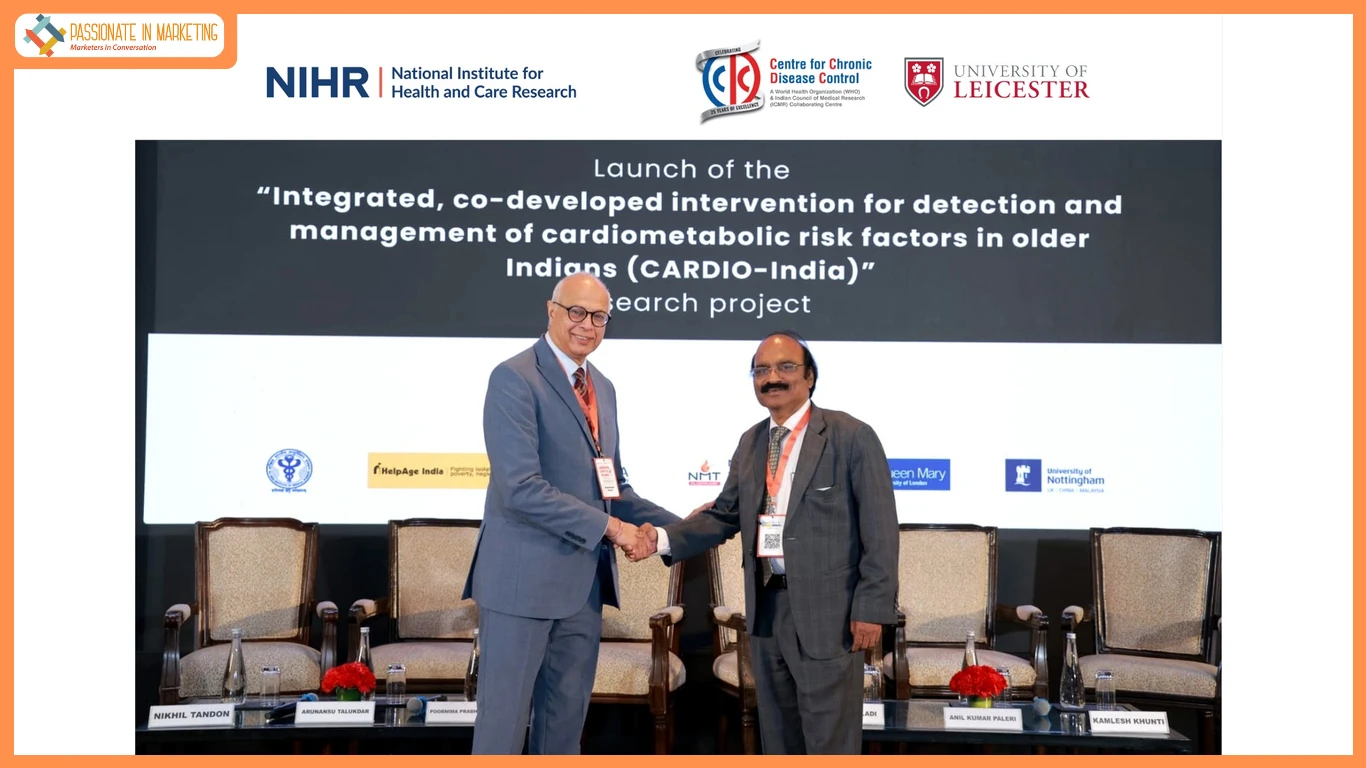
New Delhi, March 17th: The University of Leicester, UK, and New Delhi’s Centre for Chronic Disease Control today kickstart “Integrated, co-developed intervention for detection and management of cardiometabolic risk factors in older Indians (CARDIO India)”, a £5 million (approximately ₹62 crore), five-year research programme funded by the National Institute for Health and Care Research (NIHR). The initiative aims to improve detection and management of cardiometabolic risk factors among adults aged 60 and above — a population at high risk of cardiovascular diseases (CVDs),
where access to regular screening and long-term management remains limited. CVDs are the leading cause of death accounting for over 25% of all mortality in India and the burden is growing. This programme will co-design contextually relevant interventions, implement and evaluate by conducting a cluster randomised controlled trial involving 48 Mobile Health Units across 10 states for close to 2000 participants.
CARDIO-India builds on the Government of India’s Mobile Medical Units (MMUs) initiative introduced under the National Health Mission to deliver an integrated model of care across rural and sub-urban areas. A decade since the Government launched their initiative, more needs to be done.
CARDIO-India’s programme begins with a formative and co-design phase involving patients, caregivers, clinicians and frontline health workers. It will then move into a cluster randomised controlled trial and the intervention will run for 24 months. Outcomes will be measured at baseline, 12 months and 24 months to assess its effectiveness in real-world conditions.
Designed unlike othertelemedicine services thatrely on patients initiating consultations, CARDIO-India adopts a community-first approach. It combines doorstep clinical assessment and remote specialist supportwherein community health workers visit older adults at home, examine them and consult specialists through an assisted telemedicine platform supported by a clinical decision support system. MMUs are equipped with diagnostic tools including an electronic stethoscope, AI-enabled ECG and handheld
echocardiography. All interactions contribute to a digital health record enablement under theAyushman Bharat Digital Health Mission of Government of India.
India’s population aged 60 and above is projected to reach 230 million by 2036 (as per UNFPA India Ageing Report), and by 2050 older adults are expected to outnumber children for the first time. CVDs are the leading global cause of death, accounting for 19.8 million deaths in 2022, which represents approximately 32% of all global
deaths. More than three quarters of these deaths occur in low-and middle-income countries, including a high burden in India. The incidence of heart disease is further projected to surge worldwide by nearly 90% between 2025 and 2050, accompanied by a more than 70% increase in deaths
Against this backdrop, CARDIO-India was conceived by the CCDC to lead on the on ground implementation alongside the University of Leicester for its capability in cardiometabolic research, clinical trial design and health technology. Funded by NIHR, CARDIO-India will work with HelpAge India to access its Mobile Health Unit network and patient population. AIIMS New Delhi and Nightingales Medical Trust will also be consulted for their specialist expertise in ageing and geriatric care whilst Krea University contributes research and analytical capacity. Along with co-applicant institutions – Queen Mary University London and University of Nottingham (UK).
Over the long term, the programme is expected to improve control of cardiovascular risk factors, enhance quality of life and increase health-adjusted life years among older adults. In the short term, the programme will generate evidence on the design, acceptability and feasibility of technology-enabled community care.
Speaking about the partnership, Kamlesh Khunti, Professor of Primary Care Diabetes and Vascular Medicine at the University of Leicester, said, “We at the University of Leicester are excited to collaborate with CCDC on CARDIO-India, which will focus on the care of older adults with cardiovascular disease and its risk factors across India. As a country with a predominantly young population today, India must begin preparing its health systems for the needs of an ageing population. CARDIO-India is our effort to supportthattransition by strengthening ambulatory care.”
Professor Dorairaj Prabhakaran, Executive Director of the Centre for Chronic Disease Control, said, “CCDC is excited to co-lead CARDIO-India. It builds on a long standing collaboration with the University of Leicester and is strengthened by the participation of partners including AIIMS New Delhi, Krea University, HelpAge India and
Nightingales Medical Trust. Just like our languages, the healthcare needs are also very diverse across the country. With a population that is ageing rapidly, our health systems must be efficient and resilient in ways to cater for their needs in the coming times. CARDIO India is a visionary effort which will help India march towards the goal of Universal Health Coverage (UHC) forits future population.”

