

July 2026: It’s 3am. You can’t sleep. You’re drenched in sweat. Your heart is racing. Your mind won’t stop. You’ve seen three doctors in six months and been told the same thing each time: stress. Burnout. Ageing. Just part of life. Nobody said menopause.
Indian women reach menopause at an average age of 46 — nearly five years earlier than women in the West. That means perimenopause begins in the late 30s to early 40s, years before most women — or their doctors — think to look for it. According to projections cited in Scientific Reports (Nature, 2024), over 400 million Indian women will be aged 45 and above by 2026, largely without a framework to understand what is happening to their bodies.
Untreated menopause is now linked to accelerated bone loss, cardiovascular risk, cognitive decline, and long-term brain health consequences that are modifiable with early diagnosis and treatment — yet most women never receive either. .
That is why “It Was Menopause All Along” exists. The podcast brings together some of India’s most influential women alongside leading global experts in gynecology, neuroscience, dermatology and sexual wellness. The brainchild of Roshini Sanah Jaiswal, founder of neurocosmetics brand Justhuman and host of “It Was Menopause All Along”, the podcast is built on research, science and real experience. It does not tell women everything will be fine. It tells them the truth about what is happening — and gives them the tools to act.
“For generations, women have been told that menopause is simply something to endure. But the truth is that many women don’t even know they’re experiencing it. They blame themselves for the anxiety, the brain fog, the sleepless nights, the sudden shifts in confidence and identity. And that is the concern — because today we have answers, we have treatments, and we have science that makes endurance completely unnecessary. Every woman deserves to know that,” says Jaiswal.
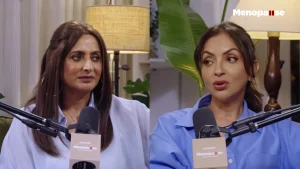
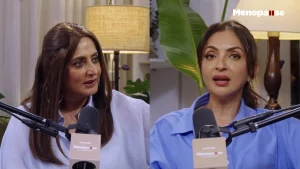
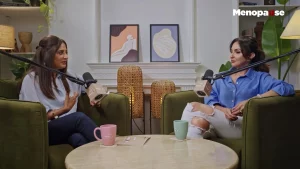
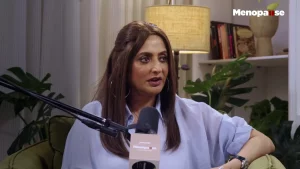
The podcast launches with entrepreneur and television personality Seema Kiran Sajdeh, who speaks with rare candor about navigating acid reflux, osteopenia, stress and depression without a framework to understand what was happening to her body. “Women are told they’re stressed. They’re told they’re overreacting. They’re told they’re getting older. The concern isn’t that women experience menopause — it’s that so many experience it without understanding what’s happening to them, and without being told that help exists. That’s the gap that needs to be closed,” says Sajdeh.
The season goes on to feature politician Mahua Moitra, journalist Shoma Chaudhury, culture journalist Bandana Tewari, gynecologist Dr Duru Shah, neuroscientist Dr Sarah McKay, dermatologist Dr Michelle Henry, celebrity aesthetician Harshna Bijlani, Editor of Hello Magazine Ruchika Mehta, Artist and Influencer Manjri Varde, sexual educator Leeza Mangaldas, Kim Vopni (The Vagina Coach), and others — each bringing a different lens to a subject that touches every dimension of a woman’s life: her brain, her body, her skin, her identity, her relationships and her work.
“These are some of the most informed, educated, resourced and well-connected women you’ll meet — and menopause still blindsided them,” says Jaiswal. “Now imagine the millions of women who do not have access to the same information, expertise or support. India does not need more menopause awareness. It needs a menopause revolution!”
“It Was Menopause All Along” was built on a single belief: that every woman deserves answers sooner — not at 55, after years of misdiagnosis and self-blame, but now, while she can still act, advocate for herself, and live the second half of her life with full information. “If via the podcast, we help one woman recognize herself in these conversations and reach for help sooner, the change is already being made,” concludes Jaiswal.
Sources:
Indian Menopause Society PAN India Survey, Journal of Mid-life Health, 2016; corroborated by systematic review, ScienceDirect, 2021.
Scientific Reports, Nature, 2024; based on NFHS-5, Government of India (2019-21).
NFHS-4/5, as cited in BMC Women’s Health, 2022.
NIH/PMC, 2019 (https://www.ncbi.nlm.nih.gov/pmc/articles/PMC6679457/).

