


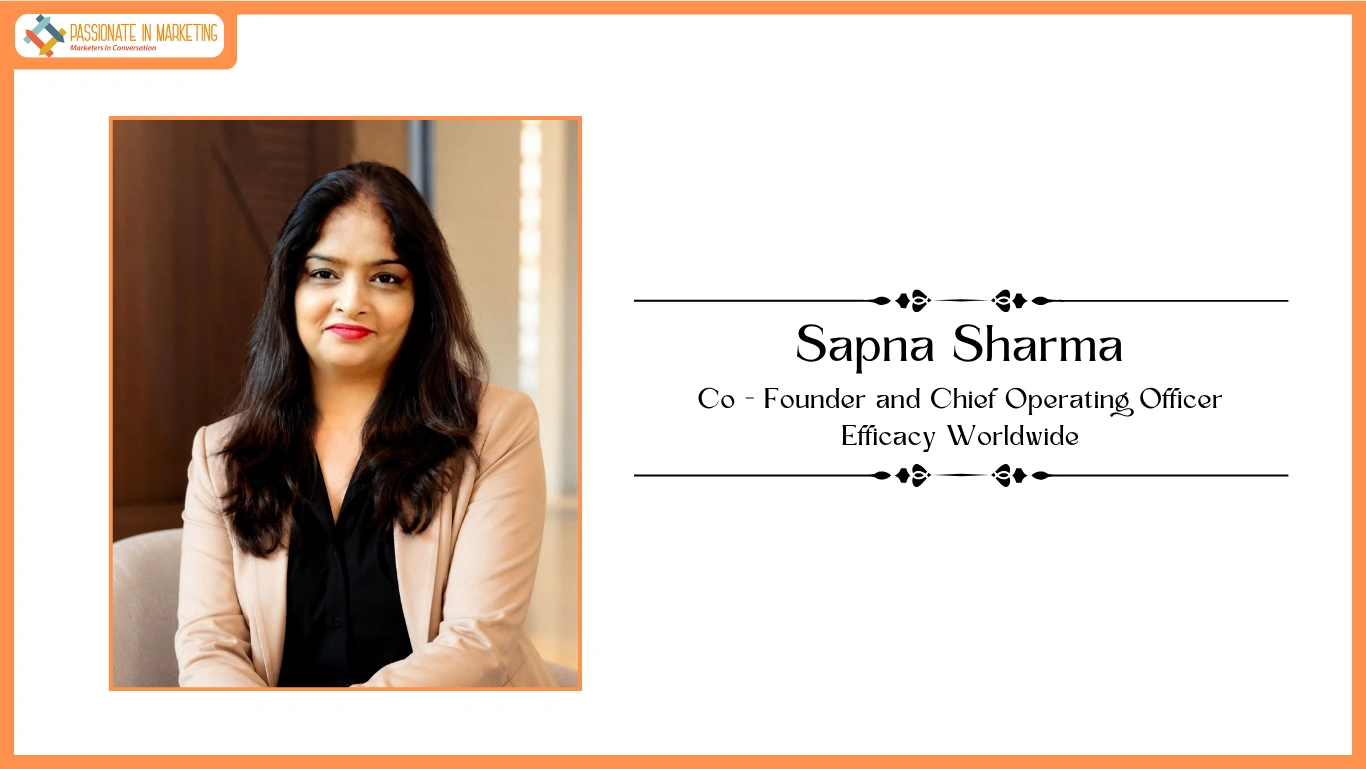
Q1. What will differentiate a great advertising agency from an average one five years from now?
The differentiator won’t be who has the best AI tools. Every agency will have the same tools. What separates the exceptional from the average will be the quality of human judgement sitting above the machine.
AI can generate a hundred campaign concepts in ten minutes. It cannot tell you which one is right for this brand, this moment, this cultural context. That requires taste. Conviction. The willingness to kill a good idea in service of a great one.
This is the bet we’ve built Efficacy around for the past five years: tight, opinionated teams who use AI as a production engine while protecting human bandwidth for the things that actually move brands: real insight, honest client relationships, and creative courage. We call it “strategic instinct at scale”. Average agencies will let AI flatten their thinking. They’ll produce faster and say less.
Five years from now, the question won’t be “how quickly can you produce?” It will be “do you have something worth saying?” Agencies that answer that confidently will win. The rest will race each other to the bottom on price and speed.
Q2. Has AI made advertising more creative, or has it inadvertently increased the risk of brands sounding and looking the same?
Both. Simultaneously. And that tension is the most honest description of where we stand right now.
AI has lowered the barrier to “decent”. Anyone with a prompt and a subscription can produce visually polished, contextually relevant content. Genuinely useful. But “decent” and “memorable” are not the same thing. When every brand pulls from the same underlying models trained on the same internet data, you get aesthetic convergence. Scroll through Instagram today. Notice how many brand visuals share the same soft lighting, the same sans-serif typography, and the same warm-neutral palette. That’s not a coincidence. That’s what happens when creativity gets optimised by the same algorithm.
The brands that have used AI most powerfully had a strong creative perspective already in place. AI amplified their distinctiveness. For brands without that clarity, AI amplifies their averageness. It’s why, when we work with clients, the strategic groundwork still comes first; the tool is neutral, but the brand point of view has to exist before AI can sharpen it. The problem is strategic. Most brands haven’t solved it yet.
Q3. Do you foresee a future where consumers can instantly identify whether an advertisement was primarily created by humans or AI, and will that distinction even matter?
Consumers already sense it. They may not be able to articulate it, but they can often tell the difference between something crafted with intent and something generated for efficiency. There’s an uncanny valley in advertising, just as there is in robotics. AI-generated content often lands slightly off. The emotion is present, but the specificity isn’t. It’s relatable without being real.
Will consumers identify it precisely? Within the next three years, probably yes. Detection tools are improving fast. Regulations in several markets already require disclosure. But here’s the more interesting question: will it matter? That depends entirely on the category. A consumer may not care whether AI wrote a flight aggregator’s destination copy. That same consumer will care deeply if a healthcare brand’s empathy campaign was entirely machine-generated.
Authenticity expectations scale with emotional stakes. Brands that understand these nuances will navigate the disclosure era cleanly. Those who treat AI disclosure as a simple yes-or-no issue miss the nuance and risk eroding trust.
Q4. Can AI truly understand cultural nuances, aspirations, and emotional triggers, or is there still an irreplaceable human element?
AI understands patterns. Humans understand meaning. That distinction matters more than the industry currently admits.
Feed AI a decade of Diwali campaigns, and it identifies recurring visual motifs, sentiment markers, and high-performing copy structures faster and more accurately than any human researcher. But ask it why a middle-class family in Jaipur feels a specific, complicated emotion when they see diyas lit in a modest home; that mixture of pride, longing, and aspiration is folded into one image, and it produces a statistically reasonable approximation. Not the real thing.
Cultural insight doesn’t live in text data. It lives in lived experience, in stories families don’t post online, and in the silences within conversations. India demands particular precision here. The emotional register of Tamil Nadu advertising is not the same as Punjab’s. Aspirations in Tier 2 cities carry a different weight than in metros. No model trained on aggregated internet data fully grasps this granularity. It’s one reason we’ve stayed India-first deliberately in our strategic thinking even as we’ve expanded into Singapore and started building toward the Middle East: the granularity doesn’t travel automatically; the judgement has to travel with it. Human strategists who have actually lived these realities still hold irreplaceable ground. That ground won’t disappear.
Q5. With AI enabling hyper-personalised advertising, where should brands draw the line between relevance and consumer surveillance?
The line is consent. Not buried in a cookie banner nobody reads; genuine, informed, explicit consent.
The industry conflates two different things. Personalisation using data a consumer knowingly shared is useful. Personalisation built by cross-referencing location data, browsing history, and payment behaviour, without the consumer ever agreeing to that combination, is surveillance with a media budget behind it.
Consumers can’t always name that distinction. But they feel it. “This brand gets me” and “this brand is watching me” produce entirely different emotional responses. Only one drives purchase intent.
India’s DPDP is pushing this conversation forward, but most brands are waiting for regulation to compel them rather than building consent-first frameworks voluntarily. That’s a strategic mistake. The brands that earn data trust now will carry a durable competitive advantage when enforcement tightens. Everyone else will be rebuilding their strategy under pressure, expensively and reactively.
Q6. Are there examples where AI has fundamentally changed the strategy behind a campaign rather than simply making execution faster?
Yes. And it happens more than people acknowledge.
The realisation that personal listening data, surfaced as identity rather than statistics, becomes shareable cultural currency? That insight emerged because AI made personalisation at that scale possible. That fundamentally changed the strategy, not just the execution.
Predictive audience modelling has also significantly shifted FMCG media strategy. Instead of planning around demographic segments, AI now identifies behavioural clusters of people exhibiting specific purchase consideration triggers at specific moments. This moves the strategy from “who is my target?” to “when is my target?” That’s a genuine strategic evolution, and it’s exactly the kind of capability we built our own DSP, EfficacyAd., around not to speed up media buying for its own sake, but to act on those behavioural signals in real time instead of after the fact.
Closer to home, Indian brands use vernacular AI tools to decide not just how to translate campaigns but also whether to run entirely different narratives across language markets. That’s a strategic decision, not a production one. AI creates the possibility space. Sharp strategists make choices within it. The difference between the two is where competitive advantage actually lives.
Q7. As AI-generated content floods digital platforms, will authenticity become the most valuable currency for brands in the coming decade?
Authenticity is already the most valuable currency. We’re still in a phase where most brands talk about it but don’t actually earn it.
Authenticity has a specific definition the industry tends to soften. It doesn’t mean “warm tone” or “user-generated aesthetic”. It means a brand doing what it says, saying what it means, and staying consistent when no one is watching. AI can produce content that sounds authentic. It cannot make a brand actually be authentic. Consumers see that gap, and it compounds over time.
Look at what happened during the pandemic. Brands that pivoted to purpose-driven, AI-assisted content split into two camps. Those with genuine underlying values held consumer trust. Those performing a purpose lost it. The content looked similar. The foundation was different.
Over the next decade, as AI-generated content reaches saturation, consumers develop sharper filters not just for AI specifically, but for any brand voice that feels empty. The brands that survive won’t generate the most content. They’ll be the ones who earn the right to be heard. Real actions. Real positions. Real accountability. That builds durable brand equity.
Q8. Could AI eventually become a ‘consumer representative’ inside the boardroom, predicting audience reactions to campaigns before they go live?
In a limited form, it already does. And the implications for creative decision-making are significant.
Several companies have been using AI-powered emotional response modelling to pre-test creatives for years. The models analyse narrative structure and emotional arc against vast consumer response datasets, predicting how audiences will feel. That’s a version of AI representing consumer sentiment inside a room full of brand managers.
Where it gets genuinely disruptive is real-time integration. Imagine an AI flagging during a creative review: “This scene triggers a specific anxiety response in your 25-34 female audience based on 18 months of behavioural data.” That shifts the room immediately, from debate to evidence.
But boards must resist over-indexing on this. The most memorable advertising historically scores poorly in pre-testing. Consumers cannot always predict their reactions to ideas they’ve never encountered. AI reduces risk. It cannot identify greatness. That judgement still demands humans with the courage to back unconventional work, even when the data says otherwise.
Q9. Which entirely new advertising roles do you think AI will create over the next few years?
The most significant new role already emerges: the Prompt Strategist. Not a copywriter, not a technologist, but someone who understands both the brand and the machine well enough to direct AI toward strategically useful outputs rather than generically competent ones. Creative judgement, commercial understanding, and technical fluency. A genuinely new skill set that no existing job description fully captures.
Second: AI Creative Directors. Their job isn’t to generate ideas; it’s to curate, challenge, and contextualise what AI produces. They ask whether the output is right for this brand. They kill ideas. They identify the one compelling concept buried in a hundred mediocre ones.
Third: Synthetic Audience Analysts. Researchers who specialise in interpreting AI-modelled consumer behaviour, extracting real strategic insight from simulated audiences while understanding the limits of those simulations.
Fourth, and this one matters most: AI Ethics Reviewers. Brands publishing AI-generated content at scale need someone whose explicit role is auditing for bias, cultural insensitivity, and representational harm before the material reaches live audiences. This role doesn’t formally exist at most agencies today. It will be in high demand within two years. We’ve already started building this discipline into how we structure teams at Efficacy, because the agencies that build it proactively will avoid the reputational fires others will scramble to put out.
Q10. If an AI-designed campaign outperforms a human-led campaign on every measurable metric, who deserves the credit?
The question assumes credit is zero-sum. It isn’t.
No campaign exists in isolation. The AI that generates it was trained on data curated by humans, deployed with a strategic brief written by humans, and executed within a media plan shaped by human judgement. The “AI-designed campaign” is actually a human-directed system that happens to use AI as its primary production engine. Credit, accurately assigned, belongs to the people who asked the right questions, built the right guardrails, and made sharp choices at every decision point.
That said, agencies that hide behind AI when something works and blame it when something fails destroy their own credibility. Own the work. All of it. The moment you treat AI as a separate entity that absorbs credit or carries blame, you’ve abdicated strategic responsibility. It’s a discipline we try to hold ourselves to at Efficacy: transparency with clients, including about what’s machine-assisted and what isn’t, has been core to how we’ve built trust since day one.
The honest framing: great outcomes require great inputs. If the campaign worked, credit the team that defined the objective sharply, chose the right tools, trained the model with quality data, and had the judgement to recognise and amplify the winning output. The machine executed. Humans made it worth executing.

