


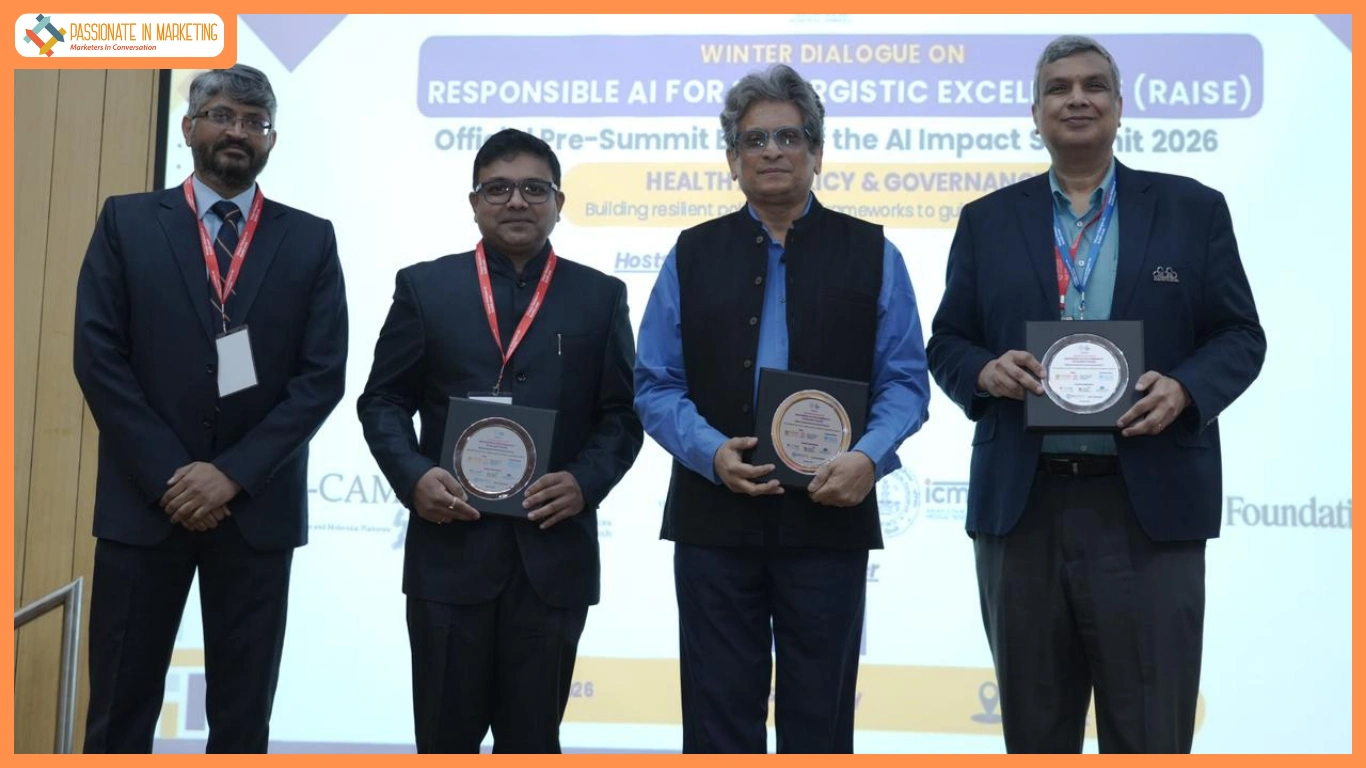
New Delhi, January 9, 2026 – The Koita Centre for Digital Health at Ashoka University (KCDH- A), recently concluded the inaugural Winter Dialogue on RAISE (Responsible AI for Synergistic Excellence in Healthcare) at the University campus. Co-hosted with NIMS Jaipur and convened with technical host WHO SEARO and partners, including ICMR-NIRDHS and the Gates Foundation, the dialogue served as an official Pre-Summit Event of the prestigious AI Impact Summit 2026. This marked the first of four RAISE dialogues scheduled across India in January 2026, with the inaugural edition focused on the theme: Health AI: Policy and Governance.
The two-day dialogue brought together leading experts, researchers, and practitioners to examine critical challenges in health AI deployment. The event benefited from the significant contribution of WHO SEARO (World Health Organization South-East Asia Regional Office), which organised five technical sessions throughout the event, bringing together international expertise and regional perspectives on responsible AI governance in healthcare systems.
The event featured eminent speakers, including Dr Karthik Adapa, Regional Adviser, Digital Health, WHO; Dr Mona Duggal, Director, ICMR – National Institute for Research in Digital Health and Data Sciences; Dr Annie Hartley, among others.
During his address, Dr Karthik Adapa, Regional Adviser, Digital Health, WHO, highlighted critical gaps in health system readiness for AI adoption, pointing to the persistent challenge of “pilotitis”—the inability to scale digital health solutions beyond initial pilots. He emphasised the need for frameworks like SALIENT, which guide AI integration from problem definition through large-scale trials.
In his opening remarks, Dr Anurag Agrawal, Head, KCDH-A and Dean of Trivedi School of Biosciences, Ashoka University, framed a central question for the field: ‘Would you choose a model with higher average accuracy, but poor performance for women, or one with lower accuracy that shows equity in outcomes?’ He emphasised on the need to reframe innovation through the lens of ‘AI for Health, not Healthcare for AI,’ stressing that responsible advancement in AI sciences must prioritise equity, real-world impact, and human outcomes over purely technical optimisation.
Dr Sanjay Pattanshetty, Director, NIMS Institute of Public Health and Governance, Jaipur, further highlighted the importance of translating academic evidence into actionable insights through collaborative platforms like RAISE.
‘The promise of responsible AI is realised when evidence moves beyond the lab. Universities must lead in translating research into societal, ethical, and policy outcomes that guide AI for the
common good,’ said Dr Sanjay Pattanshetty, Professor and Director, NIMS Institute of Public Health and Governance, Jaipur.
Discussions spanned the entire AI lifecycle: from model development and validation to real-world deployment challenges. Panelists deliberated infrastructure constraints, data quality limitations, regulatory gaps, gender bias in AI systems, and the critical balance between innovation speed and patient safety. The dialogue was further enriched by case studies highlighting real-world deployments ranging from tuberculosis screening and cancer detection to maternal health monitoring systems implemented across multiple Indian states.
A dedicated panel on mental health highlighted unique challenges in applying AI to psychological care. Dr Prabha Chand, Professor of Psychiatry, NIMHANS noted that large language models are ‘optimised for engagement, not clinical outcomes,’ while Dr Smruti Joshi, Chief of Clinical Services & Ops, Member Board of Directors, Wysa, emphasised that ‘mental health judgment cannot be fully automated.’ Panelists including Punita Mittal, Co-Founder, SoulUp, Dr Nand Kumar, Professor Centre for Advanced Research & Excellence in Neuromodulation Mental health. Psychiatry at AIIMS New Delhi, and Dr. Anant Bhan, Project Lead, Sangath, explored how AI can support lay counselors and community health workers while maintaining transparency, ensuring bots identify themselves rather than mimic human interaction.
The evaluation and validation panel brought together perspectives on continuous monitoring and bias mitigation. Dr Mary-Anne Hartley presented MOOVE India’s framework for clinically validated AI adapted to Indian settings, emphasising that imperfect data equals imperfect models. Contributors including Anubhav Arora, Dr Subhashish Banerjee (Head of the Department & Professor of Computer Science, Ashoka University), Dr Gokul Krishnan (CeRAI, IIT Madras) and Dr Kshitij Jadhav (IIT Bombay) addressed post-deployment monitoring challenges and the need for prospective human-in-the-loop approaches.
Reflecting on the broader ethical and operational challenges discussed during the event, Dr Anurag Agrawal, Head, Koita Centre for Digital Health and Dean, Trivedi School of Biosciences, Ashoka University said ‘The real test of health AI is not peak accuracy in controlled settings, but equitable performance in the real world. If AI systems work well on average but fail women or marginalised populations, we have failed the purpose. We must design AI for health— not bend healthcare to fit AI.’
Over two days of in-depth and impactful discussions, speakers underscored the critical need for stakeholder alignment to enable the responsible scaling of AI in health systems; the importance of embedding equity and inclusivity into AI design from the outset; and the necessity of treating explainability as a clinical requirement rather than merely a technical feature. Participants also stressed that robust accountability frameworks must precede large-scale deployment.
Somak Raychaudhury, Vice-Chancellor, Ashoka University Delhi NCR said, ‘Responsible AI in health cannot be built in silos. It demands deep collaboration across science, policy, ethics, and society. Universities have a crucial role to play—not only in advancing research, but in creating the intellectual and institutional infrastructure needed to ensure that AI serves public good, equity, and trust at scale. Initiatives such as RAISE are vital in surfacing both the challenges and opportunities in healthcare, and in shaping how AI can be meaningfully integrated into health systems to deliver real-world impact.’
Dr Aradhita Baral, Deputy Director, KCDH-A, who opened the conference, emphasised that “this is a platform for sustained dialogue rather than isolated conversations, bringing together leaders from health, science, technology, policy, diplomacy, and industry to build a shared understanding of how AI can be deployed responsibly to advance health and public benefit.”
The RAISE initiative extends beyond Ashoka University, with subsequent sessions planned at IIT Delhi (hosted by NIMS University, Jaipur), CCAMP and NCBS in Bengaluru, and IIIT Hyderabad. These events will bring together diverse stakeholders across different regional contexts, focusing on complementary themes including global health diplomacy in AI, AI applications in health and biology, and the intersection of healthtech and AI creating a comprehensive national dialogue on responsible AI frameworks for healthcare.

