


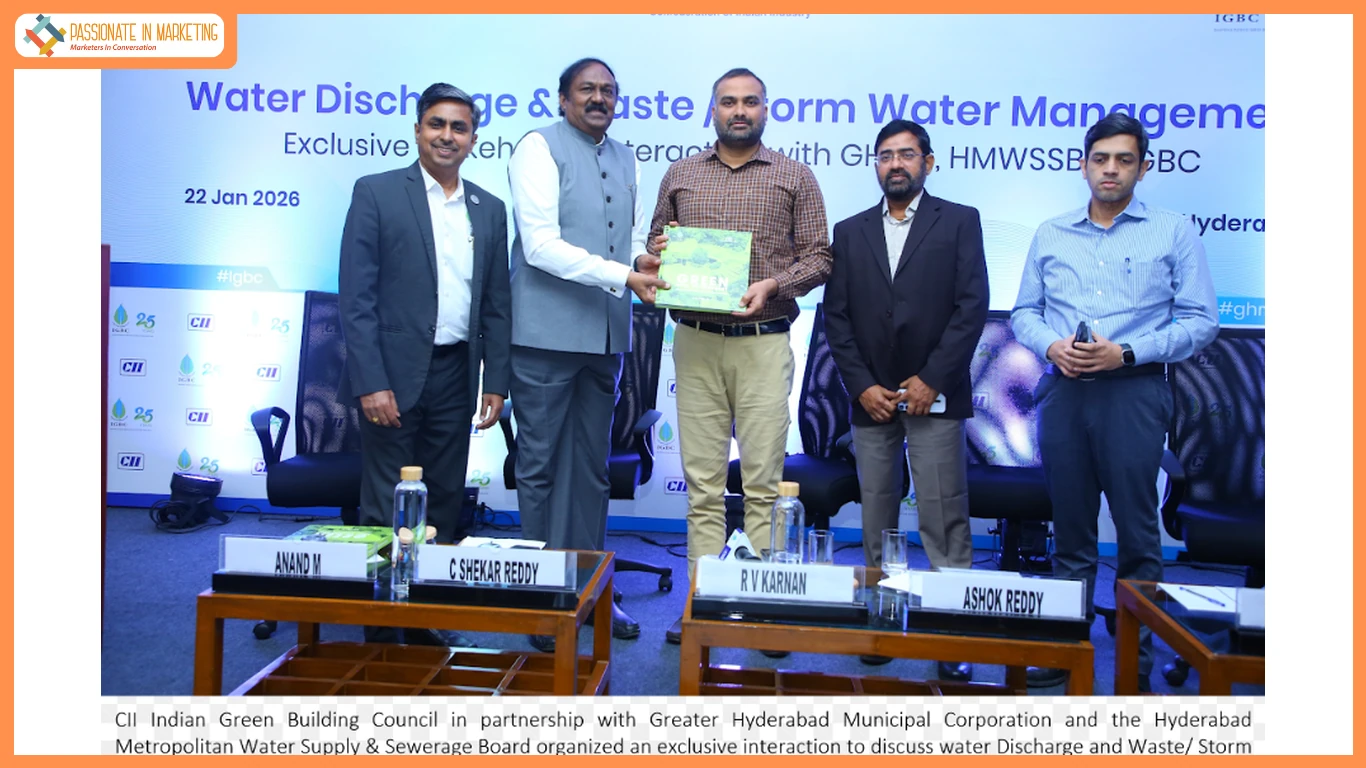
Hyderabad, 22 January 2026 — The Indian Green Building Council (IGBC), in collaboration with the Greater Hyderabad Municipal Corporation (GHMC), organized a high-level stakeholder consultation on “Water Discharge & Waste/Stormwater Management” at the IGBC Headquarters in Hyderabad. The consultation brought together senior government officials, urban infrastructure experts, developers, industry associations, consultants, and key stakeholders from the city’s built environment and water management ecosystem.
The session benefited from the direct participation of Shri R. V. Karnan, IAS, Commissioner, Greater Hyderabad Municipal Corporation (GHMC), and Shri Ashok Reddy, IAS, Managing Director, Hyderabad Metropolitan Water Supply & Sewerage Board (HMWSSB). Their presence enabled focused, solution-oriented discussions between policymakers, implementing agencies, and industry practitioners, reinforcing the forum’s role as an effective platform for collaborative learning and problem-solving.
Addressing the meet, Shri R. V. Karnan, IAS, Commissioner, GHMC, said, “At GHMC, we are addressing critical challenges of stormwater management and sewerage, alongside water supply, with a focus on mitigating urban flooding. We are mapping how water enters, flows through, and exits our city, for a holistic approach to managing waste/storm water, sewerage, and clean water, and enhancing stormwater drains and nala development. Another aspect of our focus is the unpredictable weather patterns demanding real-time forecasting data. As the centralized systems cannot handle the challenge alone, they must be augmented with distributed source-level water management. With decentralized water systems as our strongest defense, we are empowering RWAs as vital buffers. Livability must be the key goal for Hyderabad, and climate change, resulting in intense weather events, is adding to the stress of urban infrastructure. Along with government bodies, partnerships with industry, RWAs, and private players are required for prioritizing pollution reduction at source, decentralised retention & reuse, Source-level water management, and reuse before discharge. Looking to the future, we aim for a flood-resilient, water-smart Hyderabad, where every citizen thrives through an integrated and sustainable urban planning.“
The consultation was convened to strengthen Hyderabad’s urban water infrastructure and advance policy and implementation frameworks in alignment with the Government of Telangana’s vision for sustainable, resilient, and climate-responsive urban development. In the context of rapid urbanization, climate variability, and increasingly frequent extreme rainfall events, the session addressed both immediate operational challenges and long-term systemic solutions in stormwater management and wastewater discharge.
Shri Ashok Reddy, IAS, Managing Director, Hyderabad Metropolitan Water Supply & Sewerage Board (HMWSSB), while addressing the meet, emphasized, “The Hyderabad Metropolitan Water Supply and Sewerage Board stands fully geared to meet the water needs of Hyderabad City and our newly defined Core Urban Area spanning around 2,000 sq kms. Beyond building capacity to treat and supply water, the Government is actively rejuvenating the Musi River, vital for sustainable water management, and augmenting sources to future-proof our growing city. We’re exploring innovative ways to draw from Osman Sagar and Himayat Sagar, now linked to the Godavari River. Addressing challenges related to depleting groundwater and drying borewells, we are standardising rainwater harvesting pits for developers, operating 43 STPs across the city, and enabling data centres to utilize grey water for O&M efficiency. Looking ahead, we envision a water-secure Hyderabad by 2030, blending technology, community participation, and resilient infrastructure to support a healthier and greener future for our metropolis.“
Deliberations covered a comprehensive range of topics, including integrated stormwater management strategies, effective wastewater discharge systems, compliance of urban infrastructure with regulatory and environmental standards, and the adoption of green and nature-based solutions to enhance urban flood resilience. Stakeholders also examined on-ground implementation challenges, inter-agency coordination mechanisms, and the role of developers, industry bodies, and citizens in advancing sustainable urban water management.
Mr Anurag Jayanti, IAS, Additional Commissioner, GHMC, underscored “the urgent need for climate-resilient stormwater governance in Hyderabad in the context of intensifying monsoon events and rapid urbanisation. He emphasised the importance of decentralised water retention across campuses, neighbourhoods, and open spaces, supported by data-driven planning, long-term infrastructure visioning, and multi-stakeholder collaboration involving government, industry, and communities.”
Mr. C. Shekar Reddy, National Vice Chairman, CII Indian Green Building Council (IGBC), stated, “Urban water management has emerged as one of the most critical challenges facing India’s rapidly expanding cities, driven by climate variability, population growth, and rising infrastructure demands. Through this stakeholder consultation, the Indian Green Building Council, partnering with GHMC, has created an outcome-oriented dialogue platform bringing together policymakers, urban local bodies, technical experts, and industry professionals to collectively explore practical and highly impactful solutions.
Our focus is on approaches that are technically robust, scalable, and economically viable, while integrating seamlessly with existing urban systems. Significantly, these discussions are aligned with India’s broader objectives on climate resilience, water security, and resource efficiency, ensuring that policy intent translates into measurable, on-ground impact. Such collaborative platforms are vital to harmonising regulatory frameworks with implementation realities and supporting Hyderabad’s transition toward resilient, water-positive urban development.”
The consultation featured technical presentations and an open forum, enabling stakeholders to exchange insights, best practices, and recommendations to strengthen Hyderabad’s urban water infrastructure. Inputs gathered during the session are expected to inform future policy development, enhance inter-agency coordination, and support the integration of sustainable design and planning practices across both new and existing developments.
Ar. Srinivasa Murthy G, Chairperson, IGBC Hyderabad Chapter, commented, “Hyderabad stands at a critical juncture in its urban development, where infrastructure planning must proactively address climate risks while supporting continued economic and demographic growth. The city’s approach to stormwater and wastewater management will fundamentally determine its resilience, flood-risk reduction, and long-term livability. As urban densities intensify, embedding water-sensitive design and resource-efficient systems into buildings and city infrastructure becomes a strategic necessity, extending well beyond environmental considerations alone. The IGBC Hyderabad Chapter remains committed to collaborating with GHMC, HMWSSB, and the broader stakeholder ecosystem to mainstream green and net-zero principles in urban development. By aligning policy frameworks with practical implementation and promoting proven, scalable solutions, Hyderabad can position itself as a national benchmark for water-secure, climate-resilient, and people-centric urban development.”
This stakeholder engagement forms part of IGBC’s nationwide efforts to collaborate with urban local bodies and state governments in advancing sustainable infrastructure development, resource efficiency, and climate-responsive urban planning. Through structured dialogues, capacity-building programs, and on-ground technical support, IGBC continues to serve as a catalyst in bridging policy intent and industry with effective implementation.

