


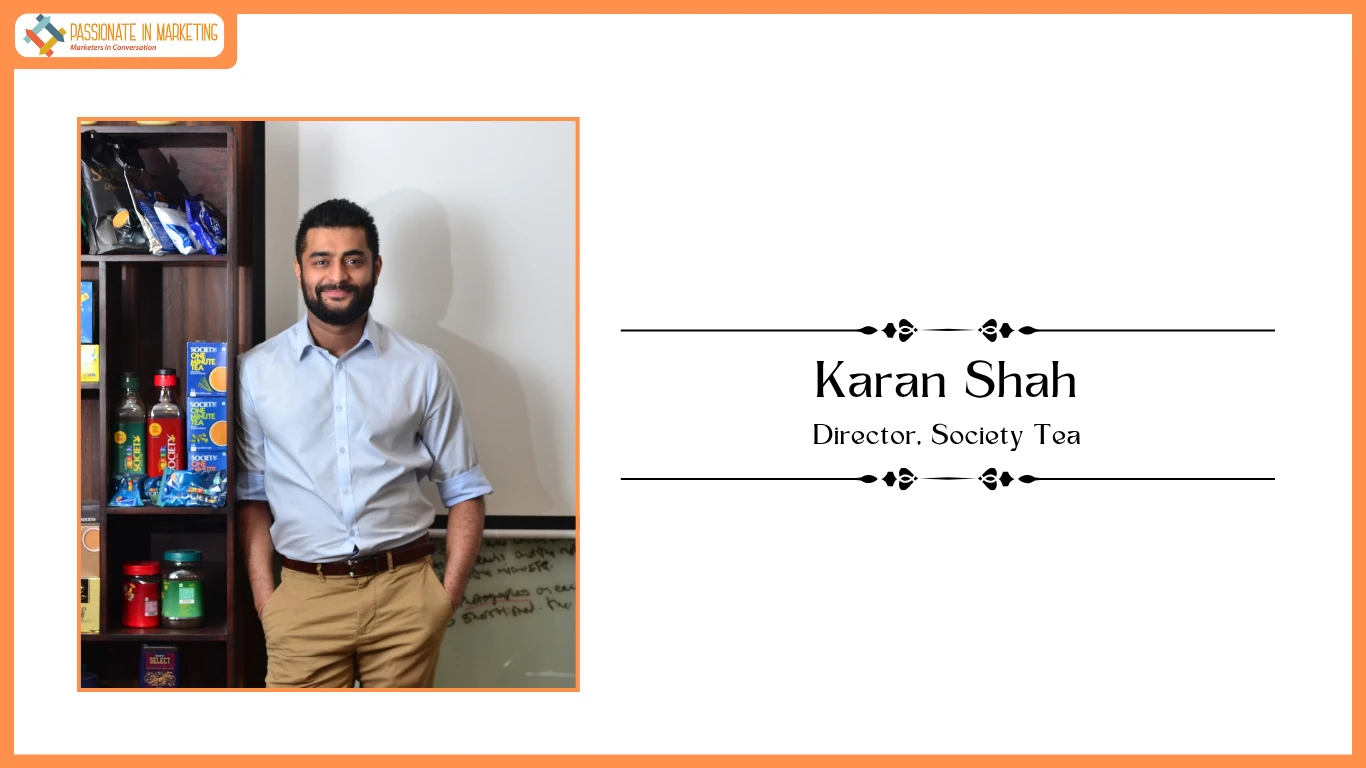
Q1. Modernising a legacy brand as the fourth generation
Society Tea has been a part of India’s tea culture for decades. As the fourth generation of the family business, how do you approach the challenge of modernising a legacy brand while preserving the values that built it?
I’d gently push back on the word challenge. Holding on to the values is the easy part, because they are not abstract — they sit in a room. Three of us in the family are tea testers. We taste every day. If a blend isn’t right, it doesn’t leave the factory, and nobody needs a meeting to agree on that. That has not changed since my father’s time and I don’t intend to change it.
What changes is everything around the cup. Where someone buys their tea, what time of day they drink it, what they reach for when it’s 38 degrees outside, how much patience they have for boiling milk on a Tuesday morning. Those things have moved a lot in the last five years, and a brand that doesn’t move with them quietly becomes a brand people’s parents buy.
So the way I think about it is: the core chai franchise is not the thing we modernise. It is the thing we protect. It is still our largest category by a distance and it funds everything else we try. What we modernise is the number of doors into the brand — an iced tea in a chiller, a premix at a QSR counter, a pack that arrives in ten minutes because someone ran out at 7 a.m.
My father did something similar when he chose blue for the pack. Every bit of category logic said red or green. He went with blue because it said something about security and steadiness. That wasn’t nostalgia, it was a commercial bet on what the brand should feel like. Our job in this generation is to keep making bets of that kind — in formats and channels rather than colour.
Q2. What is actually shifting in tea consumption
The Indian tea consumer is changing, particularly among younger audiences. What are the biggest shifts you are seeing in how, when and why consumers consume tea today?
The morning cup is the most stable thing in Indian consumption. I don’t lose sleep over it. What has genuinely changed is the rest of the day.
The 4 p.m. cup is now contested in a way it wasn’t ten years ago. That slot is being fought over by cold coffee, energy drinks, flavoured sodas and whatever a delivery app is discounting that week. So when I look at competition, I’m not only looking at other tea brands. I’m looking at the whole beverage set for that occasion, and asking why someone in Pune at 4 p.m. in May would pick a hot cup over something chilled. Often the honest answer is that they wouldn’t — and that is exactly why we are bullish on iced tea. It lets us be present in a moment where a kettle was never going to win.
The second shift is time. Households are smaller, more people are cooking for one, and the ritual of standing over a pan for six minutes is not universally romantic anymore. That is the instant and premix business. We already have a strong position there and we built our own dairy capability partly because a premix is only as good as the milk solids in it.
Third, people read the back of the pack now. That started around the lockdown and it hasn’t reversed. It has been good for us — we are a 100 percent Assam tea brand, we run an untouched-by-hand process, and those are things we can say plainly rather than dress up.
What I’d resist is the idea that the traditional consumer is disappearing. They are not. They are simply also the person ordering an iced tea at 4 p.m. Same consumer, more occasions.
Q3. Relevance to younger consumers without losing the trust
How do you make a heritage brand like Society Tea relevant to younger consumers without losing the familiarity, trust and nostalgia associated with the brand?
The trap is cosmetic youth. Change the typeface, put out a meme, talk about hustle culture — and you end up with a brand that is no longer reassuring to the people who buy it and still not credible to the people who don’t. We have been careful not to do that.
My working rule is that a 24-year-old should not have to inherit the brand from her mother to find it. She should be able to meet it on her own terms — an iced tea in a chiller at a college canteen, a premix at a QSR counter, a pack that shows up on a delivery app at eleven at night. Those are first meetings that have nothing to do with nostalgia, and they are the ones we are investing behind.
What stays constant across all of them is the blue and the quality behind it. We haven’t launched a separate youth brand to chase this, and I don’t plan to. The moment you do that, you’re admitting your main brand can’t hold the consumer, and you also split your quality attention across two things. Everything new sits under Society, held to the same tasting standard.
Where we do flex is language and place. Our Marathi work has been quite specific and quite regional, down to physical cutouts in smaller Maharashtra towns rather than only a film on a feed. Younger consumers in Kolhapur or Nashik respond to being spoken to in their own idiom, not a national one translated downwards.
So — new formats, new channels, same name, same standard. Nostalgia is a lovely thing to have but it is not a strategy. Availability in the right moment is.
Q4. Regional depth versus national ambition
Regional consumer preferences have always played an important role in the tea category. As Society Tea looks to expand beyond its traditional markets, how are you balancing regional relevance with the ambition to build a stronger national brand?
Tea is the most regional category in the Indian pantry. The strength of the liquor, the colour, how much milk, whether elaichi is welcome — all of it changes within a few hundred kilometres. Kolhapur does not want what Mumbai wants, and Kolhapur is proud of that. Anyone who tries to run a single blend and a single film across India in this category will lose money learning why.
So we don’t plan nationally and then localise. We go market by market. Before we enter, we want to understand what the consumer there is already drinking and what they’d consider an improvement on it. That is slow, and it is the right kind of slow.
Mumbai is our strongest market and we are the market leaders there. Pune and Bengaluru contribute meaningfully. We’re now present in over 35 Tier I cities and in more than 100 cities through online and quick commerce. Metros are the near-term priority, along with a fairly aggressive push on the QSR side, where a good premix can put us in front of thousands of consumers a day without us owning a single outlet.
The real risk in this phase isn’t that a market rejects us. It’s that we spread ourselves across too many at once and lose execution intensity everywhere. I’d rather be genuinely strong in eight cities than notionally present in eighty.
What has to stay identical everywhere is the product experience. A consumer who buys us in Chennai on the strength of what a cousin in Mumbai told her should get exactly the same cup. That is why the manufacturing discipline matters more as we widen, not less.
Q5. Quick commerce, e-commerce and digital-first discovery
Quick commerce, e-commerce and digital-first discovery have changed the way consumers buy FMCG products. How are these channels influencing Society Tea’s growth and distribution strategy?
The thing most people get wrong about quick commerce is treating it as another shelf. It isn’t. It is a discovery medium that happens to deliver.
In a kirana store, the retailer decides what a consumer sees, and we have spent decades earning that placement. It is still the heart of the business and it isn’t going anywhere. But on an app, a consumer in a city where we have no history at all types iced tea into a search bar and we are in front of her, next to every other option, judged on the pack and the price and nothing else. No relationship required. That is a completely different entry cost into a new market, and it is the single biggest reason we can say we are present in over 100 cities today.
The second thing it changes is impulse. The gap between wanting tea and having tea used to be a trip downstairs. Now it’s ten minutes. That compresses the decision, and compressed decisions favour recognisable packs and small formats. So our pack architecture has to answer that — trial sizes, single-serve premixes, something priced for a person who is topping up rather than stocking up. A one-kilo pack is a monthly decision. A premix sachet is a Tuesday-evening decision. We need both.
The third thing, and I think the most underrated, is that these platforms are the cheapest consumer research we have ever had. We can see what sells, at what hour, in which pincode, and how fast a new variant moves before we commit to a full launch. That used to take a year and a research agency.
The discipline we hold ourselves to is not buying volume there. Discount-led growth on quick commerce is rented — it stops the day you stop paying. We’d rather grow slower on that channel with the right assortment than look big for a quarter.
Q6. Digital, content and how we talk to the next generation
How important is digital marketing in reaching the next generation of tea consumers, and how has it changed the way Society Tea communicates with its audience?
Our view has always been that if the product is good, it is the best salesman you have. I still hold to that, but digital has changed what it means in practice.
What digital gives a brand like ours is the ability to be in a conversation rather than to announce something at people. Our best work has come from that instinct. The Tea Society Called India was about tea as the one thing that holds a fairly disagreeable country together. Our Marathi films have been about a bond between a customer and a brand over thirty years, told as a story rather than a product pitch. Sounds of Society was about music, not tea. None of those start with the pack.
On influencers, I am probably more conservative than most of my peers. We don’t run an always-on agency roster. We pick individuals, one at a time, usually people with a real following in a specific region — the Marathi entertainment world has been particularly good for us — and we work with them directly. It’s slower and it doesn’t scale neatly, but it means every partnership is one I could defend in a room. A hundred creators saying the same line about chai is noise. One person whose audience actually believes them is worth more.
The other change is that digital is now a listening tool as much as a broadcast one. Comments on a launch post tell us about a flavour in about a week. That feedback loop is genuinely new.
What I’d caution against is confusing engagement with business. A film can do very well and sell nothing. We try to hold both numbers in view.
Q7. Where the real innovation opportunity sits
The tea category is seeing greater experimentation around premium blends, convenience formats and newer consumption occasions. Where do you see the biggest opportunities for innovation?
I’d separate innovation into two kinds, because they’re funded differently and judged differently.
The first is occasion innovation, and that’s where the money is. Iced tea is the clearest example — it isn’t a new flavour, it’s a new hour of the day and a new season. Summer used to be our weakest quarter by the nature of the product. It doesn’t have to be. Instant and premix is the same logic applied to time-poverty rather than temperature, and it’s a category where we already have real depth and our own dairy capability behind the milk solids. Then there’s the out-of-home occasion, which is why we’re pushing hard on QSR. A premix behind a counter reaches a consumer we will never meet in a grocery aisle.
The second is adjacency, and here I’m more careful. We are in coffee, in dairy — ghee, whitener, milk powder — and in pickles and chutneys. Those came from a simple observation: we already have the manufacturing standard, the distribution and the trust, so the marginal cost of doing a good job in an adjacent pantry category is lower for us than for a new entrant. Some of those recipes are family ones. But adjacency is also where brands lose focus, so the test I apply is blunt — can we make it demonstrably better than what’s on the shelf, and does it earn its place in the same trucks and the same stores?
Wellness is the one I get asked about most and where I want to be honest: there is a lot of noise in that space and not much rigour. Green tea, tulsi, ginger blends — we do them, they sell. But I’m not going to put a functional claim on a pack that I can’t stand behind in a tasting room. Tea is already a reasonably good thing to drink. It doesn’t need to be sold as medicine.
Our facilities were built to be adaptable across premixes, instant, iced tea and formats we haven’t launched yet. That’s the real enabler. Innovation isn’t ideas; it’s whether you can make the idea at consistent quality, at scale, and put it in front of someone next month.
Q8. Competing against much larger players
For a legacy FMCG brand competing against much larger national and global players, what do you believe is Society Tea’s biggest competitive advantage?
Let me start with what it isn’t. It isn’t spend. We will never outspend the largest players in this category on media, and building a strategy that assumes we might would be foolish.
The first real advantage is that the people who decide what goes in the pack are the people whose name is on it. Three of us in the family taste. There is no committee between a bad batch and the decision to reject it. In a commodity-derived business where the raw material changes every season, that shortens the distance between a quality problem and a quality fix to about a day. Most organisations our competitors’ size cannot do that, and it shows up in the cup over years rather than quarters.
The second is speed on the small decisions. A family business can approve a pack change, a regional film, a new SKU for one channel, in a conversation. The trick — and this is the actual work of my generation — is to add professional systems for the things that need them without killing that agility. Getting that balance wrong in either direction is how legacy businesses die: either you stay intuitive and can’t scale, or you systematise everything and become slow without becoming big.
The third is depth over breadth in the markets we’ve earned. Being genuinely number one in Mumbai is worth more than being a minor presence in fifteen states. It gives us a profit base to fund experiments elsewhere and it means a consumer in a new market is being offered something with a real track record, not a launch.
And there’s the product story itself, which we can state plainly: 100 percent Assam, blended in our own facilities, an untouched-by-hand process from raw material to pack. My family drinks this tea. That is not a marketing line, it’s just the standard.
Q9. Scaling deeper into India and abroad
As you look at taking Society Tea deeper across India and into international markets, what are the biggest opportunities and challenges in scaling an established regional brand?
Internationally our philosophy is simple and slightly unfashionable: wherever there is an Indian consumer, we want Society Tea to be available. We’re already in the Middle East and in parts of the United States, and we work with Indian distributors in markets with a meaningful diaspora. Select European markets are next on the list.
That approach has an obvious ceiling and I’m aware of it. Selling to Indians abroad is not the same as cracking a local British or German tea drinker, and we haven’t pretended otherwise. But it’s a real business, it’s profitable, and it teaches us how to run a supply chain at distance before we attempt anything harder. I’d rather earn the right to the second thing by doing the first properly.
Domestically the opportunity is that the barriers which used to make national expansion expensive have partly dissolved. You no longer need a distributor in every town to be findable in it. Quick commerce and e-commerce have let us into over 100 cities without the capital that would have taken a decade ago.
The challenges are three. First, taste differs market to market, so this is not a copy-paste exercise. Second, consistency — a consumer in a new market has no reason to forgive us a bad pack, and the shelf life of a first impression is one cup. Third, and most real: spreading too thin. Attention is the scarcest resource in a business our size. Every new market we open takes management bandwidth away from a market we already win in. The discipline is in saying no often enough that the yeses get looked after properly.
Q10. What defines the next phase
Looking ahead, what will define the next phase of Society Tea’s growth: younger consumers, new products, digital commerce, national expansion or international markets?
If I say all of them are connected, that’s a non-answer, so let me put them in order.
First, protect the core. Packaged tea is still our largest category and it pays for everything else. The day we get distracted enough to let quality or availability slip in Mumbai is the day the rest of the plan stops mattering. That’s not a growth line, it’s a floor, and it’s the one I watch most closely.
Second, occasions. Iced tea, instant and premix, and the out-of-home business through QSR. These are where incremental growth actually comes from over the next three years, because they add hours and seasons rather than fighting for the same morning cup someone is already drinking.
Third, channel. Quick commerce is the discovery engine that makes the second point work in cities where we have no history. It is how a brand from Masjid Bunder becomes findable in a flat in Hyderabad at nine at night. I’d expect its share of our business to keep rising, and I’d expect us to keep resisting the temptation to buy that growth with discounts.
Fourth, geography — metros first domestically, select European markets internationally, in that order and not simultaneously.
Younger consumers aren’t a separate item on that list. They are the reason for items two and three.
And underneath all of it, the boring part that doesn’t change: source well, blend well, taste it every day. My great-grandfather was solving an inconsistent cup in Mumbai’s tea shops in the 1920s. That’s still the job. The channels have simply got faster.

