


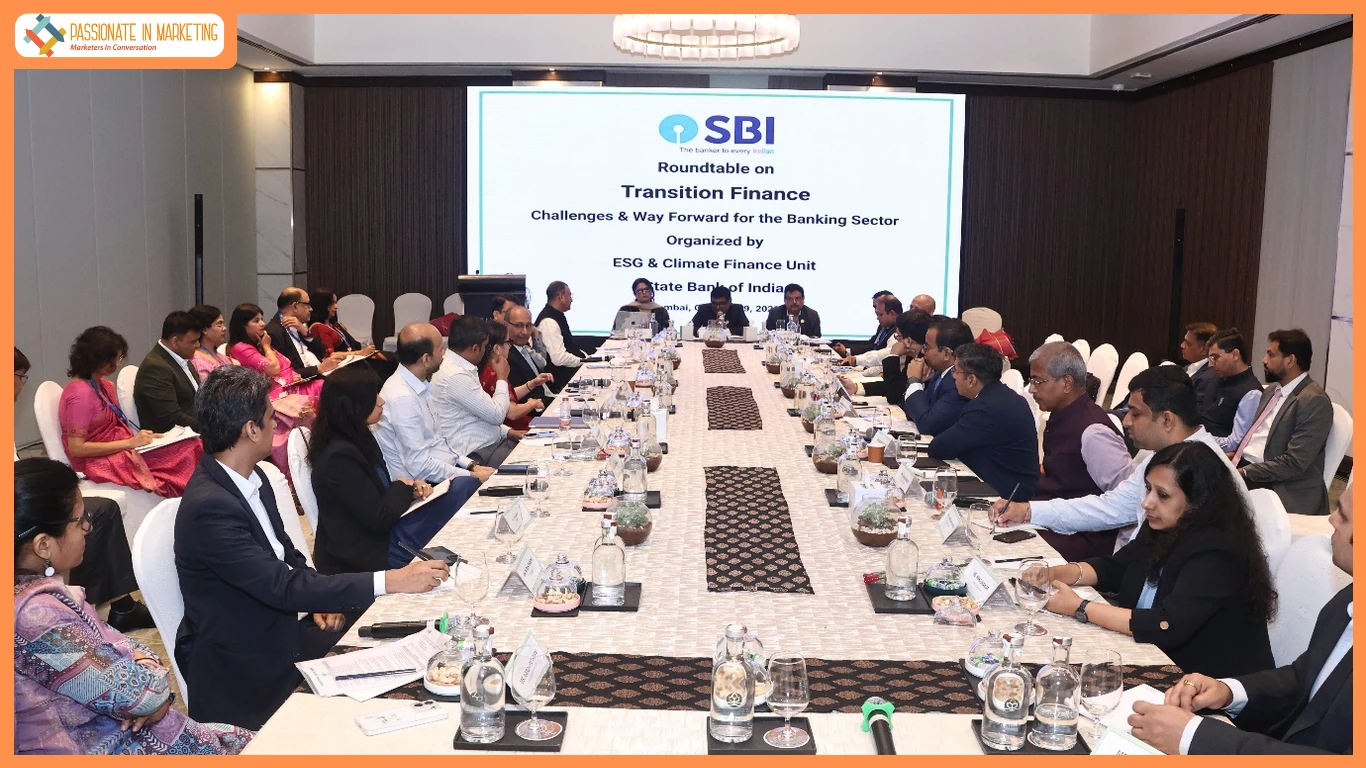
Mumbai, November 10, 2026: State Bank of India (SBI), through its ESG & Climate Finance Unit, organised a roundtable on “ Transition Finance – Challenges & Way Forward for the Banking Sector” on October 29, 2026, in Mumbai.
The round table was organised with the objective of fostering meaningful discussions on the evolving landscape of transition finance and its critical role in facilitating India’s journey towards a low carbon and climate resilient economy.
While addressing, Shri Ravi Ranjan , Managing Director (R,C & SARG) , SBI, said, “ Transition Finance bridges the gap between today’s carbon-heavy operations and tomorrow’s net-zero targets. It funds incremental technology retrofits, energy efficiency, alternative fuels (e.g., green hydrogen, biomass co-firing), and Carbon Capture, Utilization, and Storage (CCUS). Transition finance offers opportunities across the entire economic value chain, in energy and power, hard-to-abate industries, transport and logistics, buildings, agriculture and MSMEs. He insisted on developing a more diversified, resilient, and efficient financing ecosystem as substantial opportunities exist in rooftop solar, energy-efficient housing, solar-powered irrigation, efficient industrial machinery, resource conservation and distributed renewable energy”.
Shri Satyendra Kumar Singh, DMD & CCO and Chief Sustainability Officer, SBI said “India’s transition must be inclusive and Financing should support renewable energy, distributed solar, energy efficiency, electric mobility, and cleaner industrial processes, while expanding opportunities for MSMEs, farmers and emerging enterprises”.
The deliberations were moderated by Shri R Shailesh Unnithan CGM (ESG & CFU).The discussions primarily focussed on the opportunities and challenges in scaling up transition finance in the Banking Sector with clear roadmaps, particularly in supporting hard-to-abate sectors in their decarbonisation journey. Key Areas of deliberation include innovative financing mechanisms, evolving regulatory and policy frameworks, credible transition pathways, robust assessment and monitoring of transition related investments and challenges faced by the borrowers and Financial Institutions in adopting Transition Finance.
The roundtable underscored the importance of & need for collaborative efforts amongst the financial institutions, policymakers, industry stakeholders and other ecosystem participants to develop a credible and scalable transition finance framework. The event was attended by senior officials from the financial sector including the RBI,NABARD,SIDBI, Public & Private Banks and the Climate Bond Initiative.
The event reaffirmed SBI’s commitment to playing a proactive role in shaping India’s transition finance ecosystem and enabling the banking sector to contribute meaningfully towards the country’s long- term sustainability and net-zero aspirations.
About State Bank of India:
State Bank of India is the largest commercial Bank in terms of assets, deposits, branches, customers, and employees. It is the largest mortgage lenders in the country which has so far fulfilled the home buying dreams of over 30 lakh Indian families. The home loan portfolio of the Bank stood at ₹9.85 lakh crore mark as of September 30, 2026. The Bank has a deposit base of over ₹62.77 lakh crore with CASA ratio of 38.32% and advances of more than ₹52 lakh crore, as of September 30, 2026. Adjudged as the World’s Best Consumer Bank for two consecutive years – in 2025 & 2026, by Global Finance magazine, SBI commanded a market share of 28.1% and 18.7% in home loans and auto loans, respectively, at the end of FY26. SBI has the largest network of over 23,000 branches and 65,300 ATMs/ADWMs in India along with around 79,900 business correspondent outlets, as of September 30, 2026. The number of customers using internet banking stood at 12.8 crores, by the end of Q2 FY27 on September 30, 2026. With SBI’s digital strategy right on track, the Bank witnessed 29.2 lakh of new savings accounts being opened through the integrated digital and lifestyle platform YONO in the period between July 2026 to September 2026. YONO, which now has 11.1 crore registered users, also witnessed close to 60 lakhs New YONO registrations in Q2 FY27. In terms of digital lending, the Bank disbursed pre-approved personal loans worth ₹1,510 crores through YONO during July-September 2026. As on September 30, 2026, SBI has 28 million followers on Facebook, 5 million followers on Instagram, 4.7 million followers on X and 23.2 million subscribers on YouTube. State Bank of India is the most followed Bank globally on Facebook, Instagram & X.

