


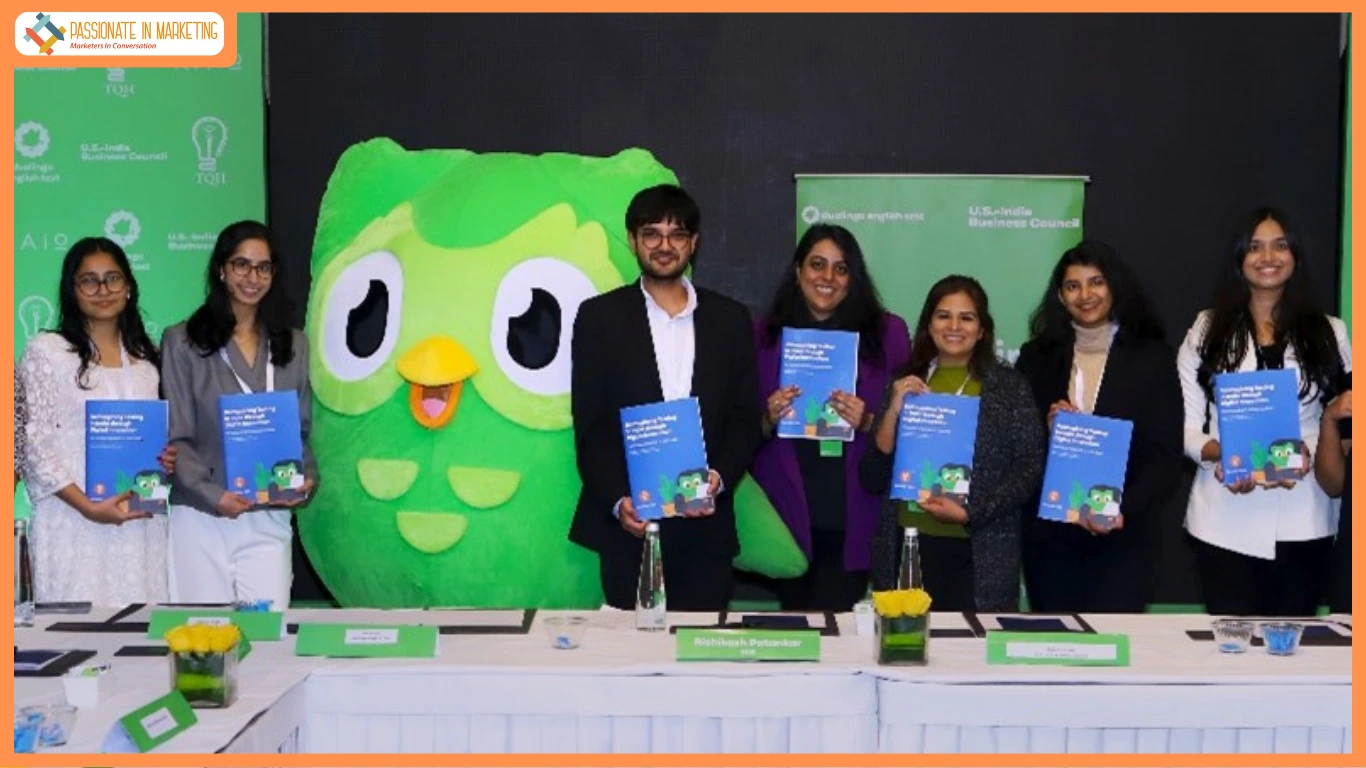
New Delhi, 10th December, 2025: The Duolingo English Test (DET), a global leader in digital-first English proficiency assessment trusted by over 3 million test-takers, and The Quantum Hub (TQH), a policy research and advocacy firm, today unveiled a white paper titled “Reimagining Testing in India through Digital Innovation.” This first-of-its-kind report presents a comprehensive analysis of India’s testing ecosystem for higher education, particularly English Proficiency Testing (EPT) and outlines how technology-enabled assessment models can transform opportunities for millions of Indian learners, aligned with India’s national education and skilling priorities.
India is experiencing an unprecedented surge in global education aspirations. More than 1.8 million Indian students are currently pursuing higher education overseas1 and over 330,000 Indian students were enrolled in U.S. institutions in 20242, making India the top sender of international students to the United States. English proficiency tests have therefore become critical gateways, not only for university admissions but also for visa processes and in many countries as qualifying criteria for work permits in high-demand sectors such as global healthcare, STEM and specialised professional fields.
Against this backdrop, the white paper underscores that India’s testing architecture must evolve to keep pace with its ambitions. The National Education Policy (NEP) 2020 calls for technology-led reform across teaching, learning and assessment, an agenda reinforced by national digital public infrastructures. As India moves toward the Viksit Bharat @ 2047 vision, secure and accessible testing systems will be fundamental to unlocking opportunity for its young population, 65% of whom are under the age of 353.
Yet traditional centre-based tests remain entrenched in barriers. Test centres are limited and disproportionately urban. Many aspirants from Tier-2 and Tier-3 towns still travel hundreds of kilometres, spending heavily on transport, accommodation and fees, costs that often decide access more than ability. These structural limitations make physical testing costly, vulnerable and exclusionary.

The white paper is a reflection of desk research and almost 30 interviews and highlights how tech-enabled, AI-driven assessments can address these gaps at scale. It examines the Duolingo English Test, which integrates AI-driven adaptive question design and secure remote delivery to measure real language ability. With the DET being a fully online, round-the-clock exam, test-takers don’t need appointments or visits to testing centres, and it costs only about a third of what traditional exams charge. India is already demonstrating a strong appetite for such solutions. Global recognition of the DET continues to expand with the test now accepted by over 6,000 programs worldwide, including undergraduate programs for all eight Ivy League universities, as well as other prominent universities like the University of Toronto, Imperial College London, the University of Western Australia, and Trinity College Dublin, among others.
Sidharth Deb, Associate Director at The Quantum Hub and coauthor of the report added: “Our research shows that technology-enabled assessments can meaningfully strengthen India’s testing ecosystem and remove long-standing barriers — improving accessibility, lowering costs and enhancing security. Models like the Duolingo English Test provide a compelling example of how next-generation testing can adapt to modern testing requirements and support India’s talent in seeking opportunities globally.”
Commenting on the whitepaper launch, Tara Kapur, India Market Lead, Duolingo English Test, said: “Barriers to international education are fundamentally barriers of equity. When a talented student must spend significant time and money just to reach a test centre, we’re not measuring their English, we’re measuring their access. India’s rapid adoption of DET shows that students are ready for secure, accessible alternatives aligned with NEP 2020’s vision.”
“As an admissions officer, I had never considered in 30 years how expensive and difficult it was for students to travel to get an English language test. With DET, you spend $70, sit at your own machine at any time of day or night, and send the result to any number of institutions at no extra cost. That’s visionary,” said Andrew Disbury, Chair, UK Advisory Group, Duolingo English test.
The full white paper is available at here.
With 30+ stakeholder interviews involving conversations with students, test developers, foreign universities, embassies and education consultants, the white paper delivers actionable recommendations for governments, institutions and policymakers.

