


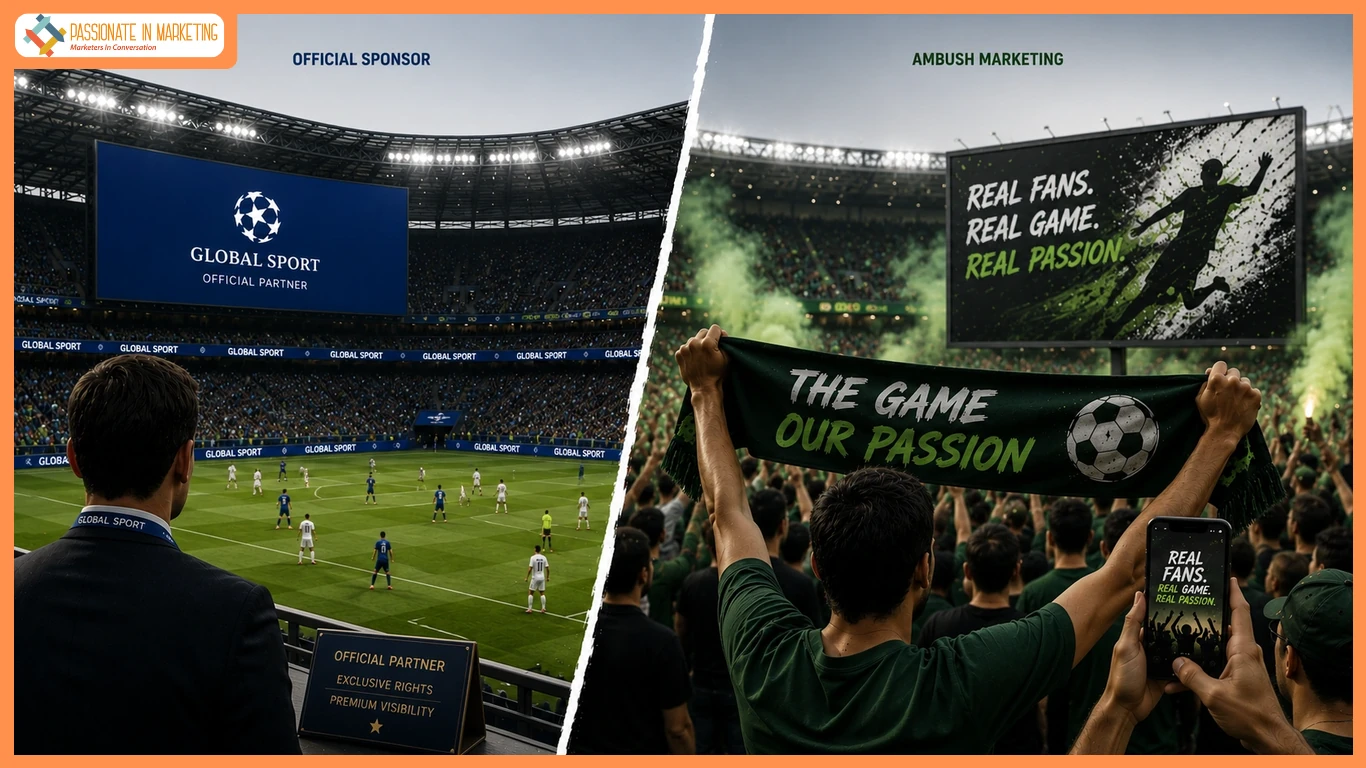
Major global events like the Olympics or the FIFA World Cup generate billions of data points in viewer engagement, making them incredibly valuable for advertisers. Official sponsors pay millions of dollars for the exclusive right to associate their brand with these events. However, not every company is willing, or able, to pay those premium fees. Instead, competing brands rely on the raw creativity of marketing and sharp data analytics to capture the audience’s attention without ever signing an official contract. In the advertising industry, this practice is known as ambush marketing.
To understand these evolving dynamics, MaxEd conducted a study drawing on Olympic and World Cup sponsorship data, digital advertising costs, search trends, and social media engagement across major global sporting events.
Stealing the Spotlight (Nike vs. Reebok, 1996)
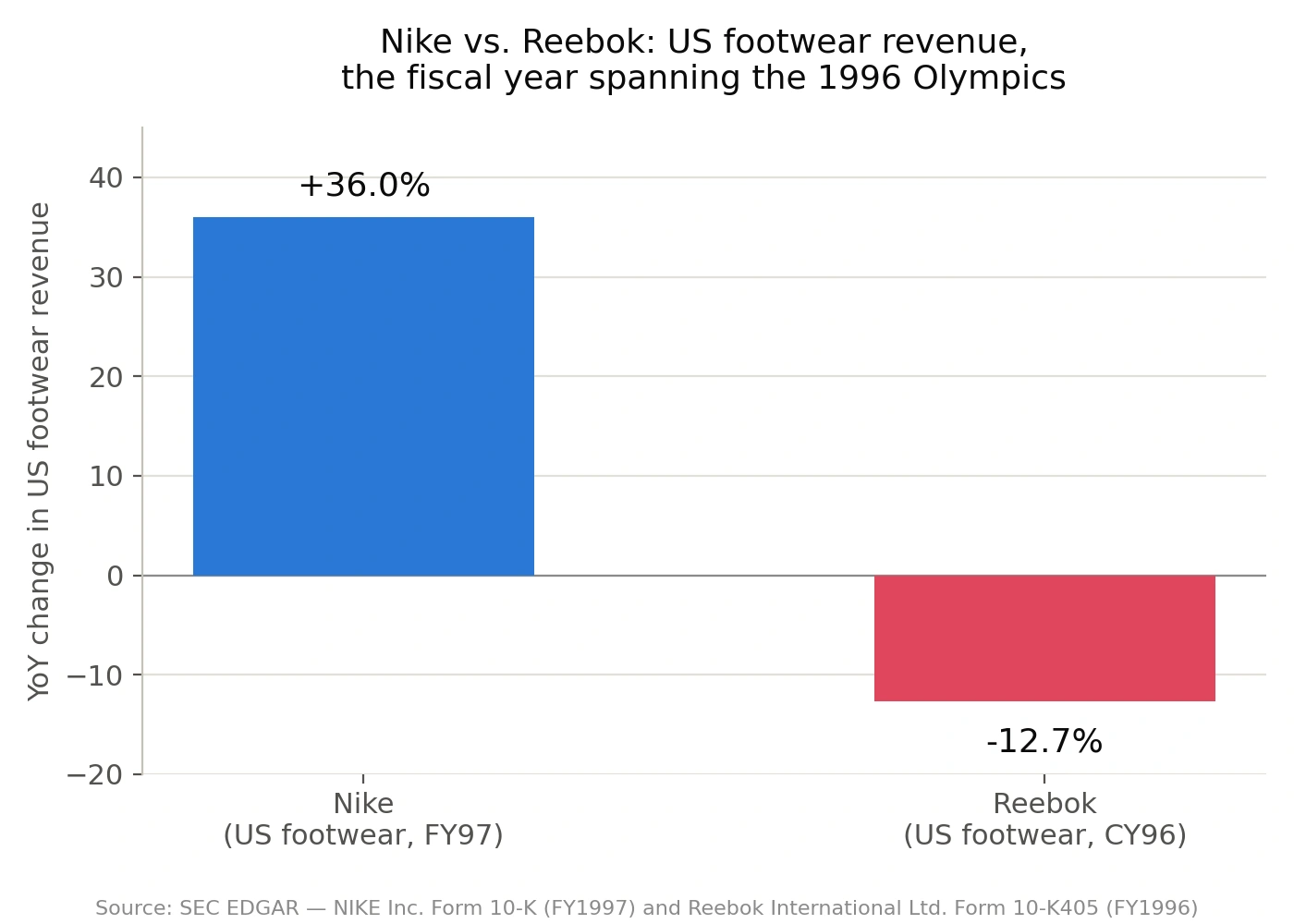
If you wanted to see a textbook example of creative marketing overriding a massive sponsorship budget, you needed to look no further than the 1996 Atlanta Olympics. Reebok paid a staggering $50 million to become the official footwear sponsor, expecting a significant return on investment through global brand visibility.
Nike did not purchase an official sponsorship. Instead, it relied on marketing creativity and effectively took over the city. The company covered Atlanta with billboards, built a massive Nike Center near the Olympic Village, and handed out branded flags to fans entering the stadiums. Nike understood something crucial: “Olympic Sponsor” was merely a legal designation in a contract, but to everyday people, the “Olympic Brand” was the brand they saw most often.
The results became evident the following year. Nike’s fiscal 1997 filings, covering the period of the Games, showed that U.S. footwear revenue increased by 36%, representing a $1 billion rise driven by higher sales volumes and improved pricing. In contrast, Reebok’s filings revealed that U.S. footwear sales declined from $1.367 billion to $1.193 billion over the same period. Despite paying $50 million for the official sponsorship, Reebok lost market share in its core category to a competitor that chose creative marketing over official sponsorship.
The Indian Masterclass (Pepsi vs. Coca-Cola, 1996)
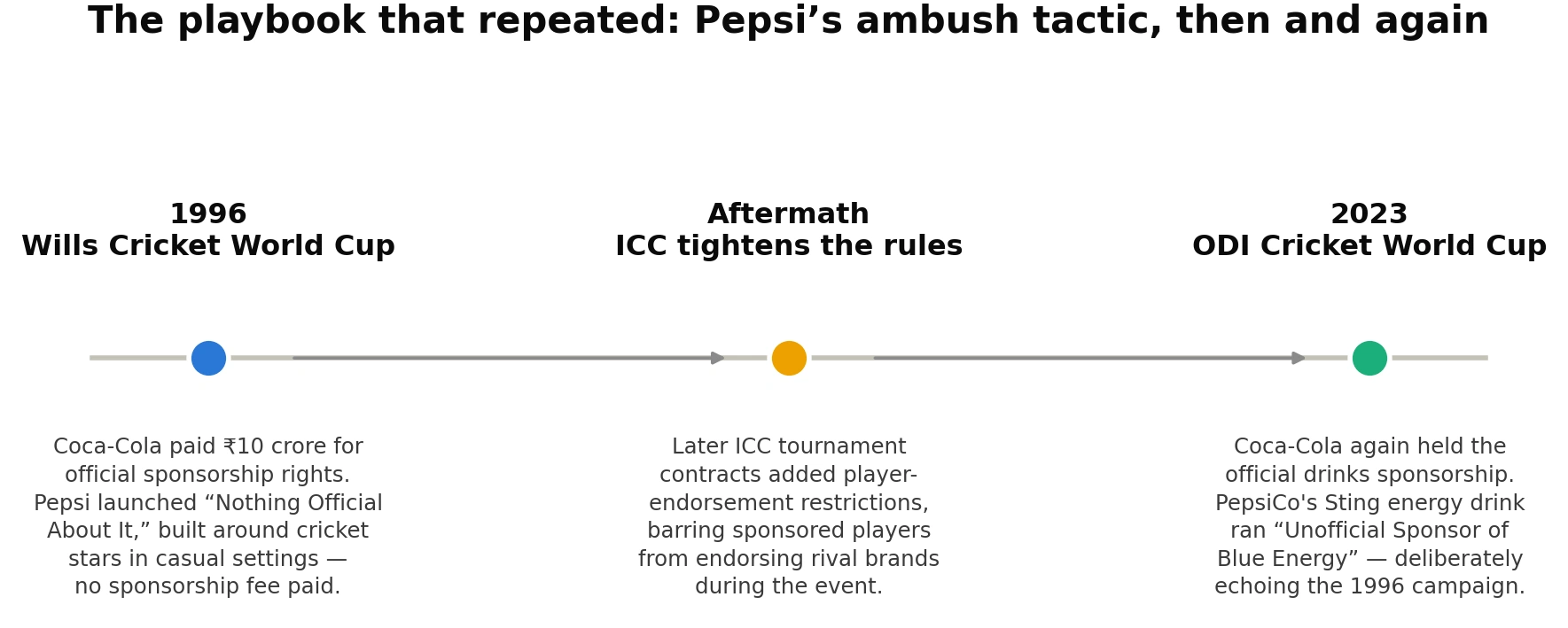
Bringing this strategy closer to home, the 1996 ICC Cricket World Cup provided a legendary example of marketing creativity. Coca-Cola paid millions to become the Official Drink, securing premium stadium branding and broadcast rights.
Shut out of the stadiums, Pepsi went rogue. It launched the now-iconic “Nothing Official About It” campaign, featuring some of the biggest cricket stars of the era in casual settings. Pepsi drew on deep consumer insights, recognizing that the youth of post-liberalization India viewed being “official” as boring and restrictive. By creatively mocking the very concept of official sponsorship, Pepsi positioned itself as the cool, rebellious alternative.
Pepsi’s gambit paid off in a way that outlasted the tournament itself. The campaign prompted regulators to rewrite sponsorship contracts, closing the very loophole Pepsi had exploited. Decades later, PepsiCo returned to the same strategy by promoting Sting during the same tournament, demonstrating the enduring influence of its original ambush marketing approach.
The Counterattack: Why Do Big Companies Still Sponsor?
After seeing how easily creative ambushers can steal the spotlight, it’s fair to ask: why do brands like Coca-Cola or Reebok keep paying official sponsorship fees, and why don’t event organizers simply shut ambush marketing down?
They tried. FIFA and the International Olympic Committee began requiring host cities to pass strict “clean zone” laws, making it illegal for non-sponsors to advertise anywhere near event venues.
But laws alone don’t explain why brands keep paying a premium for official status. The real answer is that sponsorship buys three things ambush marketing can’t: safety, scale, and global access.
An official sponsor locks in guaranteed TV exposure, VIP hospitality suites for closing deals, and the legal right to use event branding on products worldwide. Ambush marketing offers none of these guarantees, only exposure, and exposure comes at a price.
During UEFA Euro 2012, Danish striker Nicklas Bendtner celebrated a goal by revealing underwear branded with betting company Paddy Power, which was not an official tournament sponsor. UEFA responded by imposing a €100,000 fine and a one-match ban. That same year, at the London 2012 Olympics, UK legislation threatened non-sponsors with fines starting at £20,000 for using words as ordinary as “Games,” “2012,” or “London” in advertising.
The message was clear: physical ambush marketing had become a legal minefield. But as organizers built higher walls around their stadiums, ambushers realized they no longer needed to climb over them. They could go around, digitally, guided by real-time data instead of physical proximity.
The Data-Driven Perimeter: Geospatial Interception
The current evolution of data has started to open completely new windows for ambush marketing. Today, you do not need to rent physical billboards to pull off an ambush. You just need to leverage the massive amounts of geolocation data generated by people’s smartphones.
Using location tracking, often called geofencing, brands draw an invisible, virtual boundary around an event space, like a cricket stadium. When a fan walks into that area, their phone crosses the invisible line, triggering highly targeted ads. Instead of buying a million dollar stadium sign, a challenger brand combines spatial data with creative marketing to send an ad straight to your phone. It is a smart strategy designed for hyper-local dominance, essentially giving fans a “pincode privilege” or exclusive discount unlocked just because their data shows they are physically standing in that specific zip code.
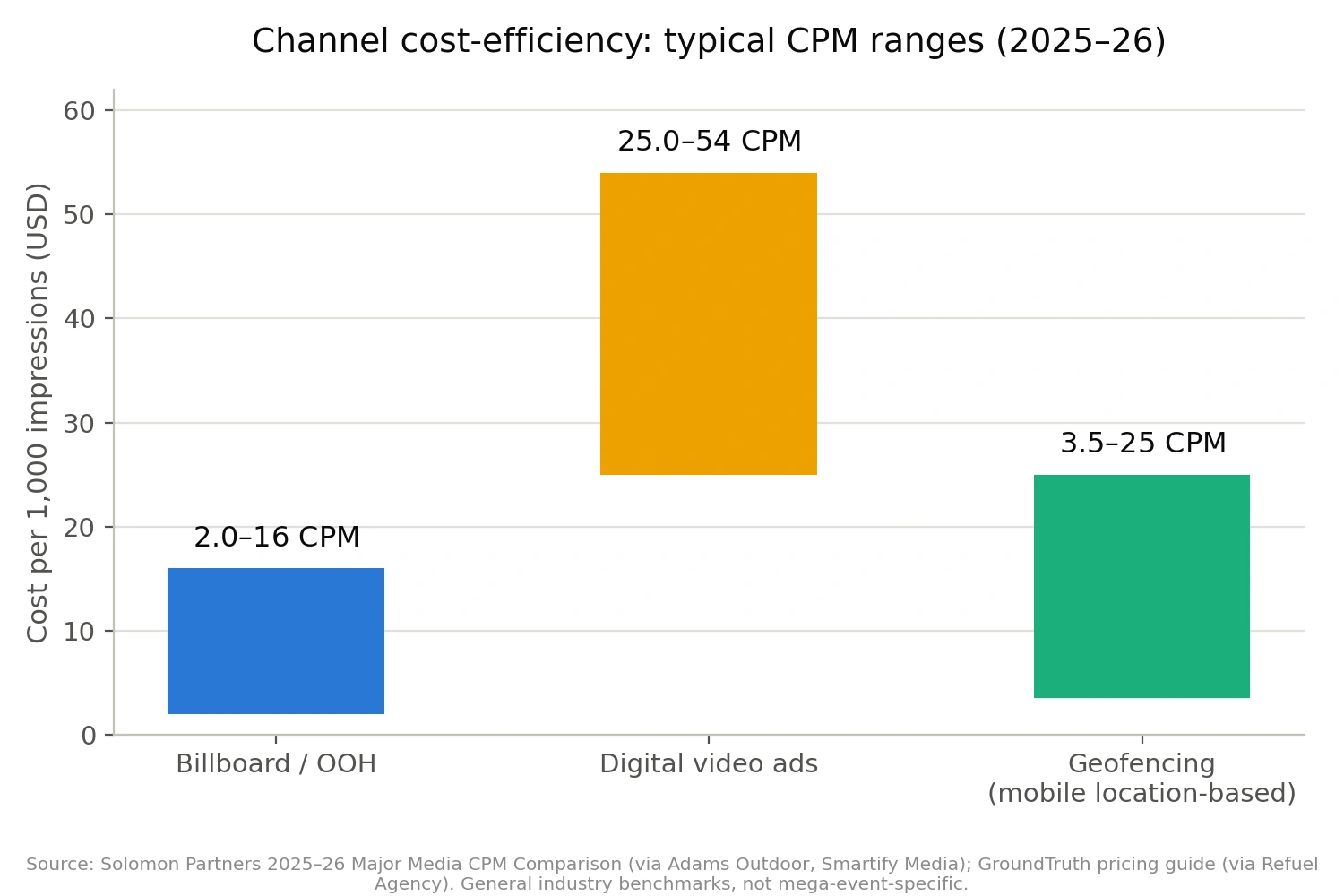
Ordinary advertising channels tell a very different story. Standard outdoor billboards run a modest $2 to $16 per thousand impressions, broad digital video sits considerably higher at $25 to $54, and geofencing splits the difference at $3.50 to $25. In fact, geofencing frequently outperforms broad digital while still reaching prospects standing in the exact zip code that matters. Ultimately, the efficiency lesson is not about which channel is cheap or expensive in the abstract. It is that precisely targeted reach always costs less than generic reach, wherever you choose to draw that line.
Sponsoring the “Wrong” Thing (The Parallel Property)
If location data tracking is a tech hack, this next strategy is a legal masterpiece fueled by search analytics. Event organizers fiercely protect their trademarks, meaning you cannot legally use the words “World Cup” or “Olympics” in an ad without paying for them.
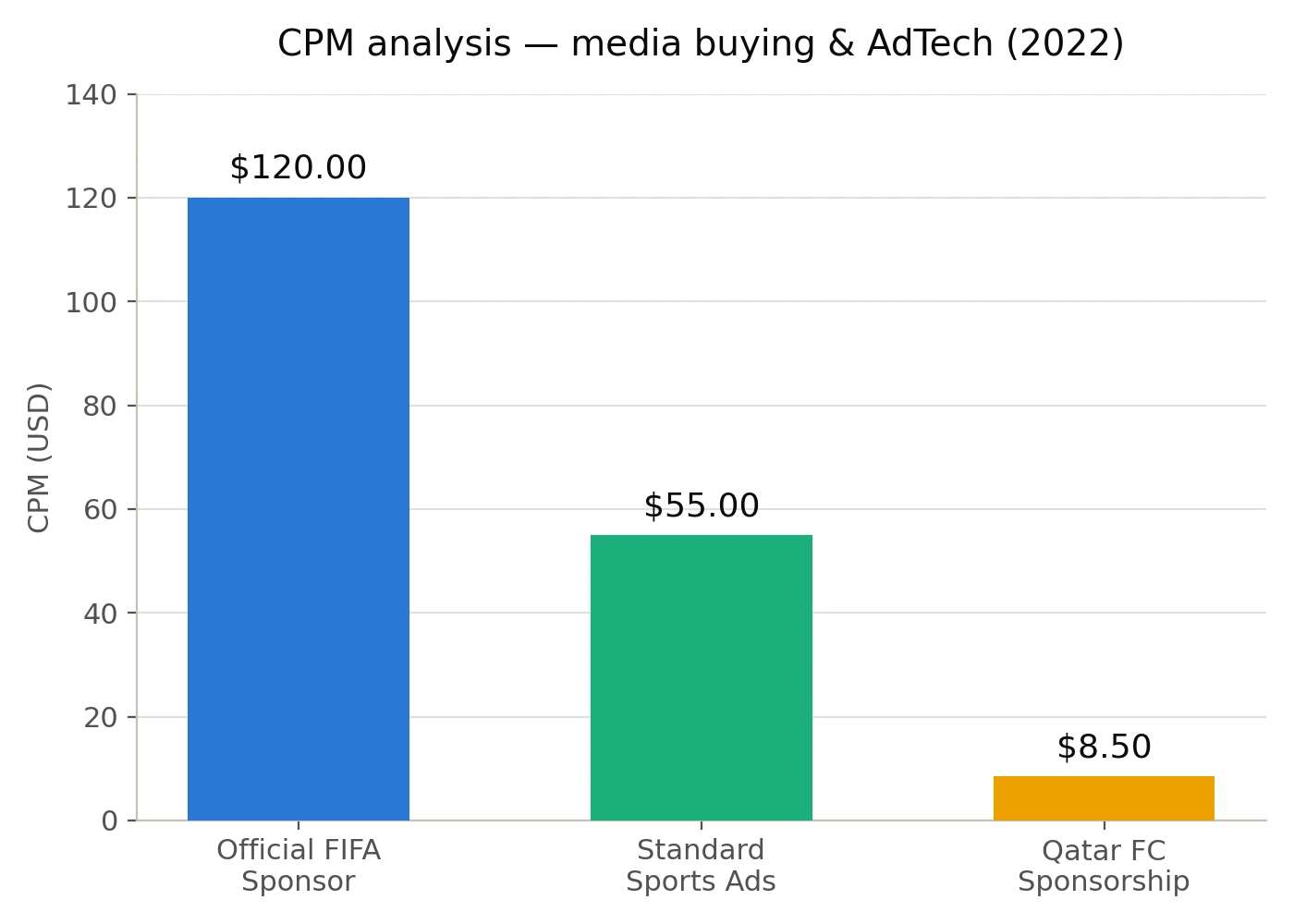
So, smart brands look for loopholes by analyzing search overlap and sponsoring something entirely different that happens to share the same keyword. During the 2022 FIFA World Cup in Qatar, the language app Duolingo wanted to capitalize on the football hype. Instead of competing with FIFA, it creatively sponsored a small amateur Brazilian football team that happened to be named “Qatar FC.” The company flooded social media with campaigns cheering for “Qatar,” legally capturing the massive search traffic and online attention surrounding the World Cup without violating any intellectual property laws.
This strategy is all about identifying the most cost-effective way to capture attention. While official sponsors pay a substantial premium to reach every 1,000 viewers, data show that sponsoring a clever alternative can reduce that cost dramatically.
The 2026 Landscape: How Ambush Marketing Has Evolved
AI Enables Real-Time Campaign Activation
Generative AI and marketing automation have significantly reduced campaign development time. According to Nielsen (2025), 71% of large advertisers identify AI as the most important marketing trend, while 47% already use AI for content creation and 46% for predictive analytics. This enables brands to react to live sporting events faster, narrowing the speed advantage traditionally held by official sponsors.
Social Media Is the New Ambush Battleground
Ambush marketing has shifted from physical venues to digital platforms where audiences actively engage. A 2025 study analysing 9,387 Instagram posts from 622 Olympic athletes found that athlete-generated content increasingly intersects with sponsorship restrictions, highlighting social media as a major arena for brand association during sporting events.
Creator Marketing Has Become a New Ambush Channel
Brands increasingly leverage creators and athletes to gain event visibility without purchasing official sponsorship rights. WARC reports that the global influencer marketing industry grew from US$6 billion in 2020 to US$24.1 billion in 2025, while 77% of marketers plan to increase trend-based social content to engage younger audiences. This growth has made creator-led marketing an increasingly powerful channel for indirect event association, complementing traditional ambush marketing strategies
Sport Marketing Quarterly. (2025). Athlete Social Media and Olympic Sponsorship Communication.
Nielsen. (2025). Annual Marketing Report 2025.
WARC. (2024). Trends for Social Media and Influencer Marketing in 2025.
Conclusion
The evolution of ambush marketing demonstrates that winning consumer attention no longer depends solely on securing official sponsorship rights. From Nike’s takeover of the 1996 Atlanta Olympics to AI-powered campaigns and geofencing today, ambush marketing has evolved from physical visibility to data-driven audience targeting. The case studies demonstrate that creativity, consumer insights, and analytics can enable challenger brands to compete with official sponsors without purchasing expensive sponsorship rights.
At the same time, official sponsorship continues to offer unique advantages, including legal brand association, guaranteed global exposure, and exclusive commercial rights. Rather than replacing sponsorship, ambush marketing has transformed how brands compete for consumer attention.
As digital technologies continue to reshape advertising, the competitive advantage will increasingly belong not to the brand that spends the most, but to the one that uses data, technology, and creativity most effectively.
About MaxEd
MaxEd is one of South India’s leading market research and consulting firms, dedicated to delivering actionable intelligence that empowers businesses to make confident, data-driven decisions. With a deep understanding of regional markets and a commitment to research excellence, MaxEd bridges the gap between complex market dynamics and clear strategic direction. From consumer insights and brand analytics to competitive intelligence and business consulting, MaxEd offers end-to-end research solutions tailored to the unique needs of each client

