


Mumbai – June 12, 2026: Recently, McCann released The Truth About Global Brands, a study of 20,713 people across 20 markets, revealing a fundamental reset in how brands achieve growth and relevance globally. This year’s study draws on independent insights from an analysis of B2B decision-makers conducted by Economist Enterprise, the B2B arm of The Economist Group.
At a time when AI is reshaping decision-making, trust is fragmenting and cultural influence is shifting, the research finds that brands must help consumers navigate an increasingly complex “Truth Maze” by eradicating doubt to drive growth.
“Global brands are experiencing a growth crisis as we’ve shifted from a trust economy to a doubt economy, putting CMOs under more pressure than ever,” said Tyler Turnbull, Global CEO, McCann. “The new playbook for the future of brand building will be grounded in a brand’s ability to show up with clarity, credibility and cultural fluency at every decision point.”
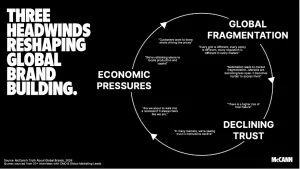
The “Truth Maze”: a New Battleground for Brands’ Bottom Line
In a world flooded with information, consumers and business leaders are navigating a “Truth Maze”: a complex web of conflicting information, AI-generated content, and competing claims that has made it harder than ever to determine what is real.
- While 73% of people in India say it’s more important than ever to prioritize truth, 46% believe brands are less truthful than they were 20 years ago
- 71% of people in India worry they will soon be unable to distinguish between real people and artificial ones online
While AI adoption is expected globally — 72% of consumers and 88% of B2B leaders say brands must use AI to keep up — accountability is what will set brands apart.
- 57% of people in India say being transparent about AI use is the most effective way for brands to build trust, and 49% say brands should help them understand what’s real and what isn’t in AI-generated content
The commercial stakes are high, with the research revealing that trust is not a soft brand value, but a revenue driver.
“In a world where truth matters more than ever, certainty is the new value exchange,” said Harjot Singh, Global Chief Strategy Officer, McCann.
- A vast majority of people (88% in India) say they will actively choose brands they trust, even if they cost more, signaling a growing premium on credibility
- 71% of consumers in India and 79% of global B2B decision-makers have stopped using a brand because they no longer trusted it
“The data tells a compelling story: when business leaders lose faith in a brand, they walk away and they don’t come back easily,” said Tamara McMillen, Chief Revenue Officer at Economist Enterprise. “What this means for global brands is that the commercial cost of doubt is real and measurable. Brands that invest in being trustworthy guides to B2B decision-makers are the ones best positioned to grow.”
“Multi-Modal Globality” Challenges Traditional Brand Building Playbook
In a world inundated with information, the research reveals a major shift in how culture and influence flow globally, as ideas move fluidly across markets, platforms and communities.
- Influence is increasingly multi-directional, not West-to-rest
- Markets like China, India and Saudi Arabia are shaping global norms
- 79% of people in India say you can be a global citizen without travelling
Culture no longer flows in a straight line from global to local. Instead, it circulates — emerging, evolving and scaling across interconnected networks. Legacy models of global brand building — top-down or bottom-up — are no longer sufficient.
The Next Growth Engine: 1 Billion Strong “Upward Class”
With culture and influence now moving multi-directionally, a new, highly influential and expanding audience is defining the new era of brand growth: the “Upward Class.”
- 1.02 billion people globally
- $29.5 trillion in annual spending power
- Highly motivated by progress, self-improvement and upward mobility
Unlike previous generations, these consumers use brands not just to consume, but to signal progress, identity and belonging, reshaping the meaning of status itself.
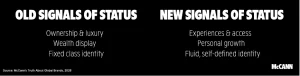
Critically, the “Upward Class” shows lower brand cynicism and stronger belief in brands as tools for advancement, making them disproportionately influential in defining what growth looks like next.
“Future growth won’t come from leaning on existing audiences or legacy markers of scale,” continued Turnbull. “It will come from brands that turn truth into a genuine growth engine, building connected systems of meaning, culture and commerce. That’s what McCann’s Truth Well Told framework is designed to do.”
The New Playbook for Global Brand Growth
Across all findings, one principle stands out: the brands that succeed in 2026 and beyond will not be those that say the most, but those that remove the most doubt and connect with segments shaping tomorrow’s demand. This requires:
- Acting as a trusted guide in a complex information landscape
- Going back to the basics, delivering products and experiences that are relevant, useful and prove their value
- Identifying and engaging emerging, high-growth audiences that believe in brands
- Designing truth-based ideas that move with culture and scale across networks
Research Methodology
The Truth About Global Brands is based on a survey of 20,713 people across 20 markets [US, UK, Australia, Brazil, Canada, China, France, Germany, Italy, India, Japan, Mexico, Spain, UAE, Saudi Arabia, Philippines, Singapore, South Korea, Thailand, New Zealand], conducted between November 2025 and January 2026, combined with qualitative insights from senior marketing leaders and global CMOs.
*Trended data is reported on a like-for-like basis, with the following markets [US, UK, Brazil, China, France, Germany, India, Japan, Mexico] across 2018, 2023, 2026.
This year’s report includes a B2B brand perspective based on independent insights from Economist Enterprise, the B2B division of The Economist Group that helps organizations understand global economic and geopolitical change, make informed strategic decisions and reach influential audiences. Their analysis surfaces the critical nuances that distinguish B2B audiences from the broader consumer sample – and what those nuances mean for brands competing for the trust and confidence of business buyers today.

