


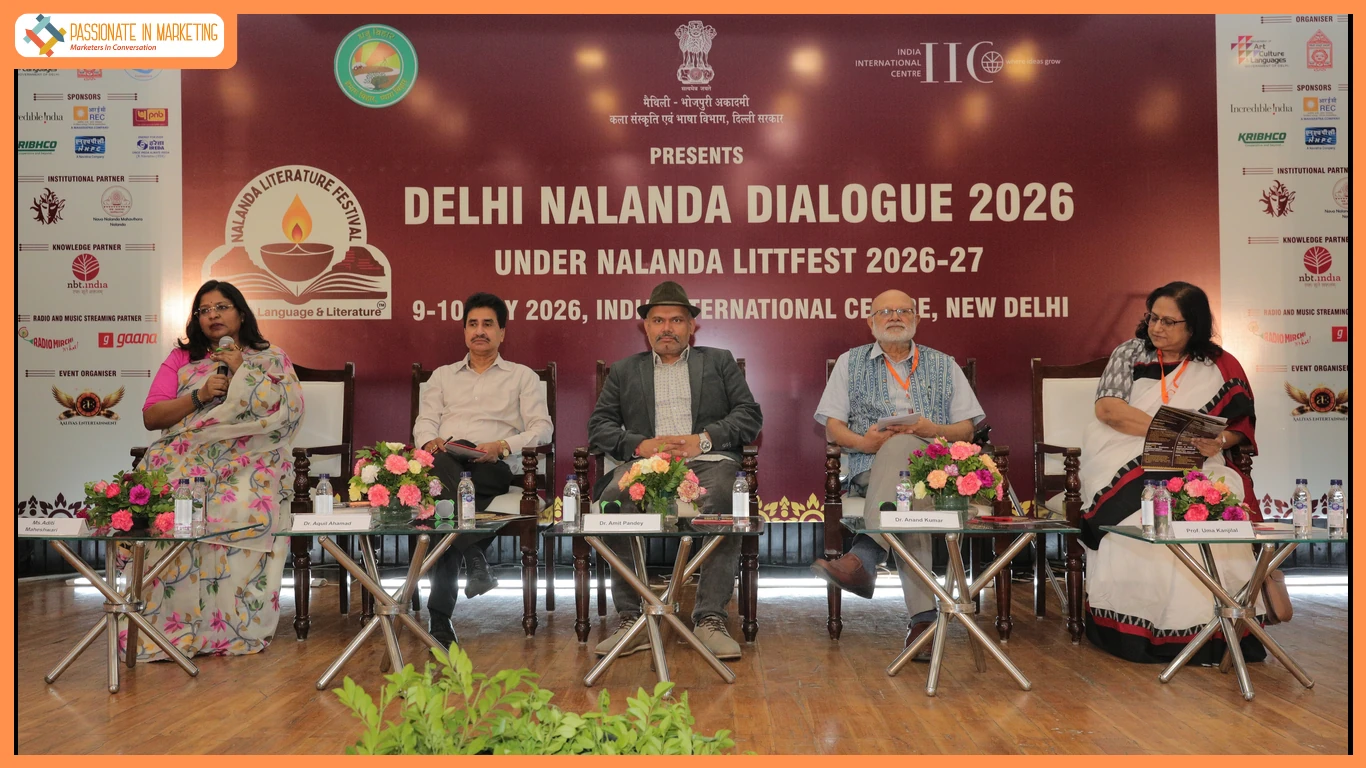
New Delhi, May 11, 2026:The second and final day of the Delhi Nalanda Dialogue 2026 concluded today at the India International Centre, New Delhi, marking the culmination of a two-day dialogue centred on knowledge systems, culture, governance, and the future of education. Held under the umbrella of the Nalanda Litt Fest 2026–27, the Dialogue brought together senior government representatives, policymakers, schola rs, authors, diplomats, and young civil servants from across India and beyond.
Organised by Dhanu Bihar in collaboration with the Department of Art, Culture and Language, Government of NCT of Delhi, and India International Centre, the second day focused on the theme “Knowledge, Youth & Cultural Exchange Dialogue”, exploring the intersections of language, education, and public engagement in shaping cultural continuity.
Session I: Indian Languages & Knowledge Preservation
The session explored the role of Indian languages as repositories of knowledge, memory, and cultural continuity, while examining how governance, education, and technology can collectively support their preservation. Discussions highlighted the importance of linguistic diversity, oral traditions, and the need to integrate Indian languages into emerging technological frameworks, particularly in the age of AI.
Sh. A. J. Alphons, Eminent Writer & Ex-Civil Servant noted, “No language is superior to another—clarity of thought and strength of fundamentals must guide how we engage with knowledge systems.”
Prof. M. J. Warsi, President, Linguistic Society of India stated, “India’s linguistic diversity is a living archive of knowledge, and its preservation requires both community participation and technological innovation.”
Sh. Kaushal Kishore, Writer & Ex-Civil Servant observed, “Languages carry memory and philosophy, they survive not just through policy, but through active cultural engagement and dialogue.”
Ms. Surekha Sahu, Writer & Civil Servant remarked, “Language shapes how we experience the world and our identities, emotions, and cultural memory are rooted in our mother tongues.”
Session II: Public Engagement, Academic Exchange & Cultural Dialogue
This session focused on the relationship between institutions and society, examining how public engagement and academic exchange can strengthen cultural ecosystems. Conversations reflected on translation, accessibility of knowledge, generational shifts, and the evolving nature of cultural participation in a digital age.
Dr. Vishwapati Trivedi, Writer & Ex-Civil Servant shared, “Language shapes identity, and translation becomes one of the most rigorous intellectual exercises in carrying meaning across cultures.”
Sh. Tajender Singh Luthra, Writer & Ex-Civil Servant stated, “Culture does not belong to elites, it lives among people, and it must be nurtured across generations.”
Sh. Chaitanya K. Prashad, Writer & Ex-Civil Servant observed, “We have transitioned from seeking knowledge in libraries to carrying it in our pockets—how we engage with that knowledge now defines its value.”
Session III: Nalanda as a Global Knowledge Tradition
Moderated by Dr. Shashank Shekhar Sinha, this session examined Nalanda’s evolution from a regional centre of learning into a global intellectual tradition rooted in dialogue, philosophy, and multidisciplinary scholarship. Discussions highlighted Nalanda’s role in fostering coexistence among diverse schools of thought, its expansive manuscript culture, and its influence across Asia through networks of knowledge exchange.
Prof. Siddharth Singh, VC, Nava Nalanda Mahavihara stated, “Nalanda was not merely a place; it became a living tradition of wisdom accepted across the world of knowledge.”
Prof. Anand Singh, Eminent Writer emphasised the scale of Nalanda’s manuscript culture, observing, “It preserved not just religious texts but also medicine, metallurgy, and the wider intellectual life of society.”
Prof. Himanshu Prabha Ray, Eminent Writer reflected on the evolving understanding of Nalanda’s historical and archaeological landscape, stating, “What we have today is only a fraction—there is still much to be brought into the public domain.”
Session IV: AI, Knowledge Systems & Future Learning
Moderated by Ms. Aditi Maheshwari, this session explored the intersection of artificial intelligence, education, and India’s knowledge traditions, examining how emerging technologies are reshaping learning while engaging with deeper philosophical questions around intelligence and consciousness.
Prof. Uma Kanjilal, VC, IGNoU, Delhi stated, “We must work towards building a Digital Nalanda that connects our knowledge traditions with future learning systems.” She emphasised that institutions need to evolve with AI and integrate it into education frameworks rather than resist technological change.
Dr. Amit Pandey, President, Soscients AI & Robotics, France stated, “AI should not be used merely for comfort and convenience—it must be harnessed for meaningful creation and innovation.” He highlighted its growing role across sectors while noting that its real value depends on how consciously it is used.
Dr. Aquil Ahamad, Writer stated, “Using AI effectively is not simple—it requires awareness, understanding, and continuous learning.” He reflected on both the opportunities and risks associated with AI, underlining the need for a balanced and informed approach.
Dr. Anand Kumar, Eminent Writer stated, “The evolution of artificial intelligence must also be understood alongside human consciousness and identity.” He explored how machines attempt to replicate human intelligence, connecting these ideas to India’s philosophical traditions and knowledge systems.
Session V: Golden Pathway with Nalanda at its Centre
Moderated by Sunil Tandon, this session explored Nalanda’s role as a global centre of knowledge and its influence on the transmission of ideas across regions, drawing from historical narratives, manuscripts, and cross-cultural exchanges.
William Dalrymple, Writer and Historian stated, “There are two concepts: spread and development.” He noted that Indian ideas had already begun spreading across Asia before Nalanda, but added, “Once Nalanda was established, it became the undisputed centre of learning and authority.”
He reflected on Nalanda’s intellectual ecosystem, stating, “Nalanda was like modern AI—you could access immense knowledge instantly,” while highlighting its role in preserving and disseminating both Buddhist and non-Buddhist knowledge systems.
He also highlighted the need for greater engagement with heritage, stating, “Only around 20 percent of Nalanda has been excavated,” adding that stronger efforts are required towards conservation and public understanding of its legacy.
Session VI: Concluding Dialogue
The Dialogue concluded with a final plenary featuring Sonal Mansingh, D. Aaliya, K. Mahesh, and Sanjay Kumar as moderator, reflecting on the broader outcomes and future direction of the Dialogue.
Dr. K. Mahesh, Secretary (Art & Culture), Govt. of NCT of Delhi, emphasised, “Strengthening cultural dialogue and expanding access to manuscripts is no longer optional, it is urgent. Knowledge must move beyond elite circles and engage a wider public. At the same time, we must revive gazetteers as structured repositories of knowledge; their decline risks the loss of foundational governance resources. Indian languages like Bhojpuri already have a global presence, and it is time they receive the institutional recognition they deserve.”
Dr. Sonal Mansingh reflected, “Art, culture, and knowledge remain India’s strongest pillars—enduring through centuries of change while preserving our core values and civilizational continuity.”
Adding a forward looking perspective, the organisers reiterated that the Nalanda Literature Festival seeks to move beyond dialogue to meaningful outcomes, with a focus on enabling the next generation through structured support in research, publications, and academic engagement.
The Delhi Nalanda Dialogue 2026 concluded with a strong emphasis on the continued relevance of India’s knowledge traditions in a rapidly evolving world, underscoring the need to connect heritage with future facing systems of learning and cultural exchange.
Know more about the festival and upcoming initiatives at @NalandaLittFest.
About Dhanu Bihar:
Dhanu Bihar, established in 2020, is a non-profit trust based in Patna, Bihar, dedicated to uplifting underprivileged communities across the state through a multifaceted approach. Its core pillars include empowering girls, supporting farmers, preserving cultural heritage, promoting education, and enhancing social welfare.
The organization is driven by a vision to uplift communities through knowledge, collaboration, and sustainable practices. By working closely with local stakeholders, institutions, and individuals, Dhanu Bihar aims to create meaningful and lasting impact across various sectors.
For queries please visit our website: website: littfest.in.

