


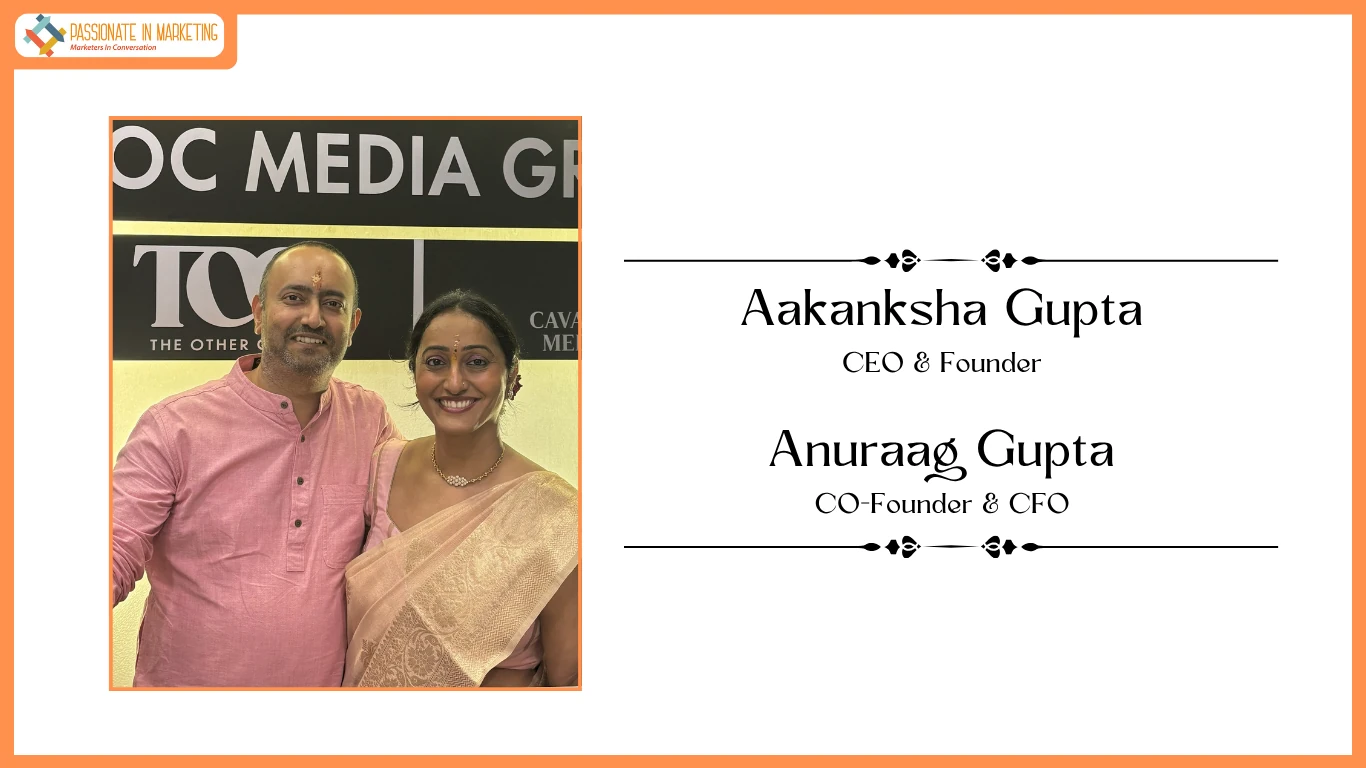
1.Take us back to when The Other Circle began: what made you both decide to come together as business partners, rather than pursuing separate paths?
Anuraag: Well Aakanksha started TOC as a freelancer way back in 2013. In early 2015 I was in between careers. I had bored myself to death with CA practice and my teaching assignments went kaput all of a sudden. I was sort of a headless chicken mode so I took some time off to figure out what my next career move should be.
It was during this time that Aakanksha came up to me and she said, “Anuraag, the business is picking up. Why don’t we do this together?” Now to be honest at first even the thought of a sibling working together did not agree with me since we are complete opposites.
We started as a pilot but that did not work. After a while we both sat again and Aakanksha said, “We have to do this together.” Perhaps at that time both of us agreed. Then I said, “Okay fine, if I have to come into the business then I have to sort this thing out. I need some structure. I cannot be winging it.”
That is how I joined in 2015 and in 2016 is when we got a structure in place. Also one fun fact: Aakanksha is very bad with numbers and extremely good with creativity and sales. I am the complete opposite. I am excellent with numbers but I am an introvert and really suck at sales. So this polarity actually got balanced into the mix.
2.In the early days, how did you divide roles and responsibilities? Did that division come naturally, or did it evolve over time?
In our case, the roles were divided automatically due to our formal education backgrounds and inherent personality traits. I am quite the introvert CA who took charge of the back-end roles pertaining to administration and finance. Aakanksha is a formally trained PR professional and the more expressive between the two of us, so it made sense for her to take on the front-end role that’s more creative. However, this isn’t rigid. We both test each other’s waters for being interchangeable.
3.Were there any early disagreements or differences in approach that actually shaped how you work together today?
Being siblings means disagreements are inevitable. One of our major disagreements was around bringing emerging technologies, particularly AI, into the work environment. It led to quite a few debates because both of us have valid arguments and strong viewpoints. We eventually resolved it by adopting AI as a pilot project for a temporary period, with the option of continuing or discontinuing it based on how it worked.
That experience shaped how we work together today. Whenever we disagree on big decisions, one of us is willing to step back if it’s in the best interest of the business. After spending more than a decade building a business, we agree to disagree for the sake of our business.
4.After 13 years of co-founding TOC together, how would each of you describe the other’s working style in one/few lines? OR What’s one thing about working with your sibling that outsiders often get wrong or don’t expect? In what ways does sibling trust give your brand an edge?
Anuraag: Trust is a cornerstone of every relationship, be it personal or professional. In our case, our USP lies in the implicit trust we have in each other, and the freedom we give each other to calling a spade a spade, but always with a caveat of staying respectful.
That openness doesn’t stay between the two of us. When the team sees it play out at the co-founder level, it sets the tone for how everyone else works too, and honesty, transparency and commitment stop being things we talk about and start being how things actually get done.
But it always comes with its challenges. Being in each other’s face daily, sometimes at home and always at work, means there’s very little room to switch off. But the trade-off is worth it, because it also means always having someone who has your back. It’s a constant process of reinventing both yourself and the relationship.
5.How do you ensure personal and professional boundaries don’t blur, especially during high-pressure moments?
During high-pressure moments, personal emotions seeping into our professional lives becomes inevitable. Over the years, we’ve learned that the boundary between professional and personal doesn’t hold on its own. We have to actively protect it. When there is a crisis or a disagreement, we have made it a priority to park the emotion until after the fire’s out and then actually revisit it. That discipline is what’s kept both the business and relationship intact.
6.Is there a moment you both recall where your sibling bond (rather than just professional trust) helped the business get through a difficult phase?
COVID-19 didn’t just test us as business owners, but it also tested our bond as siblings. Like everyone else, we were scared of the unknown. But we stood beside each other, and there was a kind of care that didn’t need to be said out loud. We just felt it in the way we showed up for each other. That phase reshaped the way we think about everything, including the business. Since then, we have lived by the motto It’s me for you, and you for me. This mantra not only helped us come out of COVID but also carried us through every difficult decision we have had to make together.
7.Aakanksha, as Founder & CEO, and Anuraag, as Co-founder & CFO, how do your current roles complement each other in driving TOC and Cavalry Media’s direction today?
Aakanksha: My role has always been about deciding the creative and cultural direction of TOC and Cavalry Media. Anuraag gives structure to that vision. As a CFO, he thinks in terms of whether a move is scalable and if it holds operationally, and also weighs the risk. I can dream big, but he’s the one who guides me in the direction of what’s actually worth building and makes sense financially. The clarity makes the complementary part—creativity with discipline—actually work.
8.How has your understanding of the PR and marketing communications industry evolved individually, and how do those perspectives inform decisions you make together?
Aakanksha: When I started out in PR, there was a fairly linear playbook across the industry. Now, watching it evolve over the years has honestly been one of the most exciting parts of building the business. It might sound cliché, but for several years now, we have made peace with the fact that change is the only constant. For me, it is the understanding that India is not a mere market but an evolving cultural landscape that has really shaped how I think about our audience and narrative.
Anuraag: I come from a finance background, so my outlook towards this industry has been with a focus on numbers. I tend to look at things in terms of how scalable and sustainable they are and not just creatively exciting. While Aakanksha brings cultural interpretation, I bring the structural one. When those two perspectives merge, that’s usually when we take our best calls.
9.What’s a recent industry shift (AI, changing media consumption, etc.) that you both view differently and how do you reconcile that at a leadership level?
We had polarising views when it came to the adoption of AI into our system. While Aakanksha was very much keen and inquisitive about the technology, I was not very comfortable with the idea of optimising our operations using AI. Aakanksha and I had many conversations and discussions on how AI will be utilised as only a thinking partner rather than completely taking over our operations. My change in perspective came around the same time when AI became an inevitable part of our lives—be it at the company-level, worldwide, or in our personal lives. To this day, I give credit to my sister for adopting the technology in its early days. Now, we use AI to make our business efficient, as we delegate researching, mapping, and planning tasks to it.
10.Individually, what’s one goal you’re each personally driving for TOC and Cavalry Media (let me know if I should include this) in the next few years?
Today, the role of PR is changing. It is no more about media coverage, but it is also being at the forefront and shaping the zeitgeist. PR is also influencing businesses and being called to account for outcomes. In this new era, we want to push the envelope when it comes to building narratives and drive culturally relevant and strategic storytelling. PR isn’t about reactive publicity. We are here to create long-term brand equity and focus on measurable outcomes rather than just media volume.
11.As co-founders, what’s the shared long-term vision you’re building toward, for TOC, and possibly beyond (referencing ventures like Cavalry Media)?
Any business is made by people, run by people, and is for the people. TOC, and the industry we are in, Public Relations, is a people-first industry, even though a lot of the day-to-day work can make you forget that. As we have always said, the long-term vision is to bring people back into the equation, and not just in the stories we tell for our clients, but in how we build and run our own ventures. This is what all our ventures, including Cavalry Media, are doing, or are symbolic of.
12.If TOC had to be defined by one value the two of you agree on unconditionally, what would it be?
If we had to choose one, it would be creativity, built on a foundation of trust, transparency, and honesty. Because one without the other does not hold. Creativity without honesty is just noise, and trust without creativity makes for a very boring agency.
13.On a lighter note, what’s one sibling tradition (Raksha Bandhan or otherwise) that’s stayed constant through the years, despite your busy schedules?
Raksha Bandhan and Bhai Dooj are the two traditions that have stayed constant throughout the years, no matter how busy our schedules get. In fact, there have been instances where either of us has flown to cities to celebrate together, staying true to the traditions.
14.If you had to complete this sentence about each other: “Working with my sibling taught me that…” What would each of you say?
Working with my sibling taught me that even two polarising-ly opposite people can survive, and somehow a business can thrive because of it, not despite it.

