


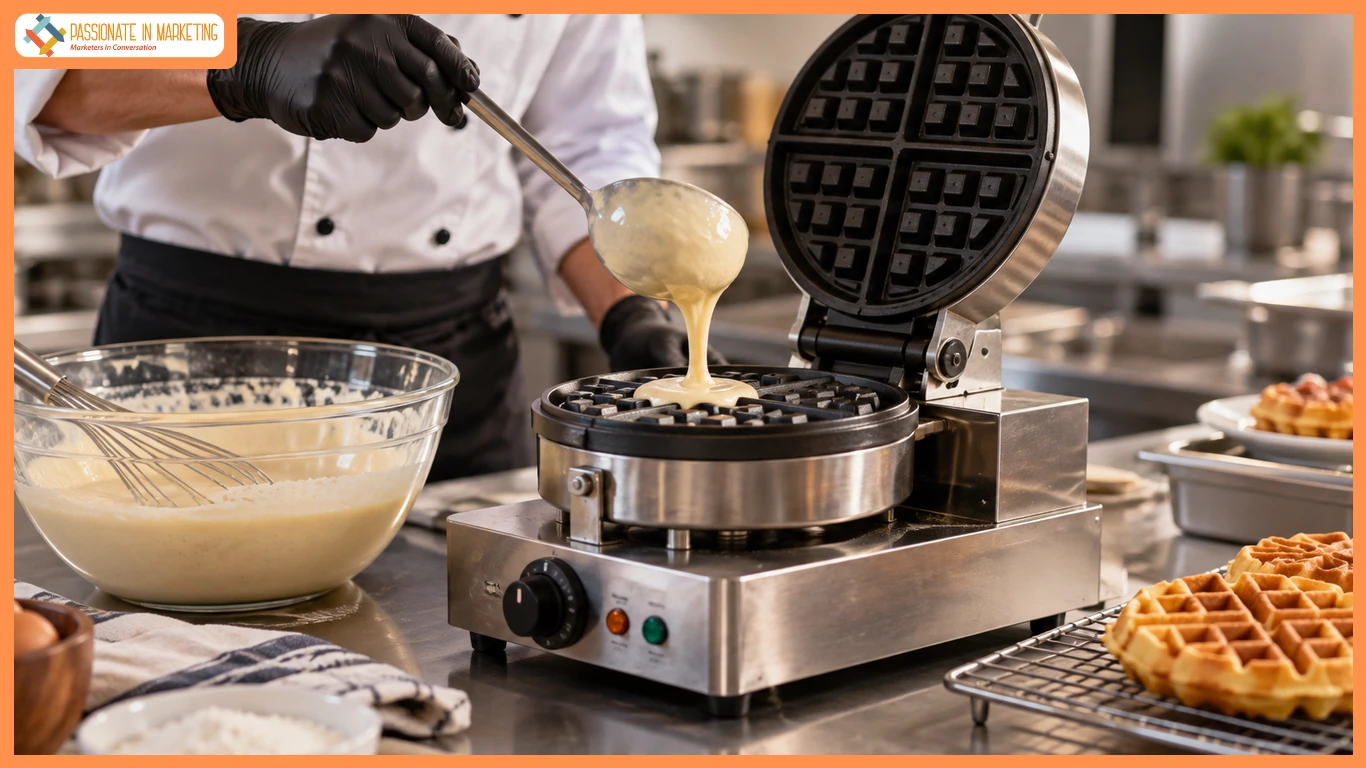
Commercial waffle equipment must reliably release finished pieces for the next stage. Baking, mould geometry, release method, and batter must work together to prevent rejects.
A commercial waffle maker ends with a physical handoff
UDTECH equipment deposits batter into steel moulds, bakes it in a tunnel, and transfers finished pieces to a discharge conveyor. Buyers should define the required piece and release condition upfront.
Needle rolling releases at the take-off point
A needle roller lifts baked pieces from open moulds onto the take-off belt. Torn edges, uneven lifting, or cavity residue can indicate release problems.
Compressed air is a different release action
Compressed air provides another release method. For the YT02H, published requirements are 0.2 m³/min at 0.6 MPa, specific to that model.
The batter belongs in the release decision
Recipe affects release. The American Society of Baking notes that fat improves release and lecithin supports steam release. Trials should use the intended batter and recheck release after recipe or product changes.
Template geometry makes the specification concrete
UDTECH matches mould geometry, mould count, conveyor length, and release configuration to the finished product. Buyers should specify shape, weight, transfer direction, and discharge condition.
Utilities support the process
The YT02H is listed at 2.1 m long with 13–21 kW of all-electric power and no stated gas requirement. These figures support facility planning but are not universal specifications.
Where the machine’s promise stops
A commercial waffle maker cannot guarantee untested batter performance, shelf life, retail acceptance, or total factory output. Cooling, packing, quality checks, and commissioning remain separate tasks. A documented trial provides stronger evidence than a broad capacity claim.
A test run is a product-fit check
UDTECH says it test-runs the line on the buyer’s own batter recipe before shipment and uses that run to confirm release configuration. This is the useful point at which a waffle machine, a pancake machine, and the intended product meet. A test result should record the product, the mould, the chosen release action, and the observation at discharge.
For a practical shortlist, start with the stated machine family and then ask for the product-specific evidence. UDTECH waffle production equipment provides the published equipment context, while the trial ties that context to a real batter and finished piece. That sequence gives the marketing claim a physical basis instead of asking readers to accept it on tone alone.
A short brief produces better questions
Before comparing offers, record the shape, batter, discharge condition, handoff, utilities, and failure signs. This helps evaluate a commercial waffle maker as a complete system and diagnose changes when the batter or product changes.
Inspect the cavity, transfer, discharge surface, and cooled piece in order. This helps teams identify the true issue and keeps marketing claims based on proven results.
**The opinions expressed in the article are solely the author’s and don’t reflect the opinions or beliefs of the portal**

