


Bengaluru, September 03, 2026: Flipkart, India’s homegrown e-commerce marketplace, today announced the results of Gridlock Hackathon 2.0, an open challenge designed to crowdsource AI and machine learning solutions for Bengaluru’s traffic and urban mobility challenges.
Conducted in collaboration with Bengaluru Traffic Police, MapmyIndia, Arcadis, and HackerEarth, the hackathon encouraged participants to build solutions using anonymised, real-world datasets through the Bengaluru Traffic Police ASTraM (Actionable Intelligence for Sustainable Traffic Management) platform, designed and implemented by Arcadis. The platform enabled access to curated datasets for traffic analysis, AI and machine learning model development, and mobility innovation, while maintaining strict data privacy and security standards.
The initiative received 33,600 registrations from students, developers, and working professionals across the country. Participants developed solutions across themes including congestion prediction, traffic violation detection, movement-pattern analysis, parking intelligence, and smarter mobility decision-making. The hackathon followed a two-stage format, beginning with an online machine learning challenge and progressing to prototype development for shortlisted participants, resulting in 1,100+ prototypes addressing real-world urban mobility challenges.
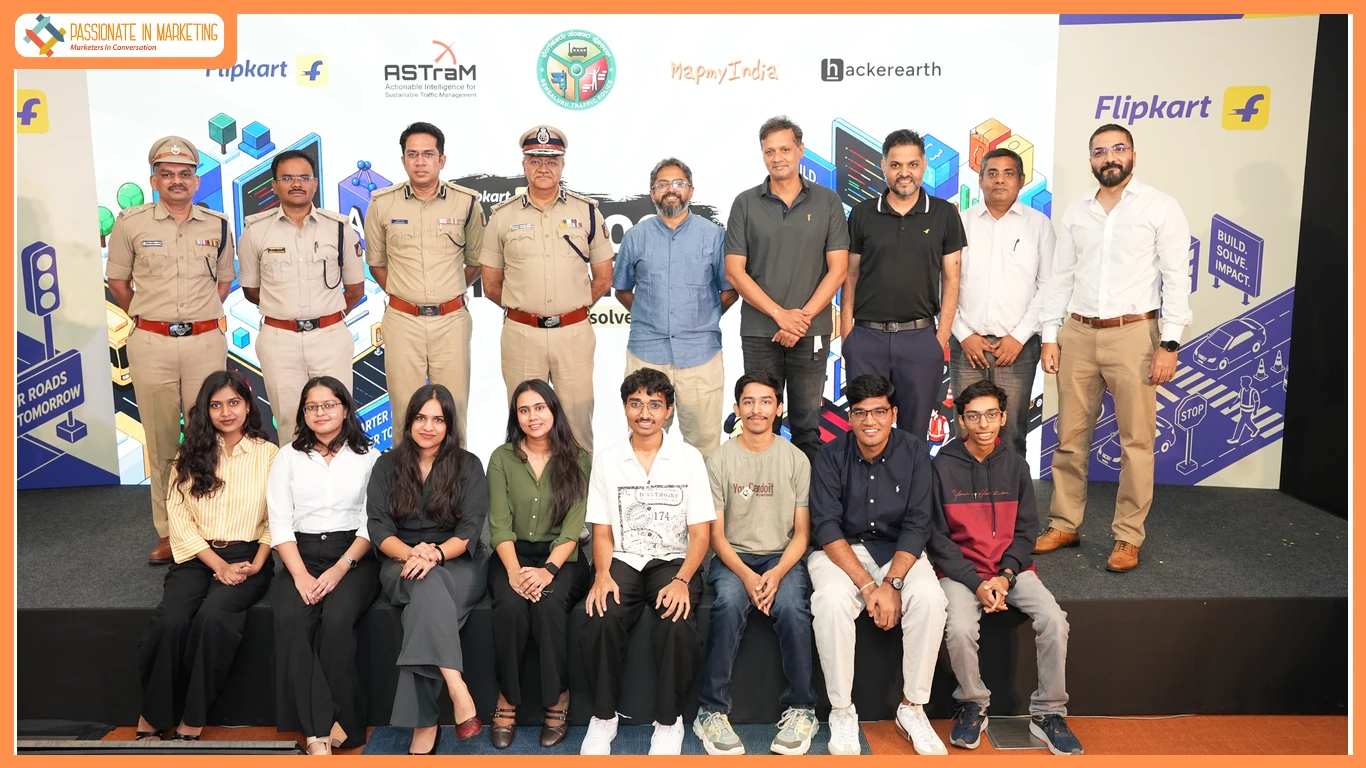
The finale was held at Flipkart’s Bengaluru headquarters in the presence of Seemant Kumar Singh, IPS, Commissioner of Police, Bengaluru City, as Chief Guest; Karthik Reddy, IPS, Joint Commissioner of Police (Traffic), Bengaluru City, as Guest of Honour; and Flipkart leaders Ravi Iyer, CFO and Senior Vice President, Strategic Partnerships; Hemant Badri, Senior Vice President, Supply Chain, Customer Experience and Re-Commerce; and Vinay Vaidya, Senior Vice President, Technology for Supply Chain.
Rajneesh Kumar, Chief Corporate Affairs Officer, Flipkart Group, said, “Some of the most difficult challenges cities face cannot be solved by one organisation working alone. Partnerships between public institutions and technology companies can bring together the data, domain understanding and technology needed to look at these challenges differently. The response to this hackathon, with thousands of participants coming forward with ideas and solutions, shows the value of opening real-world problems to a much wider community of innovators. We are pleased to partner with Bengaluru Traffic Police on an initiative that can help explore new approaches to making the city’s traffic management more effective.”
The Winning Solutions
Selected from the prototypes developed through the challenge, the three winning solutions address distinct aspects of Bengaluru’s traffic and mobility ecosystem:
- Gridlock Oracle (First Place): Predicts how a single traffic incident cascades into city-wide congestion using a Hawkes Process model, giving the Traffic Police a live control-room dashboard to deploy resources proactively before gridlock spreads.
- PRAHAR — Predictive Resource Allocation for High-Impact Area Response (Second Place): A software-only predictive traffic intelligence platform built on real Bengaluru incident data, using multiple machine learning models to forecast congestion severity, junction risk, resolution time, and cascade effects. It recommends optimal deployment of officers, barricades, diversion routes, and dispatch stations.
- ParkSight — Parking-Induced Congestion Intelligence (Third Place): Analysed parking violation records to identify priority congestion and enforcement zones, incorporating hotspot detection, forecasting, patrol optimisation, and validation against ASTraM congestion data.
The three winning teams were felicitated by the Chief Guest in the presence of Bengaluru Traffic Police leadership, Flipkart executives, and representatives from the partner organisations. The winning team received ₹2,25,000, followed by ₹1,75,000 for second place and ₹1,00,000 for third place.
Gridlock Hackathon 2.0 builds on the inaugural 2017 edition, which drew close to 3,000 registrations. The winning solution from that edition proposed using real-time traffic data to enable smarter, dynamic traffic-signal switching. Testing at Bengaluru’s Silk Board Junction indicated a potential reduction of approximately 17% in wait times. The growth from that edition to this one – in scale, ambition, and the sophistication of solutions – is an encouraging sign of the momentum that such collaborations can build.
About the Flipkart Group
The Flipkart Group is one of India’s leading digital commerce entities with a strong technology-first foundation and includes group companies Flipkart, Myntra, Flipkart Wholesale, Cleartrip, and super.money. Established in 2007, Flipkart has enabled millions of sellers, merchants, and small businesses to participate in India’s digital commerce revolution. With a registered user base of more than 500 million, Flipkart’s marketplace offers over 150 million products across 80+ categories. Today, there are over 1.4 million sellers on the platform, including Shopsy sellers. With a focus on empowering and delighting every Indian by delivering value through technology and innovation, Flipkart has pioneered services such as Cash on Delivery, No Cost EMI, Easy Returns, and UPI payments. Beyond shopping, Flipkart continues to create jobs, empower entrepreneurs, and strengthen India’s digital economy.

