


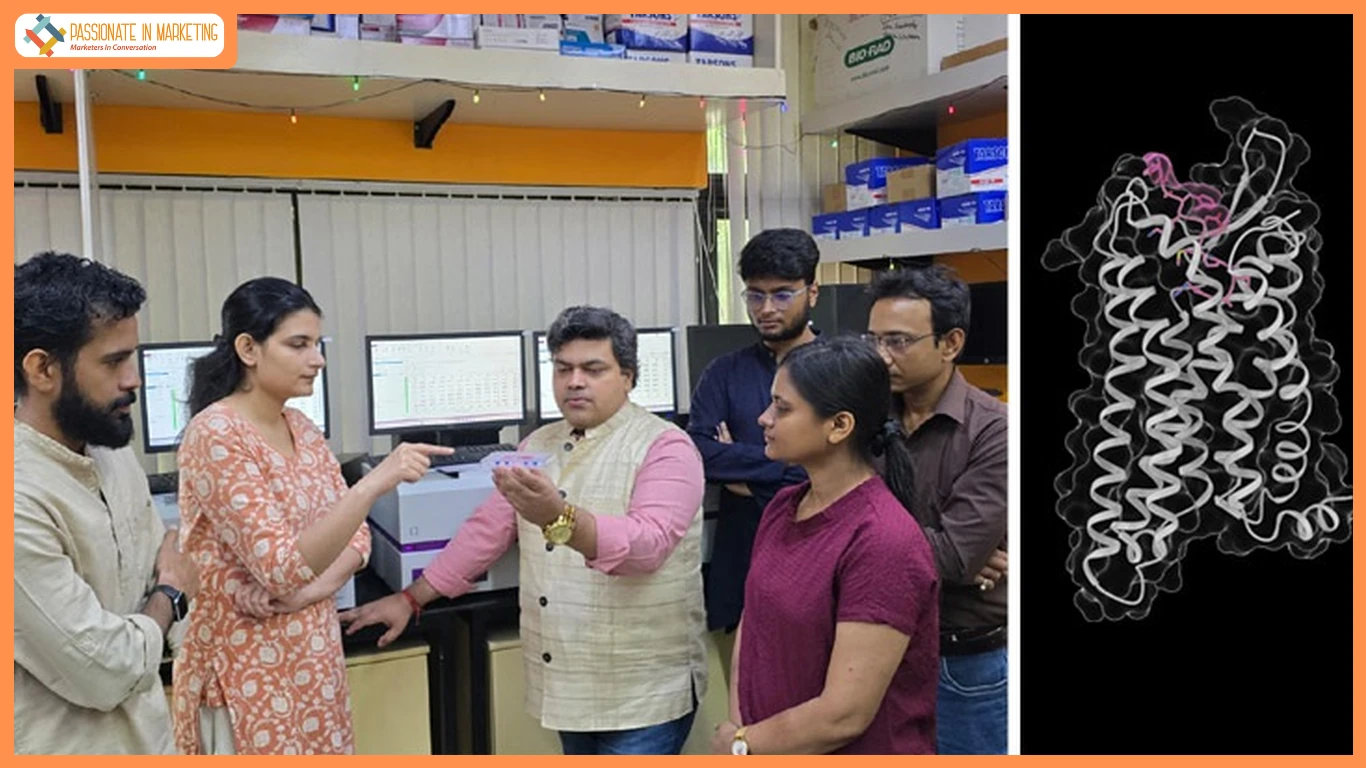
National, 22 July 2026: Scientists at IIT Kanpur have revealed how an experimental molecule called EP67 switches on an important receptor found on human immune cells. EP67 is a candidate “adjuvant”, an ingredient added to vaccines to make them work better. The finding, published in the journal Proceedings of the National Academy of Sciences (PNAS), gives researchers the first clear, close-up view of EP67 gripping its target, and hands them a blueprint for designing safer vaccines and new immune-based treatments.
When we catch a bacterial or viral infection, our immune cells release a small protein called C5a, which primes the immune system to fight back. But too much of C5a for too long leads to inflammation that is harmful and can damage healthy tissue. To prevent this, the body uses enzymes in the blood to break C5a down quickly once the threat has passed.
The researchers at IIT Kanpur took a cue from this natural safety mechanism and built a stripped-down copy of C5a, a short chain of just ten amino acids named EP67, that keeps the useful part of C5a’s activity but works in a gentler way. It wakes up two kinds of immune cells, dendritic cells and macrophages, which help the body build lasting protection. At the same time it barely affects neutrophils, the cells most responsible for the unwanted inflammation. This is exactly what is needed in a vaccine booster – a stronger, longer-lasting immune response without the collateral damage.
Earlier animal studies support this – when EP67 was added to vaccines against several viruses in mice, including the virus that causes COVID-19, the animals mounted a stronger immune response than with the vaccine alone and also tended to recover faster. EP67 has also shown a surprising ability to fight bacterial infections, including MRSA, a strain of staph that is resistant to most common antibiotics.
The IIT Kanpur team also found the method of action of EP67 as without knowing its precise target, scientists could not improve the molecule or move it confidently toward the clinic. EP67 binds to and activates a receptor called C5aR1, a member of a large family known as G protein-coupled receptors, or GPCRs. These receptors sit in the outer membrane of cells and relay signals inward, and they are the single biggest group of drug targets in the body. About one in three prescription medicines works by acting on a GPCR.
To pin this down, the researchers first grew human cells in the lab and confirmed that EP67 turns C5aR1 on, though more mildly than C5a does. They then used cryo-electron microscopy, a technique that flash-freezes molecules and images them in near-atomic detail, to capture EP67 locked onto the receptor. The pictures revealed that EP67 folds into a hook shape that slots into a space at the centre
of the receptor and switches it on.
This detail of knowing precisely how EP67 fits its target has helped the team to redesign it, adjust the amino acid sequence to make the molecule sturdier and better at hitting its mark. From here onwards, the next steps would be refining the formulation and dosing in pre-clinical tests.
The study led by the laboratory of Professor Arun K. Shukla in the Department of Biological Sciences and Bioengineering at IIT Kanpur was published in PNAS in July 2026. Contributors from Professor Shukla’s lab include Annu Dalal, Manish Yadav, Sudha Mishra, Manisankar Ganguly, Shachie Sinha, Nabarun Roy, Divyanshi Tiwari, Debdatta Mukherjee, Nilanjana Banerjee, and Ramanuj Banerjee. The work also drew on the laboratories of Professor Cornelius Gati at the University of Southern California and Professor Trent Woodruff at the University of Queensland, Australia.
The research was supported by the Indian Council of Medical Research (ICMR), the Anusandhan National Research Foundation (ANRF), the Department of Biotechnology (DBT), and the Department of Science and Technology (DST). The high-resolution structure was determined at the National cryo-EM Facility at IIT Kanpur, set up with funding from ANRF.
About IIT Kanpur
The Indian Institute of Technology Kanpur, established in 1959, is recognised as an Institute of National Importance by the Government of India. Known for its work in science, engineering and interdisciplinary education, IIT Kanpur sits on a 1,050-acre green campus and comprises 21 departments, 27 centres, three interdisciplinary programmes and three specialised schools. With over 590 faculty members and more than 9,500 students, the institute continues to lead in research, innovation and holistic development.

