


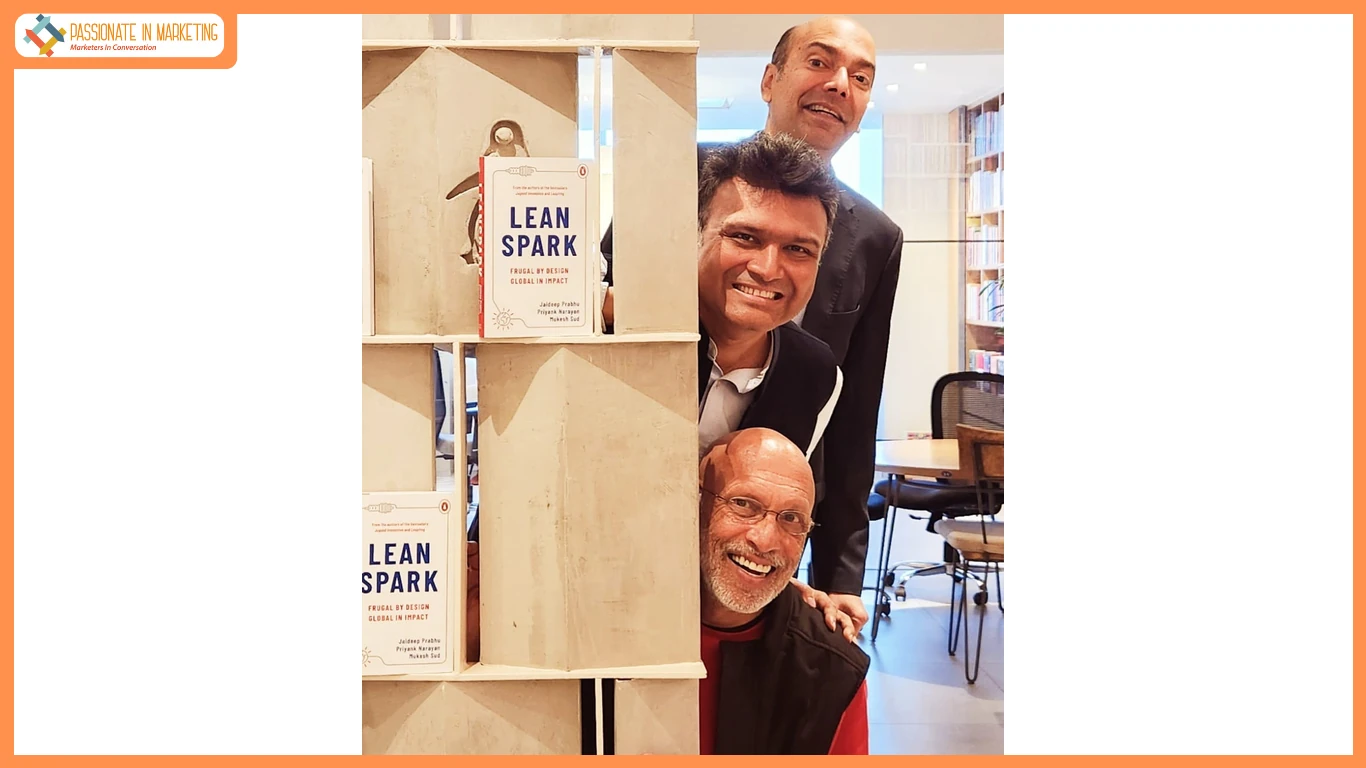
Jaipur, 27 January 2026: LeanSpark: Frugal by Design, Global in Impact, a new book by bestselling authors and academics Jaideep Prabhu (Cambridge University), Priyank Narayan (Ashoka University), and Mukesh Sud (IIM Ahmedabad), was launched at the Jaipur Literature Festival, to a packed house and an animated audience discussion.
Over a decade ago, Jaideep Prabhu, Professor of Marketing at the University of Cambridge, introduced the idea of jugaad to global audiences through his influential book Jugaad Innovation. LeanSpark represents the next step in that intellectual journey. “LeanSpark is about a deliberate and purposeful way of driving innovation and growth,” said Jaideep. “It is not just about being fast and frugal, but about building solutions that are robust and sustainable.”
Priyank Narayan, Associate Professor, Entrepreneurship & Management, and Founding Director of the InfoEdge Centre for Entrepreneurship, Ashoka University emphasized that, drawing on global research and Indian case studies, LeanSpark moves beyond the popular perception of jugaad as a cheap workaround. Instead, it reframes frugality as a systematic and repeatable approach that is scalable across contexts. “The book features stories from innovation in cricket, electric vehicles, frugal AI and even in space missions,” said Priyank.
The panel also featured Sanjoy Roy, co-Founder of JLF and Sahiba Bali, actor and content creator, both of whose frugal entrepreneur journeys are profiled in the book. Their stories illustrated how creative problem-solving, resource discipline, and long-term vision can turn frugal beginnings into enduring cultural and commercial institutions.
Sharing personal reflections, Sahiba Bali spoke about navigating multiple careers under constraint. “LeanSpark gave language to choices I was already making intuitively,” she said. “It helped me see how saying no, staying lean, and playing the long game can actually expand your creative freedom.”
Summing up the discussion, Mukesh Sud highlighted why frugality is no longer confined to emerging markets. As founders worldwide grapple with capital constraints, disruption, and sustainability challenges, this once-Indian mindset is gaining global relevance. “Resource constraint can be an advantage,” he said. “It forces a different kind of thinking that many global corporations are now trying to relearn.”
The session drew a full house, with standing attendees lining the aisles, and an extended Q&A that reflected strong interest from entrepreneurs, students, and policymakers. Several audience members stayed back to interact with the authors and have their copies signed.
LeanSpark’s launch at JLF also sparked a broader conversation on why entrepreneurial thinking matters not just for startups, but for institutions, ecosystems, and societies at large.
LeanSpark, published by Penguin Random House is now available on Amazon and at leading bookstores nationwide. Endorsed by thinkers and institution-builders such as Sanjeev Bikhchandani, R.A. Mashelkar, Yusuf Hamied and Pramath Raj Sinha, LeanSpark positions India not as an outlier, but as a blueprint for the future of global innovation. The book makes a timely contribution to cross-country debates on innovation, entrepreneurship, and sustainable growth, positioning India not as an exception, but as a blueprint for the world.
Other best-selling books by the authors include : Leapfrog: Six Practices to Thrive and Jugaad Innovation.

