


- Can you share the founding story of Stonecraft Group, the vision behind its creation, and how you see it evolving over the next decade in sustainable, lifestyle-driven real estate?
Stonecraft Group was founded in 2013 with a belief that real estate had to mean something more than construction. We saw an industry that was largely focused on delivering square footage, and we felt that was an incomplete answer to what people actually needed from their homes and communities. As a result, the company’s mission was to focus on establishing soulful residential/ commercial spaces built from nature, creative design and long-term value versus focusing only on transactional construction. That conviction has shaped every project we have undertaken, from our flagship development in the Shamshabad Airport Growth Corridor to our presence across Hyderabad’s most sought-after locations, including Banjara Hills, the Indresham–Patancheru Growth Belt, and Yadagirigutta in Telangana.
During the course of the next decade we will see Stonecraft continue its evolution as a company that emphasizes the importance of design and sustainability, as well as incorporates biophilic design principles into everyday residential living. Our ultimate objective is not only to develop new buildings, but also help create resilient, healthy communities that better align with the future of urban living.
2. Stonecraft emphasizes nature-integrated, biophilic living. How does this philosophy translate into the day-to-day experience for residents?
Biophilic living, is the foundation of how a space is conceived. This applies to the planning of homes, and how to structure them for optimal light and air-flow, and to the inclusion of outdoor/Garden or “green” spaces into the daily life, rather than being treated as things that are added later on.
The benefits to residents are a more healthy way of living, with feelings of connectedness and having a good access to the natural world, and less stress than is often found in a heavily populated urban environment. This can be accomplished through experiencing shaded and lush green landscape corridors, using community space, or just enjoying better air and lighting at home. The results of biophilic living are felt quickly and last over time.
3. Could you highlight some of your flagship developments in Hyderabad, such as Woods Shamshabad and Woods Banjara Hills, and what sets them apart for investors and homebuyers?
Woods Shamshabad is our flagship eco habitat and, in many ways, our proof of concept for what biophilic residential development can achieve at scale. Spread across 60 acres in the Shamshabad Airport Growth Corridor, the development comprises 110 generously sized plots ranging from 1,800 to 3,500 square yards. It is forest-integrated by design — over 4.5 lakh trees spanning more than 150 plant species have been planted across the development, alongside 70 heritage trees that have been carefully transplanted and preserved. For investors, the locational fundamentals are compelling: the Shamshabad corridor sits at the heart of one of Hyderabad’s most significant long-term growth vectors, with strong infrastructure tailwinds. For homebuyers, it offers something increasingly rare — the ability to build and own a home within a living, breathing forest ecosystem.
Woods Banjara Hills is an altogether different proposition — an ultra-luxury boutique residential enclave within one of Hyderabad’s most prestigious addresses. With approximately 10 residences, each a 3BHK luxury apartment ranging from 3,500 to 5,000 square feet, this is a deliberately low-density development designed for buyers who have seen the best the market offers and are seeking something more considered.
Together, these two projects demonstrate the range and depth of what Stonecraft is building — from large-scale ecological habitats to intimate urban sanctuaries, each with its own character but a shared design philosophy.
4. Stonecraft has developed one of the world’s largest Miyawaki forests within a residential project. How has this biophilic approach influenced property value, community engagement, and wellness?
The Miyawaki forest at Woods Shamshabad — where approximately 450,000 trees have been planted as part of a comprehensive ecological restoration strategy — is the most visible and perhaps most powerful expression of everything Stonecraft stands for. The Miyawaki method, developed by Japanese botanist Akira Miyawaki, creates dense, multilayered native forests that grow at nearly ten times the rate of conventional plantations, deliver significantly greater biodiversity, and generate ecological benefits that intensify as the forest matures. Implementing this at the scale we have, within a residential development, places Woods Shamshabad in a category of its own globally.
The influence on resident wellness has been immediate and tangible. Living adjacent to a forest of this scale and density creates a measurably different quality of air, sound, and environment. Residents report reduced stress, stronger physical activity habits, and a sense of daily restoration that is difficult to quantify but consistently described. Children in the community are growing up with a living forest as their natural playground — an experience that is becoming extraordinarily rare in urban India.
From a property value standpoint, the forest functions as an appreciating asset. Unlike a gymnasium or a swimming pool, a Miyawaki forest does not depreciate — it grows richer, denser, and more ecologically valuable with every passing year. That trajectory is reflected in long-term demand for the development and in the quality of buyer it attracts.
The forest has become the social and emotional centre of the community in a way that no conventional amenity could replicate.
5. With growing interest in eco-conscious living, how does Stonecraft balance sustainability, wellness, and investor returns in project design?
While there is a perception that sustainability and returns are in competition, we believe that there is a direct connection between them. Projects that have been built with an emphasis on sustainability are likely to provide a greater return throughout their lifetime than those that do not incorporate sustainability into their design during the planning process and consider it as an afterthought.
At Stonecraft, we take an approach to sustainability that is integral to the planning phase rather than something we add to a project post-construction. Sustainable design elements such as efficient land use, long-lasting building materials, water management systems, and green infrastructure help to reduce long-term operating costs and increase the resilience of an asset to withstand the test of time. Therefore, investors benefit from a property that will appreciate steadily in value while residents will enjoy healthy, environmentally conscious living environments that are built to withstand the test of time.
6. In a competitive landscape with many branded developers, what differentiates Stonecraft Group’s offerings in terms of value, lifestyle, and long-term appeal?
Our unique approach to this area of development is dependent upon an unwavering philosophy in all of our projects. We are motivated not just by scale, but more importantly by the outcome of creating thoughtfully designed environments that are in context.
Ultimately, we produce an experience that promotes nature, design, and longevity-based on how the user interacts with the space we provide through time. As a result, our projects will continue to maintain their relevance by providing a standard that is not dictated by traditional template patterns, but rather focused on originality in design; using high-quality materials; and creating spaces that are aesthetically pleasing to the user and retain their value for years after construction has been completed.
7. How do you envision Stonecraft Group expanding over the next 5–10 years in terms of geography, project scale, and product diversification?
Our growth strategy for the next 5-10 years will be based on the same principles as our existing portfolio. We will focus on expanding through major metropolitan areas and selecting sites for each location based on the ability to create a true biophilic environment.
We plan to scale our projects in a controlled way (i.e., we will not compromise the quality of design or execution standards) while also expanding into new formats that meet our customers’ changing lifestyles. Our ultimate goal is to create buildings that are sustainable, future-facing, and closely connected with how they want to live.
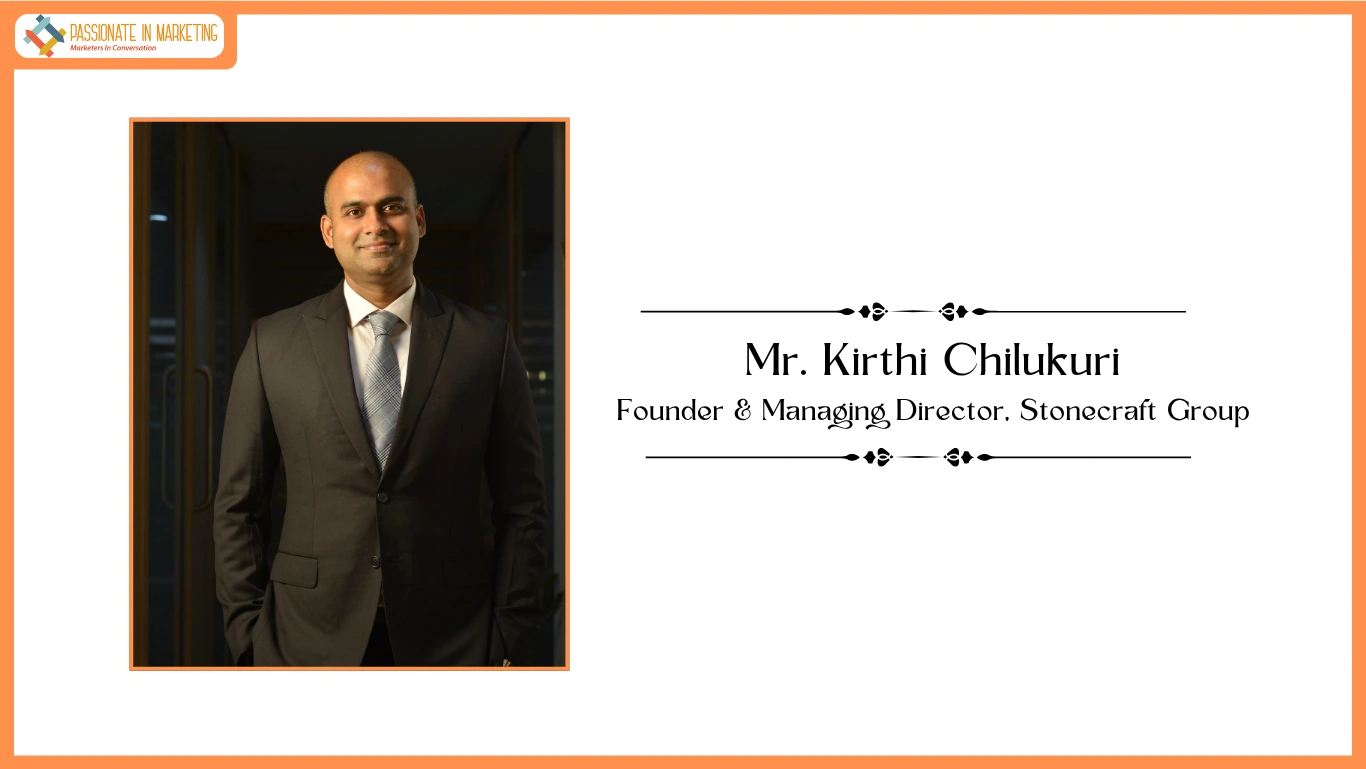
Passionate in Marketing- In converastion with Mr. Kirthi Chilukuri, Founder & Managing Director, Stonecraft Group


Read More