


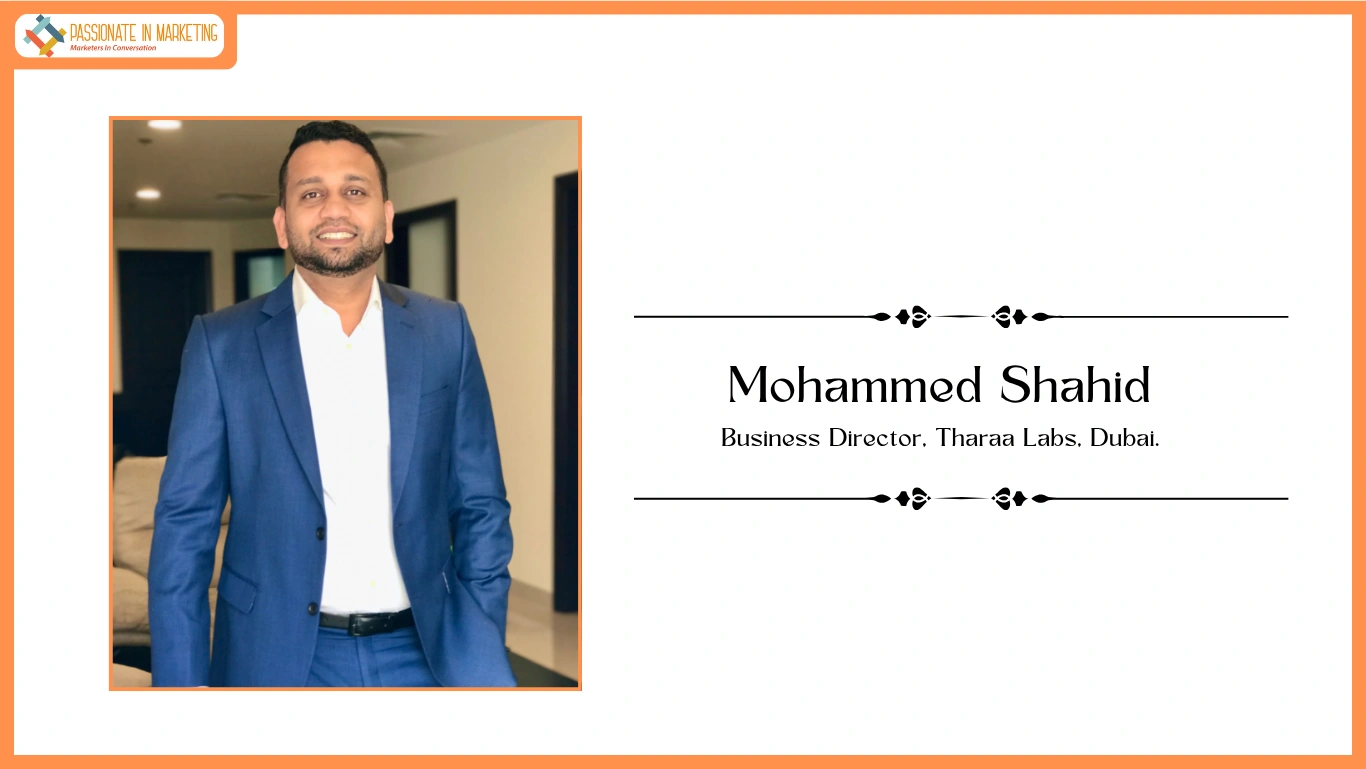
Q1. Today, almost every agency positions itself as “AI-powered.” From your perspective, what truly differentiates Tharaa Labs from a traditional digital agency that simply uses AI tools?
Most “AI-powered” agencies are the same agency they were three years ago, with a chatbot subscription added to the toolkit. The copywriter uses AI to write faster. The designer uses it to mock up faster. But the machinery underneath – the timelines, the costs, the way work actually flows hasn’t changed at all.
We didn’t add AI to an agency. We built an agency on top of AI. Our workflows are agentic with strong human layers. At Tharaa Labs, systems that research, create, test, and learn continuously, with experienced humans steering the ship instead of rowing every oar. Every campaign is based on a human insight, and every insight is based on a human layer.
That sounds like jargon until you see what it does for a client: a month’s worth of channel-ready creative in days, dozens of variants tested in the real market, and decisions made by performance data instead of whoever spoke loudest in the boardroom.
I’ll put it simply. An agency that uses AI tools gets a little faster. An agency built on AI plays a different game entirely. And playing a different game is the whole point. Tharaa Labs, being a lab, will soon be launching products for the global content ecosystem with AI at its heart.
Q2. Your career has spanned business development, technology, and digital transformation. How have these experiences shaped the way you build client relationships and drive sustainable business growth at Tharaa Labs?
Twenty years between India and the UAE teaches you things no course can. The biggest lesson: nobody buys technology. People buy outcomes, and more than that, they buy trust. Business in the UAE is built over coffee and trust. I’ve sat across the table from hundreds of business owners over the years, and the conversation is never really about the tool. It’s about their revenue, their costs, whether they can sleep at night knowing their marketing money is working.
So I’ve made honesty my business model. If a client’s problem doesn’t need AI, if it needs something simpler and cheaper, I tell them. Almost all of Tharaa Labs’ initial growth has come from retention and referral, and I’m genuinely proud of that, because you can’t fake your way to it. It only happens when people trust that you’re on their side of the table.
Q3. As someone leading growth at Tharaa Labs, how do you help clients move beyond the initial excitement around AI and focus on solutions that create measurable business impact?
Excitement is wonderful. I never want to kill it. But excitement without a number attached is just noise. When a client says “we want to do something with AI,” my first question is always: what does winning look like, in a number? Lower cost per asset? Better return on ad spend? Faster from brief to launch?
Then we pick one thing. Not ten. One. We understand where they stand today, an honest assessment, before we touch anything. We run a tight pilot, usually four to six weeks. At the end, there’s a before and an after that anyone in the company can read, including the brand team and finance team.
Here’s what I’ve learned: once that first number moves, I never have to sell again. The client starts pulling instead of me pushing. The brands winning with AI aren’t the ones running the most experiments. They’re the ones measuring properly and doubling down on what actually works.
Q4. Many businesses are enthusiastic about AI but remain hesitant when it comes to implementation. What are the biggest concerns clients bring to you, and how does Tharaa Labs address them?
Two worries come up in almost every first meeting, and I respect both of them, because they’re the worries of people who care about their business.
The first is brand safety. “Will AI make us sound like everyone else?” Fair fear. We answer it by training every workflow on the client’s actual voice and references, and by keeping human review as a hard gate. Nothing goes live without a person who understands the brand signing off.
The second is cultural compliance, which is very real in our region. We’ve deliberately made regional knowledge, be it cultural or regulatory, a core strength, and we build the checks into the workflow itself rather than praying at the end.
Q5. There’s a growing perception that AI can replace much of the creative process. Based on your experience, where do you believe human expertise, strategic thinking, and creativity will become even more valuable?
I hear this fear a lot, and I understand it. But from where I sit, the opposite is happening. AI has made competent content essentially free. The moment competent becomes free, competent stops mattering. What matters now is judgment. Taste. Knowing which idea deserves to exist at all.
A machine can generate a hundred versions of an ad. It cannot tell you what your brand should stand for. It doesn’t know that a certain phrase lands differently in India than in Dubai, or why a campaign that works in Ramadan will fall flat in summer. That kind of cultural intuition is earned by living it. I’ve spent twenty years earning mine, and I use it every single day.
And there’s one more thing AI will never give a client: someone who owns the outcome. Someone who stands behind the work, takes the call when things go sideways, and fixes it. That accountability is deeply human, and it’s becoming more valuable, not less.
The way I see it, AI is one of the finest creative instruments ever built. But an instrument needs a musician. And the good musicians are about to be worth a great deal more than they were.
AI will never be able to create magic without a human layer. AI will not win Oscars without a human layer.
Q6. Tharaa Labs entered the market as AI began transforming the creative and marketing landscape. What opportunity did you identify that convinced you there was room for a company like Tharaa Labs?
What I saw was a mismatch that genuinely frustrated me. On one side, AI was advancing at a pace. On the other side, brilliant, ambitious GCC brands were being served by agency models designed a decade ago- slow timelines, heavy costs, and “AI” that was mostly a word on a slide.
Meanwhile, this region has everything going for it. Digitally native consumers. Governments are actively championing AI, especially in the UAE. Brands hungry to move fast. We’re not the only people trying to build the agency this moment deserved.
What we are trying to build here is an agency AI native in its bones, but with deep local cultural and regulatory understanding that a global player parachuting in could never match.
Pepper Communication Group (PCG), with deep expertise in communications and marketing technology, decided it should be us. And everything since launch has only strengthened that conviction. Our constraint today isn’t demand. It’s how fast we can scale responsibly without diluting quality. That’s a good problem, and I don’t take it for granted.
Q7. AI is evolving at an extraordinary pace. Looking ahead, what trends do you believe will have the biggest impact on how brands communicate with their audiences over the next three to five years?
That’s a long period in the AI era. Few things are worth watching out for.
First, agentic marketing. AI that doesn’t just make content, but plans, buys media, optimises, and reports on its own within guardrails humans set. We already run this way, and within three years it won’t be the frontier anymore. It’ll simply be how the industry works.
Second, storytelling for an audience of one. Not personalised subject lines but personalised stories. The same brand narrative adapted to your language, your moment, your channel, at full production quality. Twenty years ago, that was science fiction. Now it’s a roadmap item.
Third, and this is the one most people haven’t noticed yet. AI itself is becoming an audience. People increasingly discover brands by asking an AI assistant, not by scrolling search results. Brands that structure their story so machines can understand and recommend them are quietly winning a distribution channel their competitors don’t even know exists.
I’ll say this plainly: I have never been more optimistic about this industry. The next five years will create more room for great storytelling than the last twenty five combined.
Q8. If you could give one piece of advice to business leaders who are still uncertain about embracing AI, what would it be?
Start now. Start small. Measure everything.
I meet leaders every week who are waiting for the technology to settle, for a clearer picture, for the perfect moment. I understand the instinct, but I have to be honest with them: the perfect moment was eighteen months ago, and the second-best moment is today. The gap between companies that started early and those still deliberating is already visible in their costs and their speed, and it compounds every quarter. Hesitation has quietly become the most expensive decision in business.
You don’t need a grand transformation. Write down where you stand today. Run a small pilot. Learn. Then expand. That’s it. That’s the whole secret.
Twenty years in this industry, and I’ve never seen an opportunity like this one. It doesn’t reward the smartest person in the room. It rewards the one who moves.

