


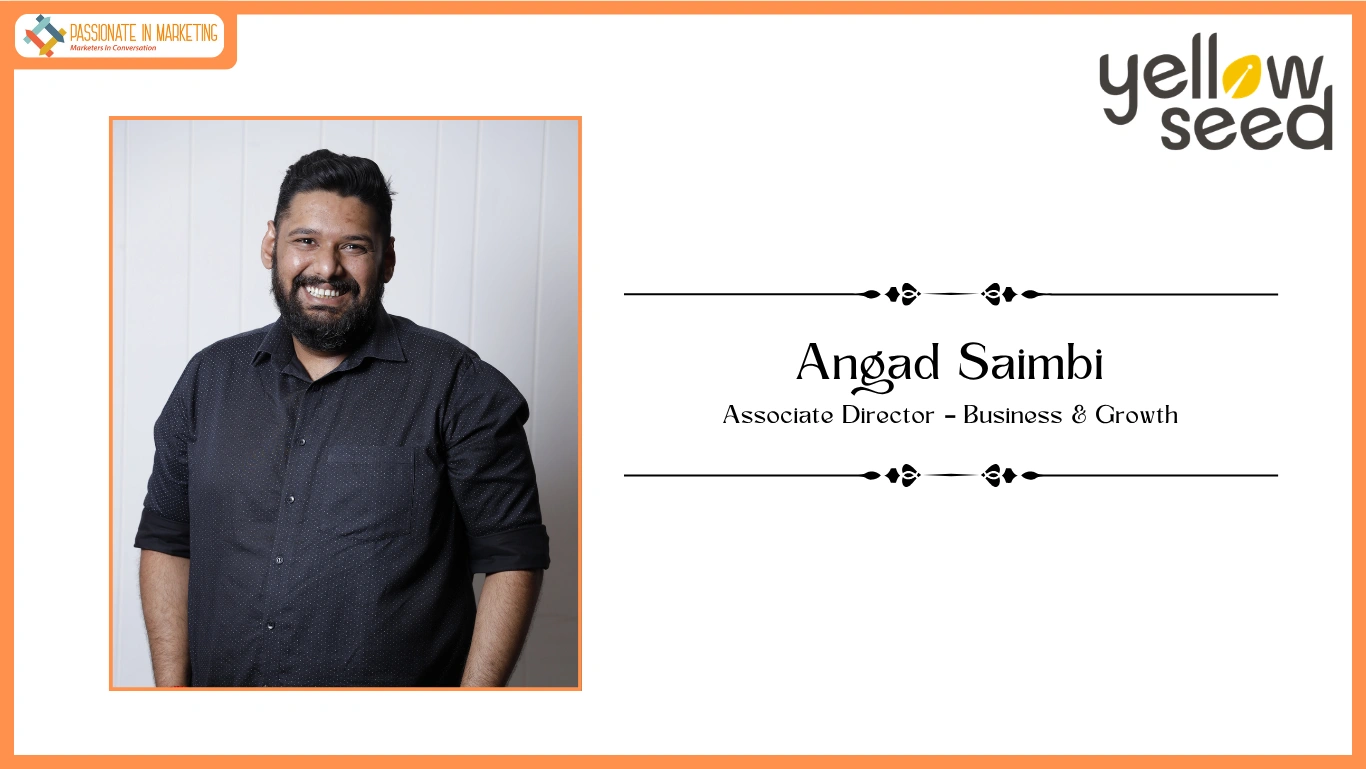
Yellow Seed positions itself as a Strategic Communications Hub rather than a traditional communications agency. What does this positioning mean in practice, and how does it translate into better business outcomes for clients?
In practical terms, it means we stop treating communication as a collection of deliverables and start treating it as a business system.
A traditional brief might ask for a campaign. Our first question is usually: What business problem are we trying to solve?
- Is the brand struggling with trust?
- Is it entering a new category?
- Is it trying to improve distributor confidence?
- Is it facing perception gaps between investors, customers, and employees?
- Is it launching a product that requires behavioural change rather than awareness?
Once you frame communication around the business problem, the solution often becomes cross-functional by default. A launch might require PR, digital storytelling, leadership communication, internal advocacy, experiential engagement, and performance amplification working in sync rather than in silos.
Clients experience better outcomes because communication stops being an activity centre and becomes a growth enabler.
Since its inception in 2012, how has Yellow Seed evolved alongside the changing communications landscape, and what have been the biggest shifts you’ve witnessed?
When Yellow Seed started in 2012, the communications landscape was far more channel-driven.
Brands asked:
- “Do we need Facebook?”
- “Should we invest in digital?”
- “Can content marketing work for us?”
Today, those questions sound almost quaint.
The biggest shift has been the movement from channel scarcity to attention scarcity.
In 2012, getting distribution was difficult. In 2026, distribution is abundant. Every brand can publish instantly across multiple platforms. What has become scarce is sustained attention and credibility.
The second major shift is the collapse of the distinction between brand communication and business communication. Customers, employees, investors, regulators, creators, and communities now consume the same information ecosystem. A leadership statement can become a customer conversation within minutes.
This has forced agencies to think less like campaign managers and more like reputation architects.
With AI transforming content creation, what role do you see human creativity and strategic thinking playing in the future of brand communications? How is Yellow Seed adapting to this shift?
AI is undoubtedly transforming content creation. It can generate copy, visuals, video variations, summaries, and campaign concepts.
But I don’t think AI makes human creativity irrelevant. It makes average execution abundant.
When everyone can generate competent content, differentiation shifts to three things:
- Judgment – knowing what not to say.
- Context – understanding cultural, regulatory, and business nuances.
- Strategic sequencing – deciding which message should appear, where, and in what order to influence behaviour.
At Yellow Seed, we are adapting by using AI as an acceleration layer, not a replacement layer. We use it to reduce production friction, analyse information faster, and explore creative territories more efficiently.
The human role becomes more valuable in insight generation, narrative construction, stakeholder alignment, and decision-making.
The future belongs to teams that combine machine speed with human discernment.
Yellow Seed works across diverse industries such as BFSI, healthcare, insurance, automotive, luxury, and lifestyle. How do communication strategies differ between highly regulated sectors and consumer-facing lifestyle brands?
One of the advantages of working across BFSI, healthcare, insurance, automotive, luxury, and lifestyle is that it constantly reminds us that communication strategy is shaped by risk tolerance.
In highly regulated sectors such as BFSI, healthcare, and insurance, the primary currency is trust.
The communication emphasis is typically on:
- clarity over cleverness,
- accuracy over virality,
- consistency over experimentation,
- education over entertainment.
A healthcare campaign that is memorable but medically ambiguous has failed, regardless of engagement numbers.
Lifestyle and luxury brands operate differently. They compete heavily on desirability, aspiration, cultural relevance, and emotional resonance. Here, storytelling can be more expressive, immersive, and trend-responsive.
The interesting challenge is that even lifestyle brands today cannot ignore trust, while regulated brands increasingly need human, emotionally intelligent communication. The gap between the two worlds is narrowing.
Experiential marketing and MICE are becoming increasingly important in brand building. How does Yellow Seed integrate physical experiences with digital storytelling to create more meaningful audience engagement?
Digital has given brands reach. It has not given them memory.
That is why experiential marketing and MICE have become strategically important. A well-designed physical experience creates something digital alone often cannot: shared emotional context.
Our approach is to treat physical experiences as content ecosystems rather than standalone events.
For example, an automotive showcase is no longer just a venue activation. It becomes:
- a live audience experience,
- a creator collaboration opportunity,
- a leadership storytelling platform,
- a community-building moment,
- and a post-event nurture journey.
The real value emerges when the experience continues to generate conversations before, during, and after the physical interaction.
Brands today have access to more communication channels than ever before, yet cutting through the noise has become increasingly difficult. What, according to Yellow Seed, defines an effective brand narrative in today’s environment?
The biggest mistake brands make is assuming that a brand narrative is a tagline plus a campaign film.
In today’s environment, an effective narrative has three characteristics:
- It is immediately understandable
If people need a presentation to explain what your brand stands for, the narrative is too complicated.
- It is internally repeatable
Employees, partners, and leadership teams should be able to express the core idea in their own words without distorting it.
- It is externally provable
Consumers are increasingly skeptical of claims that are not supported by visible behaviour, product experience, or operational evidence.
Emotion still matters enormously. But emotion without evidence now feels performative.
Businesses are increasingly looking beyond impressions and engagement metrics. How does Yellow Seed measure the success of a communications campaign, and what KPIs matter most from a business perspective?
Communications have historically been measured through impressions, reach, share of voice, and engagement. These metrics are useful, but they are leading indicators, not business outcomes.
The more important question is: What changed because of the communication?
Depending on the client’s objective, we increasingly focus on metrics such as:
- qualified lead generation,
- sales pipeline influence,
- cost per acquisition improvement,
- brand consideration uplift,
- customer retention indicators,
- partner onboarding velocity,
- employer branding effectiveness,
- and reputation sentiment among priority stakeholders.
Sometimes the most successful communications campaign is not the one that generated the most views, but the one that reduced sales friction by making the brand easier to trust.
With clients expecting communications to directly support business growth, how has the role of a strategic communications partner evolved over the past decade?
A decade ago, agencies were often evaluated on execution capability.
Today, clients expect communication partners to contribute to:
- market-entry thinking,
- customer understanding,
- category positioning,
- leadership visibility,
- stakeholder management,
- and growth strategy.
In many discussions, we find ourselves participating much earlier in the business conversation than agencies traditionally would have. The expectation is no longer “help us communicate this decision.” It is increasingly “help us think through the implications of this decision.”
That is a significant evolution.
What are some of the biggest misconceptions brands still have about strategic communications, and how does Yellow Seed help change that mindset?
Two misconceptions appear repeatedly.
“More content equals better communication”
In reality, more content often creates message dilution. Frequency cannot compensate for a weak strategic narrative.
“Virality equals effectiveness”
A million views are meaningless if the audience remembers the joke but not the brand, or remembers the brand but takes no meaningful action afterward.
Our role is often to shift the conversation from “What can we post next?” to “What perception are we trying to build over the next 12 months?”
That change in mindset is usually more valuable than any individual campaign.
Looking ahead, what emerging trends do you believe will shape the future of strategic communications over the next five years, and how is Yellow Seed preparing clients for this evolving landscape?
I believe five trends will have an outsized impact on strategic communications:
- AI-assisted personalisation
Brands will move from broad audience messaging to context-aware communication at scale.
- Trust as a competitive advantage
As synthetic content becomes more common, verifiable authenticity will become a differentiator.
- Integrated reputation management
The boundaries between PR, marketing, internal communication, and public affairs will continue to blur.
- Experience-led storytelling
Physical and digital experiences will increasingly be designed together rather than separately.
- Leadership visibility
People trust people more than institutions. Founder and leadership communication will become central to brand equity across sectors.
At Yellow Seed, preparing clients for this future means helping them build adaptive communication systems rather than campaign-dependent visibility.
The Summary
If I had to summarise the last decade in one sentence, it would be this:
Communication has moved from the edge of the business to the centre of business strategy.
That is why we no longer think of ourselves as a company that simply creates content.
Content is one output.
Campaigns are one output.
Events are one output.
The real work is aligning strategy, story, experience, and stakeholder perception so that communication does not merely generate attention—it generates business momentum.
And that is ultimately what a Strategic Communications Hub is designed to do.

