


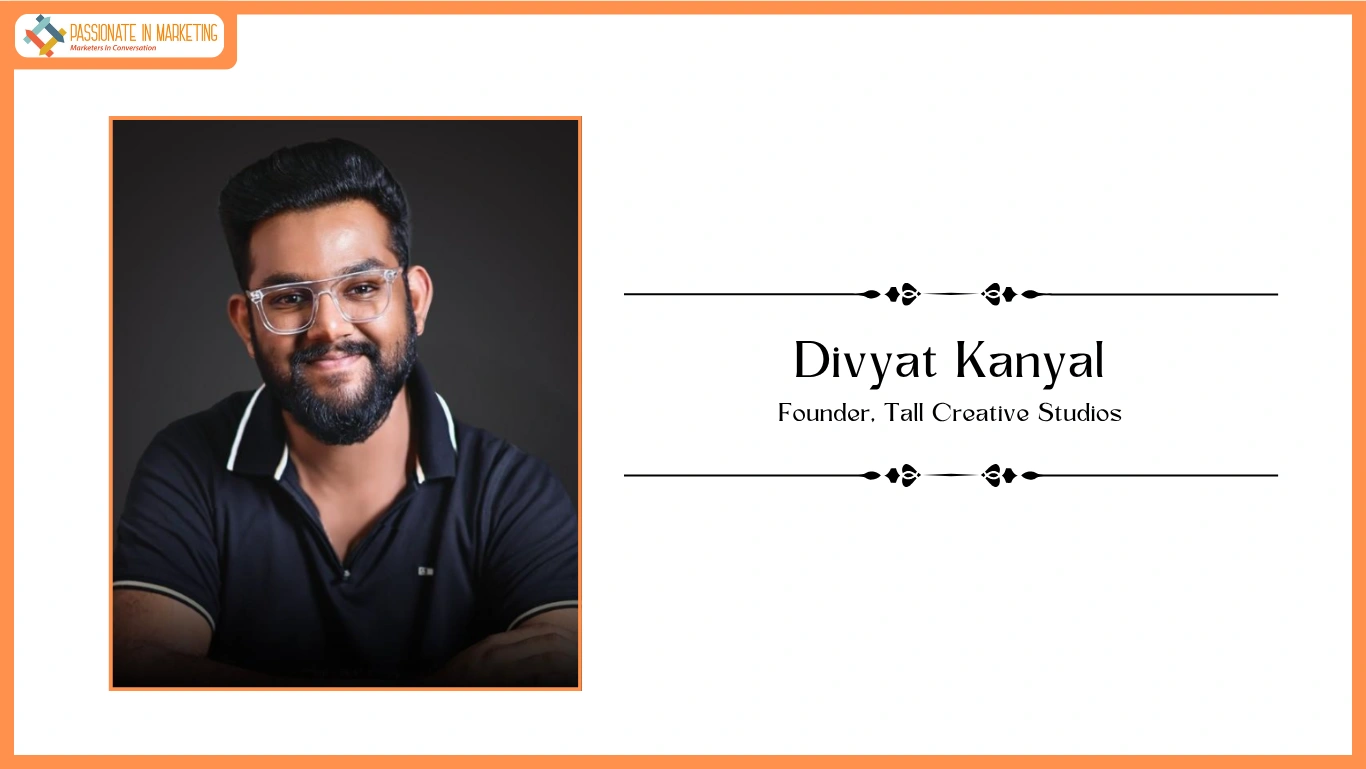
- Could you take us through how Tall Creative Studios has evolved as the creative and marketing landscape has changed, particularly with brands becoming more focused on digital-first communication?
We started with Marketing Samadhan in 2022 and worked closely with different businesses, which helped us understand how they approached marketing and content. That made us look more closely at what happens before the camera rolls; we give time to understand the audience, deconstruct the brief, and find the real communication objective, as digital is now a bigger part of brand communication and video has become central to how brands build perception and stay connected with their audiences.
Today, we work across brands, ad films, documentaries, corporate films, platform-native content, and AI-assisted production, while keeping the process closely connected from brief to delivery. For me, that combination of marketing thinking and visual storytelling is what has shaped TALL, and we are moving forward with the same thought process of providing our clients with the right communication and storytelling for what they need. So, yes, from being born as a marketing agency to growing into a platform for creative storytelling, we have evolved a lot.
- From your experience, what makes a creative idea commercially powerful rather than simply visually appealing or attention-grabbing?
A visually beautiful film can grab attention, but I believe that a strong creative idea should actually do something for the brand by changing a perception, building trust, creating curiosity, or moving them closer to their business objective. A creative idea becomes commercially powerful when it can answer one very basic question: what is it going to change for the brand? I look at the audience first to know what they currently think about the brand I am working with, and what we are actually going to try to change in their minds.
Tall Creative Studios is built on a strong belief that every frame should earn its place and help shift how the audience sees the brand, because that shift will build trust, influence consideration, and eventually drive the business forward. Your idea should have a narrative spine, because visual representation without strong storytelling, without a creative hook, quickly becomes noise. We also keep the business objective in the room through the entire process that involves the script, the shoot, the edit; even the final format should have a reason behind it.
- AI is rapidly becoming part of the creative workflow. Do you see it primarily as a productivity tool, or do you think it could fundamentally change how creative ideas are conceived and executed?
We can’t ignore the potential AI brings for creativity and ideas, as it is already fundamentally changing the creative workflow. We are using GenAI across workflow automation, moodboarding, pre-production, post-production, and the way we develop ideas at TALL. What’s interesting is that generation is only one part of the process. You can create hundreds of outputs, but the real creative work comes in knowing which one belongs to the story, which one carries the right emotion, and which one actually fits the brief. So, in a way, the machine is dreaming it, but we still have to direct it according to what will create more impact and give it the best angle that the audience can relate to in the best way. That gives creative teams much more room to experiment, and I think it will change how ideas are developed in the first place.
I personally enjoy experimenting with new AI tools and creative workflows and can see how quickly the skills around content creation are changing. That is something we are working on through our own TALL Academy, where we are combining human expertise with AI-powered learning to make skill development faster, smarter, and more practical. The idea is to make AI more accessible to creators and professionals, help them adapt to new technologies, and keep creativity and storytelling at the centre of that learning.
- The advertising industry has shifted from traditional TVCs to digital-first films, short-form content, and platform-specific storytelling. How has this changed the way ad films are conceptualised and produced today?
The shift from TVCs to digital-first films has changed the entire way we approach an ad film. Earlier, you could spend most of the film building a story and arrive at the brand towards the end. Today, you may have just a few seconds to make someone stop scrolling, so the hook and the message must be immediate. Consumers can discover a brand in so many different ways as well because they have multiple platforms to explore content that runs ads. They might see it through a creator, an influencer, a UGC video, a performance ad, or even a marketplace listing before they ever see the hero film. A simple skit between two creators can sometimes feel far more relatable than putting a big celebrity in a TVC. We focus on thinking about the concept that includes who should tell the story, where it should live, and what format will make the audience stop and engage.
That also changes production. One script you shoot today has to involve horizontal and vertical frames, cutdowns for short-form, different hooks, behind-the-scenes shoots, creator-style assets, and platform-specific content. We plan for that right from the shoot rather than trying to create everything later through cropping and editing. And the edit keeps evolving too. Digital platforms give you the ability to test, learn from audience response, and keep refining the creativity, content, and production outcomes.
- Some of the most successful campaigns are built around a cultural moment rather than a conventional product message. How important is timing and cultural context when creating a campaign today?
Timing is definitely important, but first you have to understand what is actually happening in culture and why people are talking about it. Earlier, a campaign could take weeks or months to plan, produce, and release, and the cultural moment was often something the campaign was built around in advance. Today, something can happen in the morning and become the creative brief by the evening.
Zepto’s “Gift A Book” initiative around World Book Day this year is a good example of how a quick decision can help you connect with your consumers quickly. Zepto turned World Book Day into an actual action with a doorstep donation initiative in collaboration with an NGO, where people could hand over their pre-loved children’s books to delivery partners and have them distributed to children who needed them. Also, there is the same speed in the way.
Zomato and Swiggy Instamart react to match moments; there is always a quirky message people receive on any occasion or cultural moment, memes, or something suddenly taking over the internet that attracts people a lot. The idea can come together and go live within hours. That’s where timing really matters. By the time you overthink a cultural moment, it may already be yesterday’s conversation. The creative has to be quick, relevant, and still feel completely natural to the brand.
- Tall works across different formats, from ad films to digital content. How do you decide which storytelling format is best suited to a particular campaign and its audience?
Format is never the starting point for us; the gap is. Before we even think of any type of format, we deconstruct the brief: what the client thinks they’re asking for and what the audience actually needs to feel to change how they see the brand. The stated ask and the real objective are rarely the same, and that gap is what decides the format, not the budget or the trend of the week.
A legacy brand trying to look contemporary to a new-age audience needs a different vehicle than a D2C founder trying to build trust before a scale-up round. One might call for a high-craft brand film, the other for something that looks and feels like it wasn’t “produced” at all. We look at where the audience already is, what they’re numb to, and what actually breaks through that noise. Then we reverse-engineer the format from there.
That’s really our whole philosophy of perception over views. We’re not choosing formats to fit a platform’s algorithm; we’re choosing them to shift a specific perception in a specific audience’s head. If it doesn’t move that needle, we don’t make it, no matter how good it would look on a reel.
- In your view, what is one thing brands are currently getting wrong about advertising and consumer attention?
There are times when brands underestimate how quickly people decide whether they want to give time to watch an ad film or scroll past it. Their attention span is decreasing as they are already exposed to a variety of content, seeing hundreds of videos and ads every day, so when a brand puts out another piece that is trying to explain five things together, people simply scroll past.
Good advertising starts with one strong thought, tells it well, and respects the audience enough to keep it simple. Attention today is very quick, and you have a few seconds to make someone curious enough to stay; that is why the communication should feel easy to consume, and ideas must be creative as well as simple. Sometimes brands also get too focused on chasing every trend or every platform. The better question is what is actually worth saying and what will make someone care. You end up making the audience work too hard to understand what you want to say.
- What do you think will define successful advertising in India over the next three to five years: technology, storytelling, personalisation, cultural insight, or something else?
For us, choosing the format is really about understanding what the story needs and then making sure that thought survives all the way through production. A brief can change quite a bit once you get into scripting, shooting, and editing, so we’ve kept TALL boutique for a reason.
Every deliverable needs a narrative, so the format has to support that story rather than the other way around. It could be an ad film, a documentary, short-form content, a corporate film, or even a creator-led campaign, depending on what will communicate the thought most effectively.
Because we come from marketing, we know the business before the camera rolls. That makes the format decision much more instinctive; we are really asking, “What’s the best way to tell this particular story to this particular audience?”
- Are brands today investing enough in distinctive brand-building, or has the focus on immediate performance and engagement made long-term advertising strategy more difficult?
A lot of brands are under-investing in distinctive marketing or image building today. There is a lot of pressure to show an immediate number, such as how many clicks, conversions, engagement, whatever can be measured quickly, and that naturally pushes brands towards short-term communication.
The problem is, when every brand starts chasing the same performance formats, trends, and content styles, it starts to feel and sound very similar. You may get the click, but what does the audience actually remember about the brand after that? Brand building takes time because you are shaping a perception.
I don’t think performance and brand building need to fight each other because the strongest work can drive a response today while also making the brand more memorable for the next conversation, the next campaign, and the next purchase.
- Looking ahead, what kind of campaigns does Tall Creative Studios want to be known for creating as the advertising industry continues to evolve?
The industry’s changing on more fronts than one. Attention is fragmenting across platforms, audiences are getting harder to fool with polish alone, the line between “content” and “advertising” is disappearing, and creators are becoming as central to a brand’s voice as the brand itself. We want to be known as the studio that read all of that early and built for it, instead of reacting to it a cycle too late.
That means campaigns that don’t announce themselves as ads. Work that earns attention because it’s genuinely well told, not because it interrupted someone. It means being early and thoughtful with new tools, including AI, using them to make sharper, faster, more personalized work rather than cheaper versions of the same thing. It means treating creators and influencers as narrative partners, not media placements, because fit will always matter more than follower count to us. And it means staying rooted in marketing thinking as the industry gets noisier, so the work is always built to shift perception, not just rack up views.
If we’ve done our job in five years, TALL won’t be known for one trend we rode well. We’ll be known as the studio that understood the brief before anyone else did, regardless of what format, platform, or technology that brief needed.

