


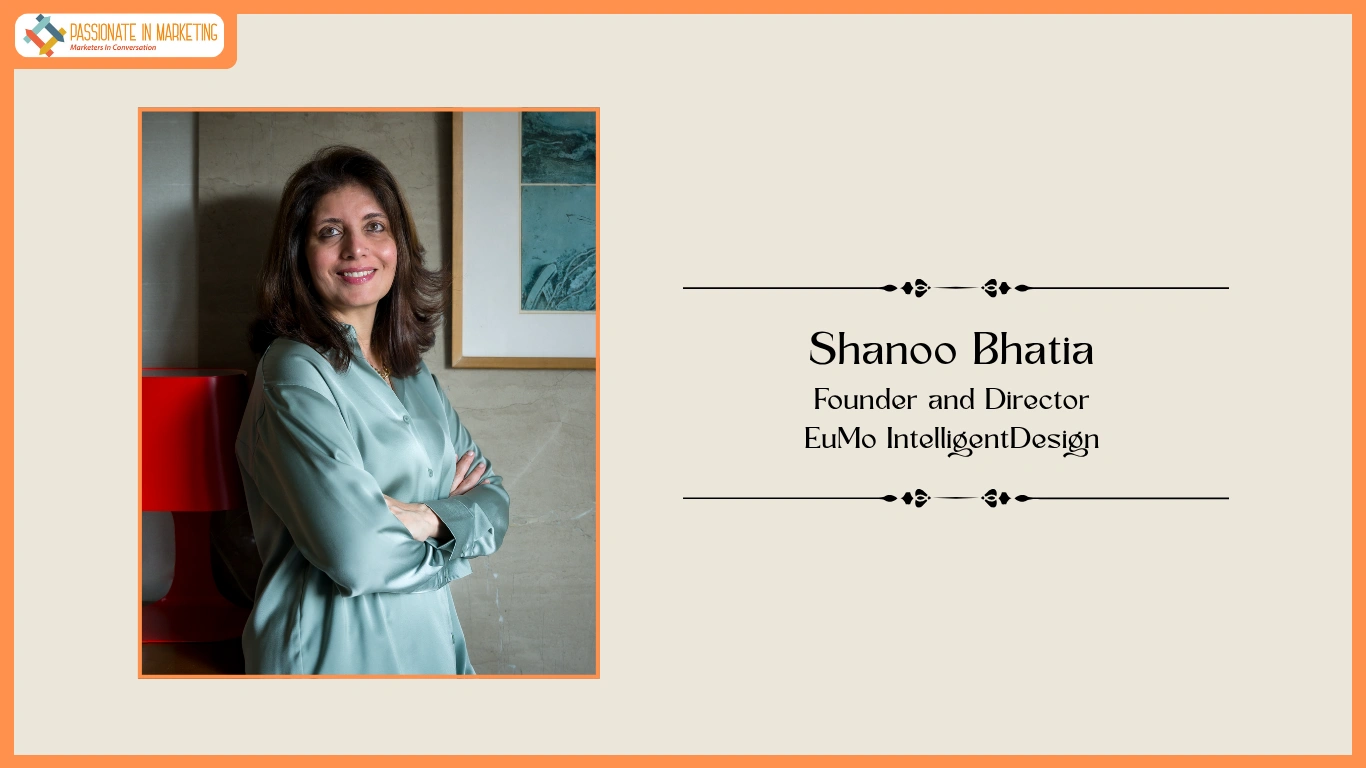
- You’ve led brand and experience transformations for the Tata Group, Mahindra, ICICI Bank, Piramal Enterprises, and others. How do you translate a company’s strategic vision into tangible, human-centred experiences?
We use our proprietary Design Intelligence framework which starts with a deep, research-based understanding of the company, its function, its purpose, and its vision. We look far beyond the brief and immerse ourselves into customer behaviour, untold stories, aspirations, habits, and patterns. At the same time, we also deep dive into the competitive landscape to identify where true differentiation can emerge.
As a team, we spend significant time with the brand’s leadership to decode their vision and then layer that with the high-frequency customer insights we uncover. The intersection of these two becomes the foundation for our Big Idea, a unifying concept that aligns the business’s intent and direction with its customers’ needs.
From there, we go about translating that idea into both conceptual and experiential formats, designing integrated brand experiences that are compelling for the brand while also being tangible, desirable, and viable for their real-world customers.
- EuMo integrates Brand Experience, Customer Experience, Employee Experience, and Visitor Experience. How do you ensure all these touchpoints work together seamlessly to create meaningful engagement?
For us, Design Intelligence is a founding philosophy, one that is inherently cross-disciplinary.
EuMo has always been a design-led firm. Gary and I bring over three decades of experience across different design disciplines. We’ve built EuMo as an integrated design practice with deep expertise across visual communication design, UX/UI, interpretive design, spatial design, and architecture. More importantly, we’ve built a culture where these disciplines don’t operate in silos.
Collaboration is so deeply embedded into how we work. Every discipline feeds into the other, so whether it’s a customer, employee, or visitor touchpoint, it all feels like one cohesive narrative, not a set of disconnected experiences.
- 3.Working across corporate, institutional, cultural, and public-sector projects, how do you ensure large-scale initiatives stay strategically aligned and practically executable?
Gary and I stay closely involved in every project and work alongside our core teams through the entire journey. Our role is to constantly anchor the work back to the original intent and the larger strategic objectives. We make sure that senior team members are always aligned with that intent, so decisions are made with clarity, not assumption. At the same time, we bring a strong lens of viability. We can usually anticipate implementation challenges early on and guide the team accordingly, without taking away from the ambition of the idea.
It really comes down to balance. Protecting the integrity of the concept, while ensuring it can be executed effectively and at scale.
- How do you help brands differentiate themselves through experience design, turning routine interactions into lasting impressions for customers, employees, and visitors?
I think experience design is often misunderstood. It’s not about putting together brand stories across multiple screens or adding layers of projections with product displays. For us, it’s about orchestrating a journey. A well-thought-out customer journey that reveals stories in layers, at the right moments, in the right way.
We work as an integrated brand experience design firm, therefore we’re able to bring together storytelling, content, interactivity, and technology in a very deliberate way. We use technology very meaningfully at the right points in the journey. Our expertise across our capabilities helps us create narrative depth and drive engagement. Intelligent sequencing and integration of the storyline into the entire journey leaves a lasting impression.
- How do you measure the impact of experience design on business performance, culture, and stakeholder engagement?
There are tangible ways to measure the impact of experience design. We look at before and after scenarios, unfiltered testimonials captured through technology, as well as metrics like footfall and time spent. These give us a strong sense of the business impact.
At the same time, cultural impact and engagement are a bit more nuanced. We study those through periodic conversations and interviews, really understanding how people are responding to the experience over time. And then there’s alignment. We look at how well the experience is helping stakeholders connect with the organisation’s goals, and that comes through clearly in their responses. So it’s always a mix of hard data and deeper human insight.
- How has your leadership at EuMo evolved to handle complex, multi-disciplinary projects, and what lessons have you learned in aligning design thinking with business goals?
Fortunately for us, our leadership has always been quite complementary. Gary brings deep expertise in interiors, hardware, fixtures, and technology integration, while my areas of expertise include conceptual direction, strategy, goal alignment, aesthetic language, and content. We work collaboratively, constantly building on each other’s inputs. We have a highly committed, select team who bring their expertise and talent across capabilities. This dynamic allows us to take on complex, multidisciplinary projects and shape them into something extraordinarily cohesive and meaningful.
The term Design Intelligence is part of our brand name. In many ways, it’s similar to how you think about Business Intelligence. For us it’s about balancing creativity and empathy with practical, viable thinking. This approach helps us align strategic design with clear business outcomes.
- What trends are shaping the future of experience design in India, and how are brands adapting to meet evolving expectations?
I’ve always believed that intent matters much more than trends. If that’s not clear, you end up chasing noise instead of building something meaningful. That said, we are seeing some huge shifts in a very short span of time. Technology, especially AI, is becoming more accessible and brands are starting to use it to create more responsive, interactive, and context-aware experiences. At the same time, audiences in India are evolving quickly. People are no longer looking for fleeting, surface-level interactions, they’re seeking experiences that move them and stay with them. This new generation is far more driven by depth and meaning. They value experiences that leave a lasting impact, rather than passive consumption or one-dimensional content. And this shift towards depth over distraction is redefining how brands need to think about engagement.
- For emerging companies what advice would you give on building a scalable brand experience strategy that grows with the organization?
Start by getting brutally clear on your truth. What do you actually stand for and what makes you meaningfully different in substance. If that foundation is vague, nothing you build on top of it will scale cleanly.
From there, define a sharp, operational brand experience persona. A clear set of behaviors, for example how the experience should feel, respond, and show up across moments that matter. Then translate that into systems: principles, patterns, and guardrails that teams can actually use across product, marketing, and service.
Scalability comes from making that experience repeatable without diluting it. That means designing for consistency upfront. Whether it’s your first 1,000 users or your next million, the experience still feels intentional.
The real unlock is internal. When teams understand the persona and can apply it instinctively in their day-to-day decisions, consistency will become organic. That’s what allows the experience to grow without losing its edge.

