


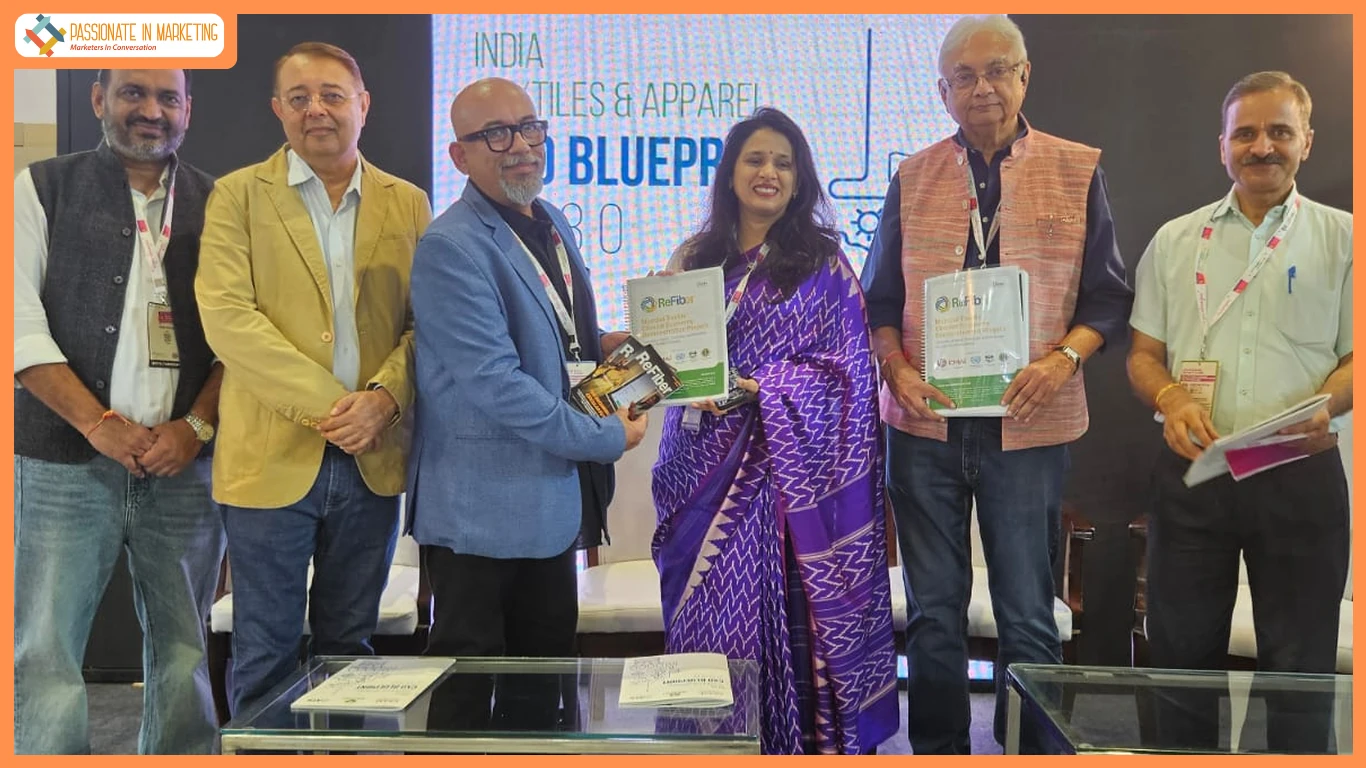
National, 20th July 2026: As one of the world’s largest producers and consumers of textiles, India faces a growing challenge in managing post-consumer textile waste. Addressing this gap, ReFiber, powered by OterRi, unveiled its flagship White Paper, ‘Mumbai Textile Circular Economy Demonstration Project’, at Bharat Tex 2026. Presented at the Eco Stitch Sustainability and Circularity Hub, an initiative by the Clothing Manufacturers Association of India (CMAI) and the Global Alliance for Textile Sustainability Council (GATS), the white paper showcases one of India’s first technology-enabled demonstrations of a city-scale circular textile ecosystem.
The White Paper documents the outcomes of the Mumbai Textile Circular Economy Demonstration Project, launched on World Environment Day 2026 at the World Trade Center Mumbai. Powered by OterRi and implemented in partnership with Tisser, CMAI, UNIDO, World Trade Center Mumbai and Lions International, the initiative brought together citizens, doorstep collection, digital traceability, women-led upcycling and responsible recycling into a single ecosystem, demonstrating a scalable first-mile collection model for post-consumer textiles.
The Mumbai demonstration collected 2.7 tonnes of post-consumer textiles on World Environment Day 2026, generating 275 collection orders from 257 citizens through 15 laundry partners across 28 branches. The project validated that existing city service networks can enable efficient first-mile textile collection without parallel logistics.
The White Paper identifies six key barriers to textile circularity in India; no source segregation, no citizen incentives, no traceability, no organized collection infrastructure, weak links to recyclers and upcyclers, and, critically, no way to measure impact. Its findings demonstrate how technology-enabled solutions can accelerate textile circularity while creating environmental, social, and economic value through women-led upcycling enterprises, Self-Help Groups, and local businesses.
Shrikant Bhangdiya, Chairman, ReFiber Initiative, said, “India’s textile heritage is deeply woven into our culture, economy and identity. At ReFiber, we aim to transform post-consumer textile waste into a resource by building a transparent, traceable and scalable circular economy ecosystem. The Navi Mumbai pilot has demonstrated how technology, citizen participation and collaboration can create environmental, social and economic value, paving the way for a circular textile future for Maharashtra and India”
Manoj Wanvari, COO, OTerRi & ReFiber, added, “The Mumbai Textile Circular Economy Demonstration Project is a significant milestone in our journey to build a scalable textile circularity model through technology, data-led insights and ecosystem collaboration. We plan to take this model forward by building city-wide, state-level and eventually national circular textile infrastructure powered by digital traceability, organised collection networks and inclusive stakeholder participation, a powerhouse solution and the need of the hour for India’s textile waste challenge.”
At Bharat Tex 2026, ReFiber presented the White Paper to senior policymakers, government representatives, industry leaders and international organisations shaping India’s textile future. The White Paper was presented to Smt. Neelam Shami Rao, Secretary, Ministry of Textiles; Ms. Vrunda Manohar Desai, Textile Commissioner; Shri Kartikay Dhanda, Secretary, Textiles Committee; Ms. Radhika Batra, Chief of Staff, United Nations Resident Coordinator’s Office (UNRCO), India; Dr. Cristiano Pasini, Director and UNIDO Representative for India and South Asia; Dr. Pankaj Kumar, National Project Coordinator, UNIDO; senior leadership from CMAI; Mr Santosh Katariya President of CMAI; Mr Naveen Sainani Chairperson CMAI Ecostitch Sustainability cell; Mr Rahul Mehta Chief Mentor CMAI; Mr. Parvinder Kadyan, Founder Director, GATS; and representatives from the Governments of Nagaland and Karnataka, reinforcing the importance of collaborative action in advancing India’s circular textile ecosystem.
Building on the Mumbai demonstration, ReFiber’s phased roadmap aims to scale from Navi Mumbai to the Mumbai Metropolitan Region, Maharashtra and eventually across India. By leveraging technology, traceability, organised collection and partnerships, ReFiber seeks to build a scalable circular textile ecosystem that transforms waste into resources and accelerates India’s transition towards a sustainable future.
The complete White Paper can be accessed here.
About ReFiber
ReFiber, powered by OterRi, is a technology-enabled circular economy platform designed to transform how India collects, tracks and recovers post-consumer textile waste. Rather than functioning as a standalone collection drive, ReFiber integrates digital citizen engagement, doorstep collection through OterRi’s established laundry and delivery network, source segregation, material traceability and impact reporting into a single ecosystem. Through partnerships with organisations such as Tisser, CMAI, UNIDO and World Trade Center Mumbai, ReFiber aims to build a scalable, replicable Digital Public Infrastructure for textile circularity—from a single city demonstration towards a state-wide and eventually national model.
About OterRi
OterRi is the doorstep laundry-service aggregator and micro-logistics network that powers ReFiber’s collection infrastructure. Its established base of laundry service partners and delivery personnel gives ReFiber a ready-made, hygienic first-mile collection channel capable of recovering textiles directly from households, addressing one of the most persistent barriers in textile recycling, access to clean, source-segregated material.

