


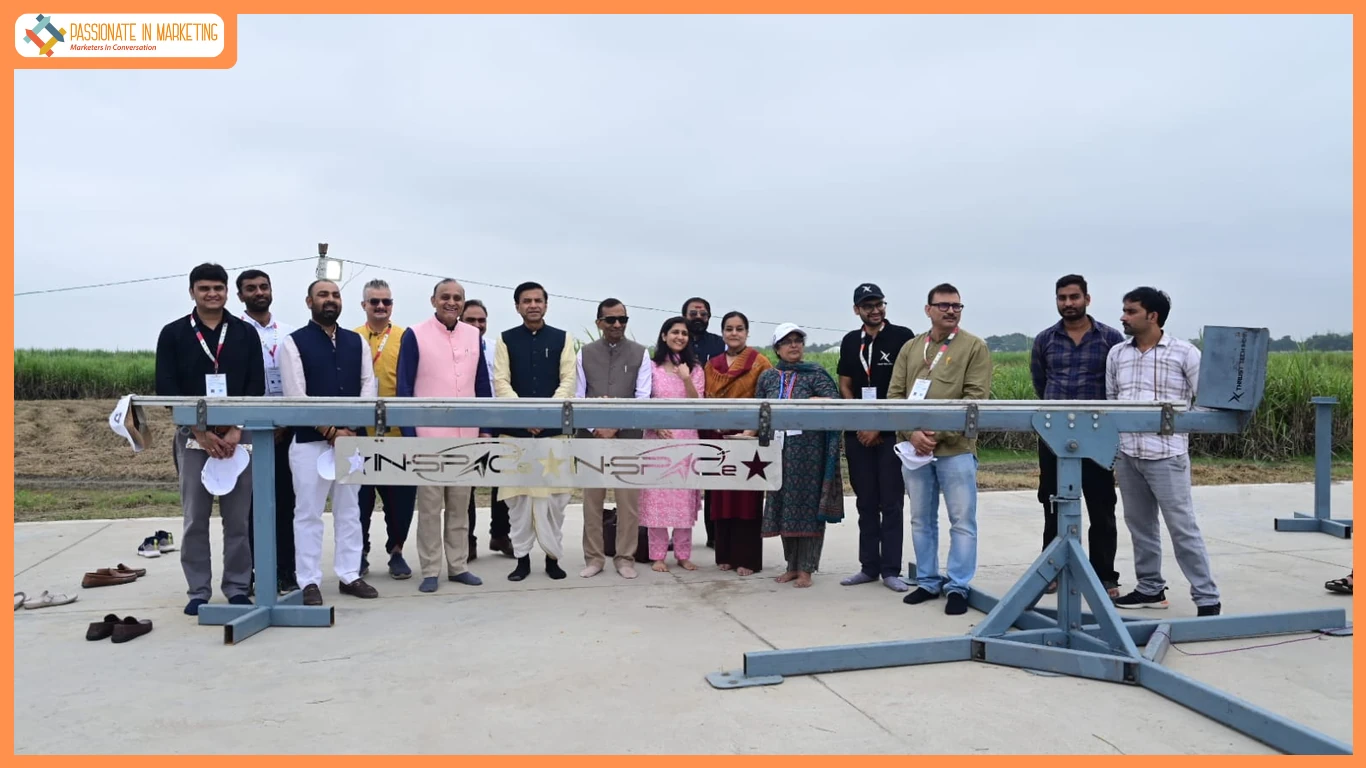
4 November 2026: Student teams from across India launched 43 CanSats and 18 model rockets at the national student space competitions run by the Indian National Space Promotion and Authorisation Centre (IN-SPACe), which concluded today in Kushinagar. Last year’s edition saw 24 CanSats and 13 rockets.
The four-day event, held from 31 October to 3 November 2026, hosted the 3rd CAN-7USAT India Student Competition and the 2nd National Model Rocketry India Student Competition, the IN-SPACe Narayani Rocketry Cup 2026. 76 teams designed, built and tested their own hardware, which was evaluated by expert committees drawn from the Indian Space Research Organisation (ISRO), the Defence Research and Development Organisation (DRDO), IN-SPACe, industry and academia.
Holding the competitions in Kushinagar took national-level space engineering to a largely rural district in eastern Uttar Pradesh. Speaking at the event, Shri Shashank Mani Tripathi, Member of Parliament, Deoria, said he aspires to set up a permanent space experimentation centre in the region, so that young people can take part in rocketry and other scientific activity year-round.
Shri Shashank Mani Tripathi said, “Technology must ultimately serve the common people. Competitions in rural regions give students an opportunity to understand real-world challenges while bringing scientific innovation closer to communities. We aspire to establish a permanent space experimentation centre in the region, enabling young people to participate in rocketry and other scientific activities throughout the year. India’s youth must translate their knowledge into innovation, entrepreneurship and nation-building.”
Dr. Pawan Goenka, Chairman, IN-SPACe, said, “Every CanSat and rocket that flew this week was designed, built and tested by students, and that hands-on experience is exactly what India’s space industry needs from its next generation of engineers. As private companies take on a larger role in India’s space programme, the demand for people who have built and flown real hardware will only grow. Holding these competitions in Kushinagar also shows that talent for the space sector exists well beyond our metros, and IN-SPACe will keep creating opportunities for it to be discovered.”
The student-built CanSats are the size of a 7U satellite bus, allowing teams to accommodate maximum payloads as well as Guidance, Navigation and Control (GNC) systems. The CanSats carried sensors to record parameters such as temperature and atmospheric pressure during flight. Some teams added cameras to capture images and video of the terrain and designated landing zones, and tested applications such as vegetation monitoring.
In the Model Rocketry competition, 18 student-built rockets were launched. Teams were judged on the design, development and testing of their rockets, with an emphasis on innovation, precision and system performance.
Dr. Vinod Kumar, Director, Promotion Directorate, IN-SPACe, said, “The dedication and year-long efforts of the students have resulted in a successful edition, with 43 CanSat launches and 18 model rocket flights, surpassing last year’s figures of 24 CanSats and 13 rockets. These competitions provide valuable opportunities for students to test their capabilities, learn through practical experience and contribute to India’s growing space ecosystem.”
Dr. M.G.R. Educational and Research Institute, Chennai, won the 3rd CAN-7USAT India Student Competition, with C.V. Raman Global University, Bhubaneswar, placing second and BMS College of Engineering, Bengaluru, third. Central University, Jammu, received the Best Team Award and BITS Pilani – Hyderabad Campus the Best Design Award.
In the 2nd National Model Rocketry India Student Competition, the IN-SPACe Narayani Rocketry Cup 2026, Nirma University, Ahmedabad, took first place, followed by Karunya Institute of Technology and Sciences, Coimbatore, and Delhi Technological University, Delhi. Dwarkadas J. Sanghvi College of Engineering, Mumbai, won the Best Team Award and Pimpri Chinchwad College of Engineering, Pune, the Best Design Award.
The first-placed teams in both competitions each received a cash prize of ₹10,000, supported by EV Society Bengaluru, with iTelematics Software Private Limited as industry partner.
About IN-SPACe:
Indian National Space Promotion and Authorization Centre (IN-SPACe) is an autonomous nodal agency attached to the Department of Space, Government of India formed on 24 June 2020 to promote, enable, authorize and supervise non-government entities (NGE) to undertake space activities. These activities include manufacturing of launch vehicles and satellites, providing space-based services, establishing a ground station, sharing of space infrastructure & facilities; and establishing new facilities under DOS.
IN-SPACe is currently functioning with three directorates viz., Promotion Directorate (PD), Technical Directorate (TD) and Program Management and Authorization Directorate (PMAD) and Legal, Finance and Administration Wing with its headquarters at Ahmedabad.

