


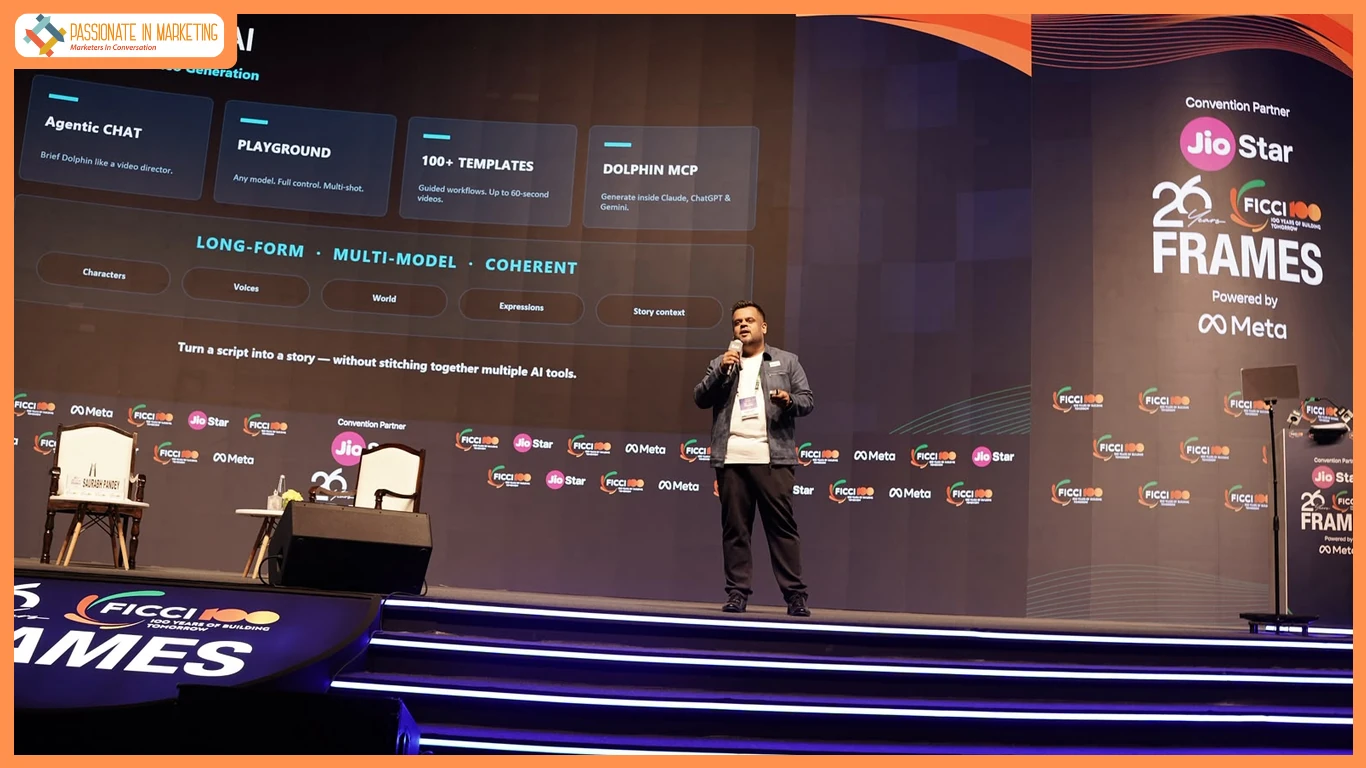
Founder and CEO Saurabh Pandey says microdrama is the quick-commerce moment for entertainment, and that India, now the fastest-growing microdrama market, can build entertainment for the world
Overview
Saurabh Pandey addressed the FICCI FRAMES audience today via his keynote session where he addressed two major questions shaping the industry: where entertainment is headed, and how AI will shape it. Titled “The Future of Entertainment: AI, Scale, Storytelling”, the keynote set out how technology is changing what gets made, how audiences watch, and where Indian entertainment goes from here. Dolphin AI is open for early access globally at trydolphin.ai.
Key takeaways
Content follows the consumer
Pandey opened with the evolution of screen entertainment. Cinema made viewing an event, and television turned it into a habit. OTT then put it on demand, before short-form video made it snackable. Microdrama is the next step, built for commutes and short breaks, and it marks a move from user-generated to professionally produced vertical content.
He compared the shift to the move in cricket from Tests to ODIs to T20, and to the rise of quick commerce. Microdrama, he said, is the quick-commerce moment for entertainment. Each time a format has become faster in India, the category has grown bigger.
India is growing fastest
Globally, microdrama is a USD 15 billion category, led by China and followed by the United States. India is now the fastest-growing market. Microdrama downloads in the country have reached roughly 60 to 65 percent of OTT downloads, and users spend 60 to 70 minutes a day on these apps. Pandey put the current Indian market at USD 600 to 700 million and, citing Redseer and Lumikai, said it is on track to reach USD 3 billion within three to four years, with the potential to overtake the Indian film industry.
Languages are the growth engine
Story TV began in Hindi and has since expanded into Tamil, Telugu, Bhojpuri, Kannada and Malayalam. In 12 months it has built a library of more than 5,000 microdramas and crossed 120 million users, who watch for over 100 minutes a day.
AI solved the scale problem
Demand soon outpaced production. Story TV was making about 100 shows a month when audiences needed 200 to 250. AI closed that gap by cutting production costs and shortening
the time taken to test new ideas. It also opened up hybrid formats that pair live actors with AI-generated backdrops, and made genres such as period drama viable at microdrama budgets. The result is a flywheel in which every idea moves from script to video, and audience performance data shapes the next round. Story TV now produces 250 shows a month.
Introducing Dolphin AI
Dolphin AI was built to fix the problems creators face with AI video today, such as lost context, locations that drop out between shots and props that change from one scene to the next. Before the public launch, the Eloelo team generated about 48,000 videos on the platform internally. Dolphin AI works in three layers:
- Hundreds of presets for UGC, social and tutorial videos, designed for first-time creators
- A chat-based agent that turns a brief into a finished video
- A studio workflow suite for professionals making long-form content and drama series, which works alongside existing tools such as Claude and n8n
From IT services to entertainment exports
Pandey closed by placing the launch in a national context. AI video, he said, could make entertainment the next major export from India, much as IT services became in the 1990s. Indian creators can now produce content in the languages of other markets without large production teams. He framed this as powering the Orange Economy of India, with the human creator firmly at the centre.

