


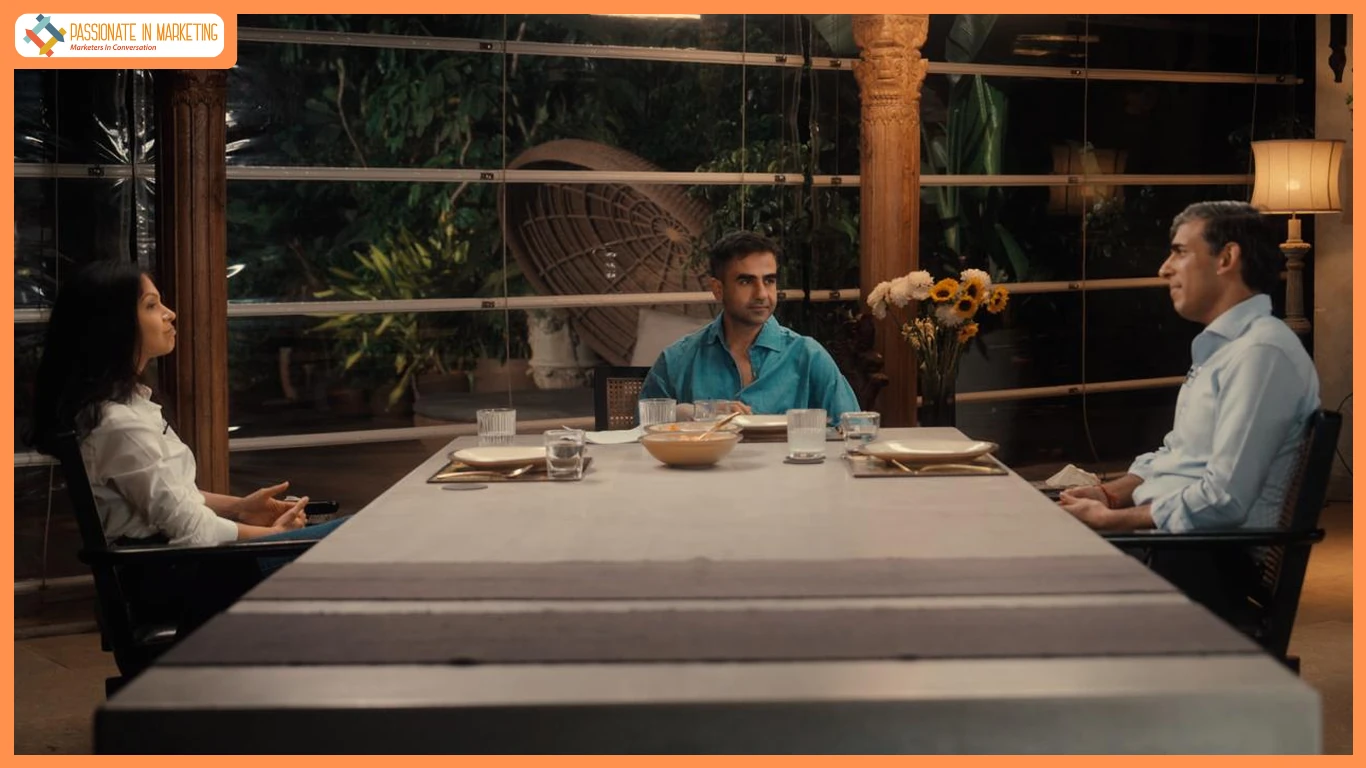
PART I: THE BLANK CANVAS
NIKHIL KAMATH: You’ve just stepped out of the Prime Minister’s office. Most people would describe that as a massive loss. But I’m curious—how do you actually experience it?
RISHI SUNAK: It’s hard. Extremely public. It comes at the end of a grueling campaign. But here’s what’s interesting: for the first time in my career, I don’t know what the next thing is. There’s no predetermined track. No expected milestone. No Google Calendar reminder about what I’m supposed to be doing. And that’s actually exciting.
NIKHIL: But you had a path your entire life. Goldman Sachs, hedge funds, Parliament, Chancellor, Prime Minister. Now—nothing.
RISHI: Now nothing. Which means, for the first time, I have to actually think about what I want. Not what’s next on the progression. What I actually want.
AKSHATA MURTY: And that’s terrifying. Because the moment you’ve been moving at that pace, that velocity, that purpose—and suddenly you stop. The silence is intense. You have to be very kind to yourself in that space. The person you have to be kindest to first is yourself.
PART II: FAILURE & THE STORY YOU TELL
NIKHIL: Most leaders either victimize themselves after a loss or pretend it didn’t hurt. You seem to be doing neither.
RISHI: The story you tell yourself about failure matters enormously. If you tell yourself you’re a victim, you’ve given away your agency. You won’t learn. You’ll just feel bitter. If you tell yourself it was entirely your fault, you spiral. The truth is usually in the middle. You had agency, but you weren’t omnipotent. You can improve, but you can’t control everything.
AKSHATA: There’s also the dharma piece. In the Bhagavad Gita, Krishna tells Arjuna: focus on your duty, not on the fruits of your action. You did what you thought was right. The outcome wasn’t what you wanted. But your duty was clean.
PART III: THE INDIA CONSUMPTION THESIS
NIKHIL: Let me shift gears. You’ve been very engaged with India economically. What are you seeing?
RISHI: India’s story right now is consumption. Your GDP is growing at 6-7%. Your consumer sector is growing at 12-13%. That’s not a rounding error. That’s a signal. A generational cohort—the 200 million young people—is borrowing and spending at rates their parents never did. And they’re not buying what their parents bought. They want new brands. They want indigenous. They want authenticity.
NIKHIL: That’s why I started Foundry. Twenty to thirty founders. Three months. Alibaug. Living together. Building consumer brands in parallel. Toothpaste. Candy. Jeans. Chocolate. The goal is to make founders into heroes before their product hits the market.
PART IV: EDUCATION, AI, AND LEARNING IN REAL TIME
NIKHIL: I never went to college. I’m still massively insecure about it. But I also think college might be obsolete.
AKSHATA: It’s not college that matters. It’s the ability to learn. I took a liberal arts path in California. Not engineering. Not business. I studied philosophy, literature, art. Because I knew that path—the India-to-engineering pipeline—wasn’t me. That willingness to be non-linear, to trust yourself enough to say ‘this isn’t my path,’ that’s what matters now.
RISHI: I use Claude for research every day. I don’t use AI to write. I write all my own speeches, all my arguments. But I use it for thinking through policy, for asking ‘what am I missing here?’ The discipline of not outsourcing your thinking—that still matters.
PART V: BALANCE, DHARMA, AND THE MIDDLE PATH
AKSHATA: During the pandemic, I read Hermann Hesse. Siddhartha. And there’s this idea of the middle path. Not renouncing desire entirely. Not being consumed by it either. The Buddha doesn’t say desire is bad. He says clinging to desire is bad. There’s a difference.
NIKHIL: So you don’t choose one extreme over the other?
AKSHATA: You drift between both. But you always know your anchor—your values, your sense of who you are. That’s where the balance comes from. Not stasis. Not the middle as compromise. But active oscillation between poles.
PART VI: IDENTITY & THE BURDEN OF LABELS
NIKHIL: Akshata, you’re introduced as ‘Narayana Murthy’s daughter’ or ‘Rishi’s wife.’ How do you carry that?
AKSHATA: I don’t. That’s not my identity. I’m very much a Bangalore girl with a British accent. I grew up in Jayanagar. My father built a company. My husband was Prime Minister. But I am not my father’s daughter. I am not my husband’s wife. I am my own person defined by impact, not labels.
RISHI: She pushed me on this too. Even when I was becoming PM, she said: you’re not going to change who you are to get ahead. That’s non-negotiable. And it wasn’t. I took the oath on the Gita. I held a Diwali reception at Downing Street days after becoming PM.
PART VII: POLITICS, LEVERAGE, AND SERVICE
NIKHIL: Should young Indians enter politics?
RISHI: Yes. With caveats. You need resilience. You need patience. You need to be motivated by service, not ambition. But if you have those three things, the leverage is enormous. One clause in one law affects 1.4 billion people. That’s not hyperbole. That’s actual compounding power.
NIKHIL: But most young people I know are building companies, not running for office.
RISHI: Because politics is unglamorous in India right now. But I’d point to William Wilberforce. Entered Parliament at 28. Spent 40 years of his life on a single mission: abolishing slavery. He was never Prime Minister. But he changed civilization.
PART VIII: THE CONSUMER ECONOMY & FOUNDRY
NIKHIL: Let me tell you what Foundry actually does. We select twenty to thirty founders. They live together in Alibaug for three months. They have access to manufacturing partners. Distribution networks. Mentorship from people like Kishore Biyani and Ronnie Screwvala. The goal is to compress years into months.
RISHI: And you’re filming it?
NIKHIL: As a seven-episode TV show. Because we want to make entrepreneurs into heroes before the product hits the market. Create narrative stakes. Make business cool. Not just the unicorns. Regular companies. Consumer companies. The companies that serve 1.4 billion people.
PART IX: ON BALANCE AND HOLDING PARADOX
NIKHIL: How do you hold paradox? You’re a quant. You like clarity. But the world doesn’t offer that anymore.
RISHI: I’ve learned to be less of a quant. Akshata is intuitive. She picks the weirdest ice cream flavor and ends up eating mine. I used to find that irrational. Now I realize: she’s not being irrational. She’s being exploratory. She’s asking: what if?
AKSHATA: He’s the one who thinks things through before acting. I’m the one who sometimes just acts and figures it out later. Together, we balance. And on the biggest decisions—I trust his analysis. And he trusts my instinct.
PART X: THE CLOSING QUESTION
NIKHIL: Final question. Are you more poet or politician?
AKSHATA: Both. I read poetry. I understand symbolic thinking. But I also understand that poems don’t change laws. Politicians do. So I’m both.
RISHI: I need to become more poetic. I wish I’d read more fiction. I’ve spent my life optimizing and analyzing. I wish I’d spent more time dreaming.
AKSHATA: You’re learning.
RISHI: I’m learning.

