

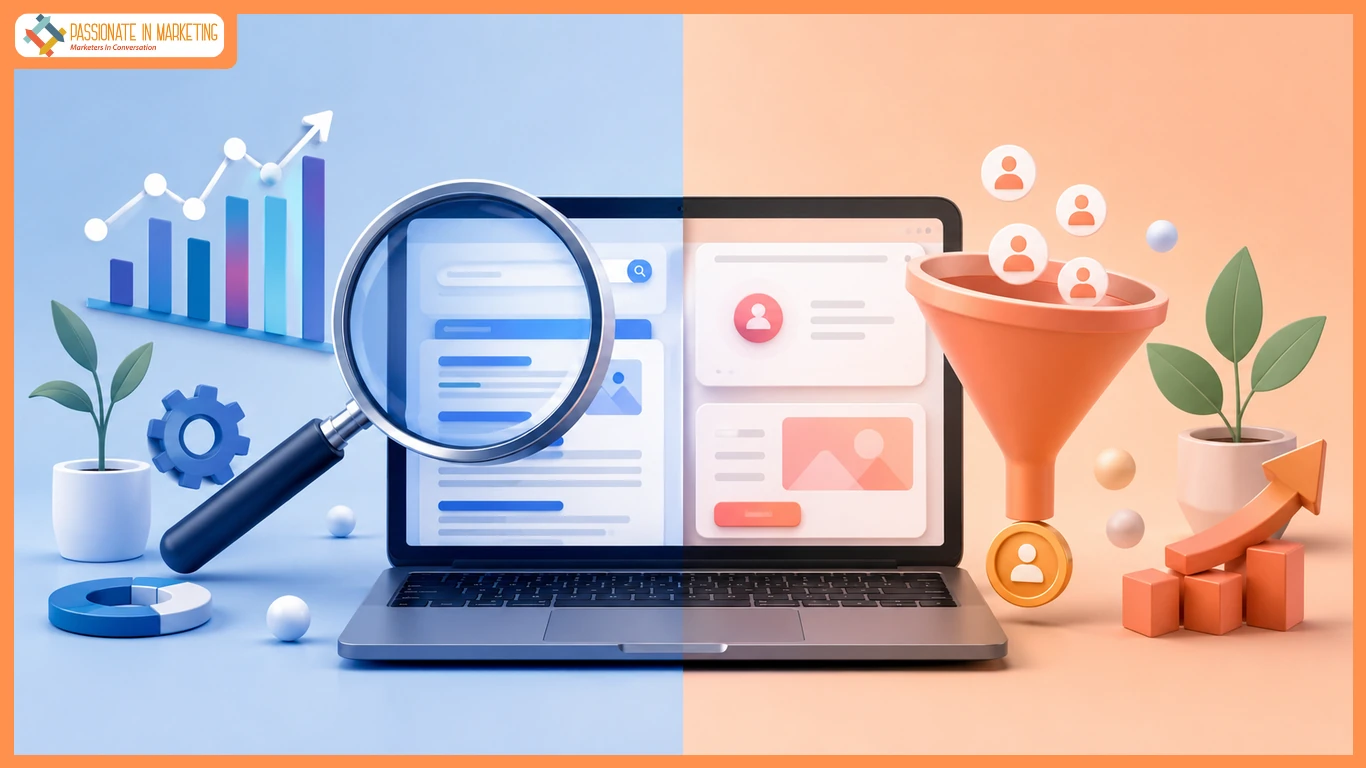
Getting to the first page of Google is a major milestone, but traffic is a vanity metric if your revenue remains flat. The disconnect usually happens because companies treat Organic SEO (driving traffic) and Conversion Rate Optimization (CRO, driving action) as separate silos. High rankings mean nothing if your digital storefront has a broken checkout counter.
The Cost of Mismatch
Businesses bleed resources when SEOs care only about volume and designers care only about aesthetics.
The Bounce Rate Trap If you create content just to rank for high-volume keywords, without thinking about the user journey, you will end up with generic, aggressive pages. Search engines can see when users immediately hit the back button. High bounce rates tell search engines that your page does not satisfy user intent, and this eventually kills those hard-earned rankings.
Search Intent Matching: Not all traffic is the same. If you optimize for keywords that don’t match your business model, you’ll get the “wrong” crowd. If an enterprise software company optimizes for “free templates,” they get high traffic but zero revenue. Aligning your strategy with commercial and transactional intent ensures the traffic you generate is actually ready to move down your funnel.
SEO vs CRO
There is no reason why SEO and CRO should be working against each other; they are two sides of the same coin.
SEO is about “crawlability”: lots of text, keyword density, and site speed that algorithms like. CRO is about “persuasion”: concise copy, visual cues, and clear calls-to-action (CTAs) that humans like. The friction comes when CRO tools (like dynamic scripts or heavy A/B testing) slow down your site, or when SEO requirements conflict with design.
The goal is to combine them: make your site fast and accessible to search bots, but also a seamless experience for the user.
Building Trust and Data
The same signals that tell search engines you’re an authority, verified reviews, case studies, and transparent authorship, also build the confidence a human buyer needs to provide payment details. Social proof isn’t just for conversion; it’s an SEO asset.
To optimize effectively, stop viewing data in isolation. If you’re getting high traffic for a keyword from Google Search Console, but heat maps show users leaving after two paragraphs, there’s a disconnect. Use behavioral tools to find out exactly where you’re losing people and then tweak the formatting or move your CTAs to where attention peaks.
Always test with “SEO guardrails” in place. Make sure that your testing software won’t produce duplicate content or prevent search engine crawlers from crawling your site. At Authority Lighthouse, we recommend testing thoroughly by tracking organic impressions in addition to conversion metrics, to make sure you’re not sacrificing one for the other.
Conclusion
Traffic alone cannot sustain a business. It’s time to move beyond counting visitors and start focusing on serving them. By auditing your highest-traffic pages and removing friction, you stop treating search engines and human readers as separate entities. You build an integrated experience that turns visibility into a predictable pipeline for growth.
**’The opinions expressed in the article are solely the author’s and don’t reflect the opinions or beliefs of the portal’**

