


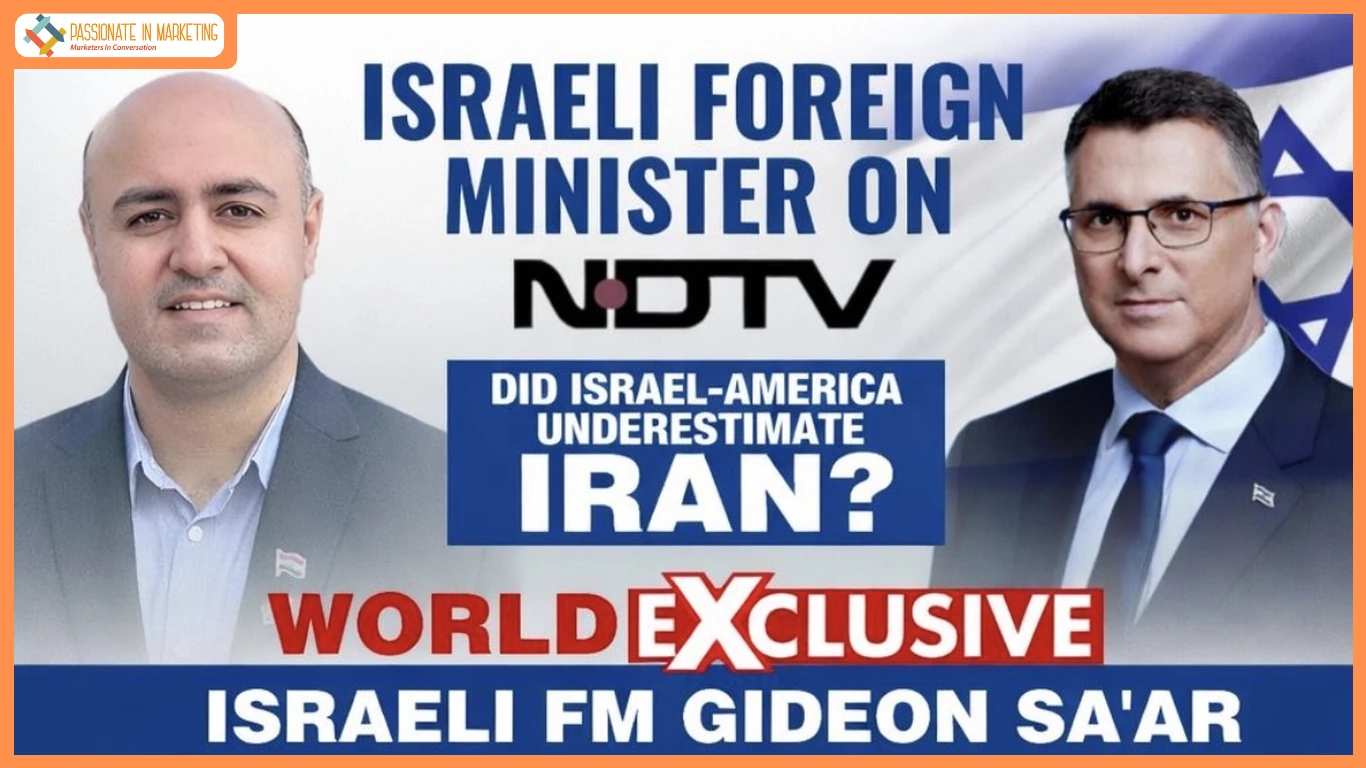
March 03, 2026: In a conflict rapidly redrawing regional and global alignments, NDTV spoke with Israel’s Foreign Minister Gideon Saar in an extensive and strategically significant conversation on the coordinated strikes inside Iran and the strategy now steering the war in West Asia.
Speaking to NDTV’s Aditya Raj Kaul from Jerusalem amid ongoing hostilities, Saar addressed the elimination of Iran’s Supreme Leader Ayatollah Ali Khamenei, the targeting of senior Islamic Revolutionary Guard Corps commanders, the widening regional fallout, and Israel’s long-term security calculus. The interview comes as missile exchanges and retaliatory threats continue to reverberate across the region, heightening global concern over the trajectory of the crisis.
At the heart of the discussion was the question being asked in capitals across the world: why act when diplomatic negotiations were reportedly underway? Saar argued that both Israel and the United States had reached the conclusion that Iran was prolonging talks while continuing to advance its nuclear and ballistic missile programmes. ‘We knew that within a very short time, Iran is going to put all its nuclear program in a very deep underground installation where not Israel and not America can hit effectively from the air,’ he told NDTV. In his assessment, delay would have fundamentally altered the strategic balance. ‘It’s more dangerous not to act rather than to act in this situation,’ he added, justifying the decision as one driven by urgency and long-term deterrence.
Saar clarified that Israel was not a party to the Oman-mediated negotiations between Washington and Tehran, noting that those talks were handled by the United States. While acknowledging that diplomatic engagement had been attempted, he emphasised that Israel’s objective remains the removal of what it considers existential threats – nuclear capability, ballistic missile expansion, and the infrastructure of regional proxy networks. He declined to specify a fixed timeline for military operations, indicating instead that Israel would measure progress against clearly defined strategic objectives in coordination with its American allies.
The future of Iran’s political leadership formed a significant part of the exchange. Saar maintained that decisions about governance ultimately belong to the Iranian people through ‘a free and fair election process,’ but argued that such a process cannot meaningfully take place while the current regime retains full coercive authority. ‘We need to weaken them to an extent that a transition is possible,’ he said, positioning Israel’s actions as an attempt to create conditions for political change rather than dictate its outcome. At the same time, he acknowledged that despite the elimination of senior figures, the Iranian establishment remains in control domestically.
The widening regional implications of the conflict were also examined. With reports of attacks affecting Gulf nations and concerns about broader destabilisation, Saar characterised the current escalation as part of a longstanding pattern. ‘After five decades that this regime caused instability in the Middle East, spread terrorism, spread fanaticism around the Middle East and beyond – is it logical to continue to give them a free hand?’ he asked, underscoring Israel’s argument that the present crisis must be viewed within a broader historical and strategic context.
Without disclosing operational specifics, Saar confirmed that the strikes targeted not only Iran’s Supreme Leader but also senior Revolutionary Guard and security officials. He described them as central to domestic repression and international terrorist activity, indicating that intelligence coordination was integral to the planning and execution of the operation. While acknowledging that the regime remains in control for now, he suggested that it could be significantly weakened over time.
In a significant diplomatic reference, Saar reflected on Prime Minister Narendra Modi’s recent visit to Israel and the strength of bilateral ties. Calling India ‘the biggest democracy on earth and a faster-growing economy on earth,’ he told NDTV, ‘India can rely on Israel’s friendship, as I believe we can rely on India’s friendship,’ reaffirming the durability of the India–Israel partnership even amid regional turbulence.
NDTV’s conversation with Israel’s Foreign Minister takes place amidst a raging conflict that is actively reshaping the geopolitical realities of West Asia and influencing strategic alignments beyond the region. In times of competing narratives, NDTV purposefully engages in conversations with global decision-makers, asking the questions that matter, and presenting perspectives with context and credibility – truly bringing the world to India, with the voices that matter.

