


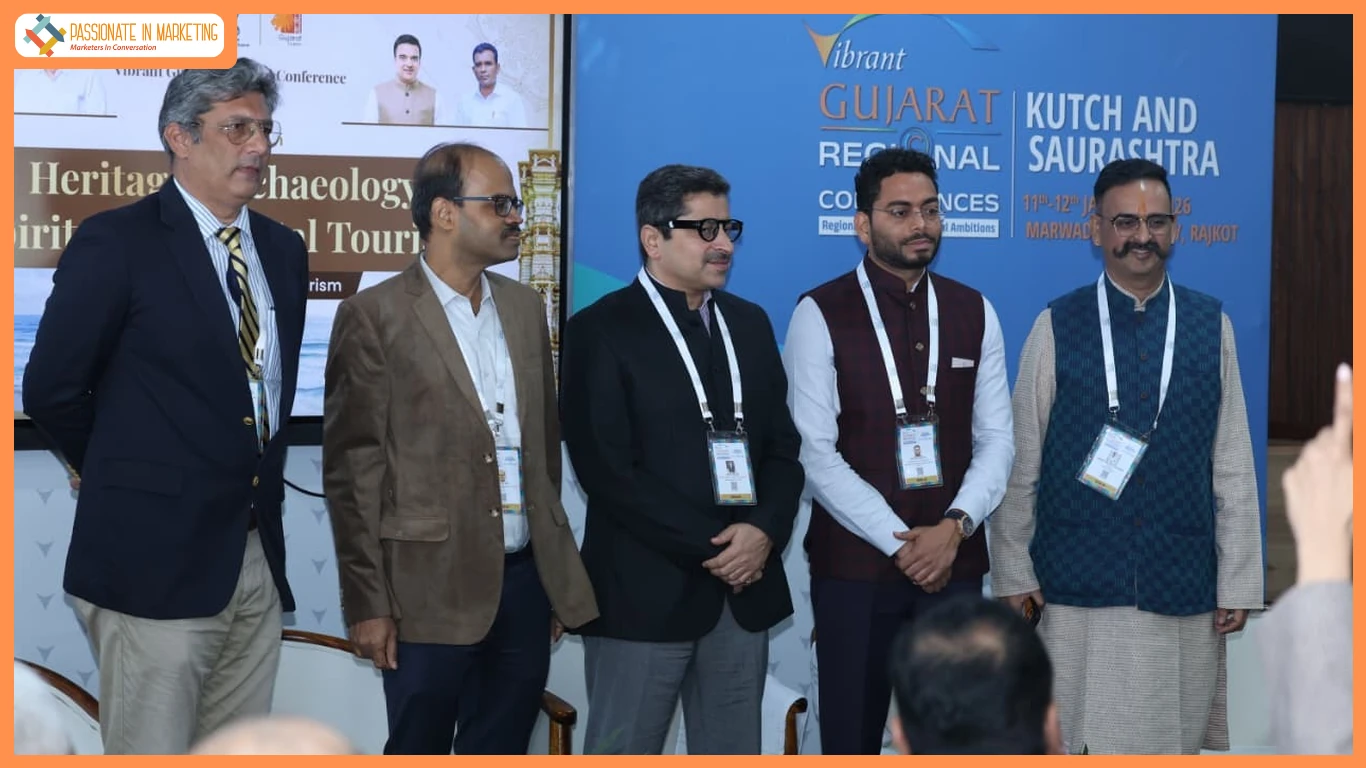
Indiawide Release, January 2026: Founder of Temple Connect & International Temple Convention & EXPO (ITCX), Shri Giresh Vasudev Kulkarni, emerged as a key voice at the Vibrant Gujarat Regional Conference 2026. He addressed the featured conference on “Unravelling Gujarat’s Treasure: A Journey Through Spirituality, Heritage, Archaeology, and the Sea”, which was held on January 12, 2026, at the Marwadi University, Rajkot. During his address, he introduced the CHESS-G Doctrine, a six-pronged strategic framework designed to reimagine India’s temple towns by strengthening spiritual tourism and enhancing the pilgrim experience.
The Vibrant Gujarat Regional Conference 2026 for the Saurashtra and Kutch region was inaugurated by Hon’ble Prime Minister Shri Narendra Modi on January 11, 2026. Conceptualised in 2003 under his visionary leadership, The Vibrant Gujarat Global Summit has evolved into one of India’s most respected platforms for business networking, policy dialogue and strategic partnerships.
“Unravelling Gujarat’s Treasure: A Journey Through Spirituality, Heritage, Archaeology, and the Sea” explored Gujarat’s spiritual legacy, cultural heritage, archaeological depth, and coastal potential, and their role in driving sustainable tourism and regional economic growth. A key highlight was the panel discussion on “Holistic Path of Spiritual Tourism,” where Shri Giresh Kulkarni introduced the CHESS-G Doctrine, to build future-ready temple towns. Centred on six pillars – Convenience, Hygiene, Experience, Sustainability, Safety, and Economic Growth, the doctrine aims to strengthen the spiritual economy while preserving the sanctity of sacred spaces through community-led participation. The discussion underscored the national importance of reimagining spiritual tourism in India with the need to move beyond footfall-driven temple management to an experience-led and sustainable approach to spiritual tourism.
The priority framework placed strong emphasis on the Convenience of pilgrims through better infrastructure, smoother mobility and improved digital support systems to ensure a stress-free and enriching pilgrimage experience. Hygiene was reframed as an important part of spiritual experience, with a call for the highest standards in sanitation, food safety, clean water and an emphasis on better public health standards across temple towns. He spoke of how Experience lay at the heart of the approach, focusing on dignified darshans, spiritual immersions, cultural storytelling and devotee-centric journeys. Safety addressed the need for disciplined crowd management, disaster preparedness, medical readiness and special attention to the safety of women, senior citizens and first-time pilgrims. Sustainability highlighted an environmentally inclined development with a focus on waste and water management, promoting green temple practices and the protection of heritage structures. He finally spoke about Economic growth that is centred on inclusion, enabling livelihoods for local communities, artisans, vendors, MSME’s and temple custodians, ensuring that spiritual tourism must benefit those who are rooted in that place.
Shri Giresh Vasudev Kulkarni, Founder Temple Connect, ITCX quoted, “I feel truly grateful to be part of a platform that has initiated meaningful dialogue—one that goes beyond being a convention and is evolving into a growing movement to reimagine how India approaches spiritual tourism. According to reports, in 2023-24 alone, the State of Gujarat welcomed 18.59 crore tourists, with nearly 72% visiting temple towns like Dwarka, Somnath, and Ambaji. These figures reflect trust and faith, but footfall alone cannot be the final measure of success. Counting visitors tells us how many people arrived, not how deeply they were impacted. Spiritual tourism must move beyond crowd management. For a truly transformative experience for pilgrims, it is our responsibility to build sacred ecosystems where faith, heritage, livelihoods, and sustainability grow together.”
The sub-event opened with the felicitation of dignitaries and a welcome address by Gujarat Tourism, setting the context for Gujarat’s growing focus on spiritual, heritage, and cultural tourism. Special remarks were delivered by Shri Kesridevsinh Jhala, Member of Parliament, Rajya Sabha, and Dr. Jayram Gamit, Minister of State for Tourism, Government of Gujarat. Shri Giresh Vasudev Kulkarni was part of the session, along with dignitaries such as Yuvraj Shri Ranjit Sinh Parmar, Vice Chairman of the Heritage Tourism Association (HTA), and Shri. Sachin Kumar Vaishya (IAS)-Chief Executive Officer, Shri Mata Vaishno Devi Shrine Board (SMVDSB), Shri . Gaurav Jha- Group General Manager, IRCTC West Zone Tourism: Pilgrimage Special Trains and Shri. Nitin Thakur- Group President Strategic Initiatives, President Corporate Affairs, Prism.
The Vibrant Gujarat Regional Conference 2026 is a testament to Gujarat’s vision of integrating spirituality, culture, heritage and economic progress. Shri Giresh Kulkarni’s keynote address aligned with this vision, emphasising the fact that temple towns are not just places of worship but economic engines, cultural anchors and assets of our civilisation. When managed with foresight and sensitivity, temples can strengthen local economies while uplifting faith and supporting the summit’s overall goal of sustainable regional growth. This calls upon policymakers, temple trusts, urban planners, investors, and ecosystem partners to move beyond merely managing crowds and instead begin building sacred cities that truly work, spiritually, socially, and economically.

