


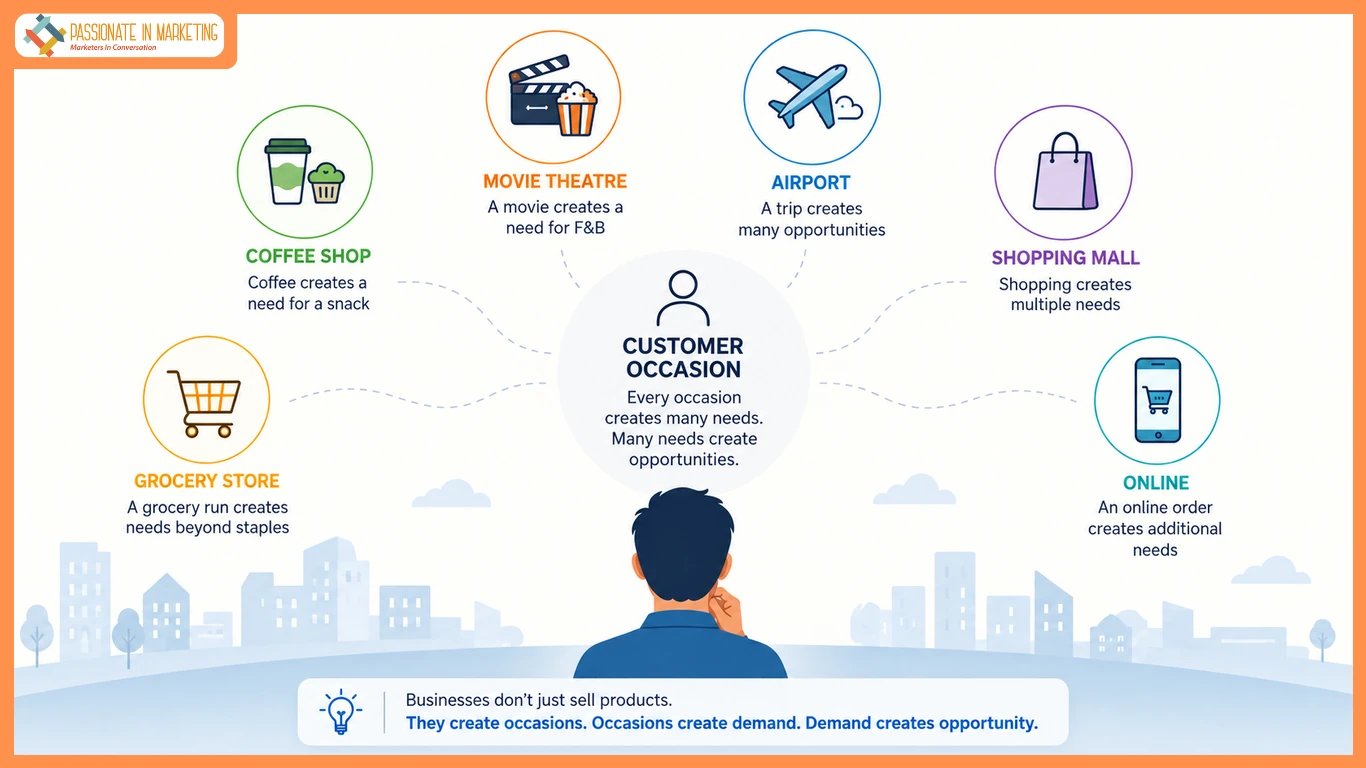
A business does more than sell its product. By bringing a customer into a particular place or situation, it can create new needs around that customer.
A cinema creates a two-hour entertainment occasion. A hotel creates a stay. A sports stadium creates a match-day occasion.
Around these occasions, demand can emerge for food, beverages, retail, transport, entertainment and other services, creating opportunities beyond the business’s original offering.
The interesting question is not simply what complements what, but what demand is created by the occasion and who captures it?
To understand these evolving dynamics, MaxEd, one of South India’s leading market research firm, examined real-world business cases and supporting data to explore how customer occasions create additional demand, how that demand expands beyond the original purchase, and where these opportunities can be identified and captured.
PVR INOX: From a cinema occasion to a new business
The cinema provides a clear example of how a primary purchase can create demand beyond the ticket itself. A movie creates a defined customer occasion: people spend time in the cinema, often creating demand for food and beverages during the experience.
PVR INOX has adopted multiple models to capture the food and beverage demand created around the cinema occasion. Some offerings operate under its own brands, such as The Dogfather (hot dogs) and Cine Café, while some food courts are operated in partnership with other companies. PVR INOX backed it as a separate business, giving rise to 4700 BC.
This matters because selling snacks is simply more profitable than selling tickets. A large share of every ticket has to be shared with the film’s distributor, so cinemas don’t keep much of that money. But when a cinema sells popcorn or a cold drink, almost all of that money stays with them. That’s the real reason cinemas push F&B so hard. It isn’t just extra revenue, it’s better cash flow.
This isn’t unique to PVR INOX either. AMC, the largest cinema chain in the US, follows the same playbook. Food and drinks make up roughly a third of its total revenue too. Different country, same idea.
To see why, look at how much of each rupee a cinema actually keeps. On tickets, roughly half goes to film distributors and other costs. On food and drinks, the cinema keeps around 80 cents of every rupee. That’s not a small edge; it’s close to double the margin. This is why cinemas everywhere, not just PVR INOX, keep pushing customers toward the snack counter.
Popcorn Beyond Cinema
4700 BC started as popcorn sold inside PVR cinemas. But instead of keeping it as just a concession item, PVR backed a separate company to grow it into a full snack brand, sold in supermarkets, on flights, and online, well beyond the movie hall.
That bet paid off. The company’s sales jumped 35% in a single year, crossing ₹102 crore.
The bigger point: a snack that started as something to eat during a movie became a business of its own. Proof that the demand created around one occasion can outgrow the occasion itself.
Cinema occasion → F&B demand → Popcorn → New occasions → Demand beyond cinemas
Delhi Airport: Unlocking opportunities beyond flight revenue
An airport does not only monetize the act of flying. The passenger creates an extended occasion around the journey – time spent at the airport, movement through terminals and access to a concentrated customer base. Around this, multiple commercial activities emerge, including retail, duty-free, advertising, parking, food & beverage and other services.
The opportunity around a customer can extend well beyond a single complementary product. At Delhi Airport, non-aeronautical revenue was substantially larger than aeronautical revenue in both FY24 and FY25.
An airport earns from more than just flights, and interestingly, it doesn’t even run most of that extra business itself. Delhi Airport doesn’t operate its own duty-free shops; it brings in a specialist retail company to run them, much like a mall doesn’t run its own clothing stores. It rents out the space and takes a share of what’s sold.
There’s a good reason for this. Retail experts know how to sell better than an airport operator does. And airports face a limit on how much they’re allowed to charge airlines, since that price is regulated. But there’s no such limit on what they earn from shops, food, or parking. So growing the shopping side is really the airport’s best lever for growing revenue at all.
And this isn’t unique to Delhi. Mumbai’s airport leans on shopping and retail revenue even more; it makes up around 60% of its total earnings. Compared to airports in the US, Indian airports lean on this kind of revenue more heavily overall, not less.
Put in a global context, the pattern is even clearer. Heathrow gets about 38% of its revenue from non-aeronautical activities, versus roughly 46% across US airports and 57–61% at Delhi and Mumbai. This reflects differences in airport pricing and regulation, which give Indian airports greater incentive to grow the commercial opportunities around the flying occasion.
From an observation to a measurable opportunity
The examples above show how demand can show up around a single customer occasion. But these patterns aren’t always obvious just by looking at the business.
A cinema sees strong demand for popcorn and snacks, while a popcorn brand can grow beyond the cinema into new occasions. An airport takes this further, creating demand across retail, food, parking, and other services around the flying occasion. The pattern is visible. The next question is whether it can be measured and identified systematically.
There are five simple questions worth asking:
Product: What do customers usually buy together?
Time: When does the extra demand show up?
Location: Where is this pattern strongest?
Customer: Which customers show this behaviour the most?
Occasion: What is it about the situation that triggers the extra demand in the first place?
This changes the question a business asks itself. Instead of “What else can we sell?”, it becomes “What additional needs are we already creating around our customer, that we haven’t captured yet?”
That’s the real shift. From noticing a pattern by chance, to measuring it with data, to acting on it.
This is where MaxEd’s market research and data-driven approach helps businesses identify the demand forming around their customers and turn that demand into actionable opportunity.
About MaxEd
MaxEd is one of South India’s leading market research and consulting firms, dedicated to delivering actionable intelligence that empowers businesses to make confident, data-driven decisions. With a deep understanding of regional markets and a commitment to research excellence, MaxEd bridges the gap between complex market dynamics and clear strategic direction. From consumer insights and brand analytics to competitive intelligence and business consulting, MaxEd offers end-to-end research solutions tailored to the unique needs of each client.

