


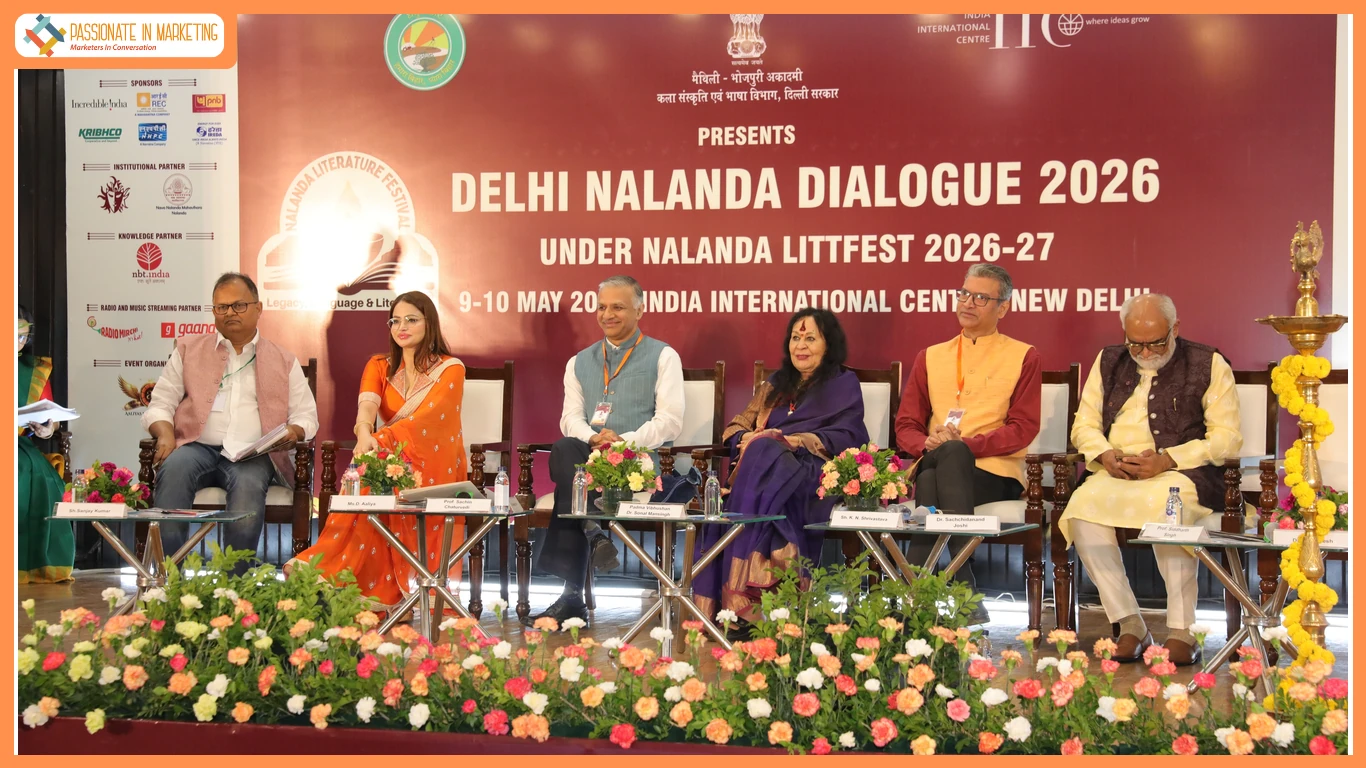
New Delhi, May11, 2026:The Delhi–Nalanda Dialogue 2026 commenced today at the Multipurpose Hall, Kamaladevi Complex, India International Centre, New Delhi, setting the stage for a multi-disciplinary exploration of Governance, Culture, and Literature. Held under the umbrella of the Nalanda Literature Festival 2026–27, the Dialogue brings together policymakers, civil servants, writers, cultural thinkers, and diplomats for a series of conversations rooted in India’s civilizational knowledge systems.
Organised by Dhanu Bihar in collaboration with Department of Art, Culture & Languages, Government of NCT of Delhi and India International Centre, the Dialogue convened over 100 senior government delegates alongside young civil servants, writers, cultural administrators, academic institutions, and think tanks.
Inaugural Ceremony Sets the Vision
The inaugural session positioned the Dialogue as a platform to revive India’s deep-rooted traditions of knowledge, dialogue, and cultural continuity while connecting them to contemporary governance and global discourse.
Sh. Sanjay Kumar, Executive Director, Nalanda LittFest reflected on Nalanda’s enduring relevance, stating, “Nalanda’s destruction did not end its legacy, what remains insufficiently explored is how its scholars carried that knowledge across geographies. The real continuity of Nalanda lies not in its ruins, but in the intellectual journeys it enabled.”
Sh. Amitabh Kant, Former CEO of the NITI Aayog emphasised the strategic importance of literature, noting, “Nations today are not defined by economics alone and civilizational depth and cultural confidence shape global influence. Literature becomes a powerful instrument in positioning India as a knowledge leader.”
Padma Vibhushan Dr. Sonal Mansingh, celebrated Dancer and Chairperson, Nalanda LittFest highlighted the philosophical core of knowledge traditions, remarking, “In our traditions, knowledge was never transactional, it was experiential, evolving through dialogue, devotion, and dissent. Without that spirit, learning remains incomplete.”
Ms. D. Aaliya, Festival Chairperson, Nalanda LittFest underlined the intent of the platform, saying, “This Dialogue is an attempt to break silos, bringing governance, culture, and literature into one continuum, where policy is informed by cultural understanding and youth are active participants in shaping that narrative.”
Inaugural Dialogue: Governance & Civilizational Wisdom
The session examined Nalanda as a global knowledge model, focusing on its intellectual legacy rather than its physical history. Discussions emphasised that Nalanda’s strength lay in its culture of rigorous debate, openness to diverse perspectives, and its ability to attract scholars across borders through ideas. The panel also reflected on the need for deeper research into how Nalanda’s knowledge systems travelled globally, and how its integration with local communities created a sustainable and participatory model of education.
Sh. Purushottam Agrawal, Eminent Writer stated, “We often memorialise Nalanda’s destruction, but rarely investigate its dissemination. A university does not end with its campus—it survives through the minds it has shaped and the questions it leaves behind.”
Sh. Tripurari Sharan, Writer & Ex-Civil Servant observed, “Nalanda’s power lay in persuasion, not dominance—it created a space where ideas competed without hostility and dialogue replaced hierarchy.”
Prof. Sachin Chaturvedi, VC, Nalanda University noted, “Nalanda’s model reminds us that institutions cannot exist in isolation—its strength came from its embeddedness within society, where knowledge and community evolved together.”
Session II: Civilizational Knowledge & India’s Governance Ethos
This session explored the intersection of civilizational knowledge and governance, highlighting Nalanda’s institutional frameworks, decentralised systems, and participatory ethos. Speakers reflected on how governance in India has historically been shaped by dialogue, ethical balance, and community engagement. The discussion also critically examined the reasons behind Nalanda’s decline—ranging from governance lapses to institutional complacency—positioning these as cautionary lessons for contemporary policy systems.
Sh. Amarjeet Sinha, Eminent Writer & Ex-Civil Servant remarked, “India’s governance traditions were never purely centralised, they evolved through layered participation, where institutions, communities, and civil society worked in tandem.”
Prof. Kavita Sharma stated, “Nalanda was not just an academic centre, it was a disciplined ecosystem with intellectual rigour, global exchange, and a deeply internalised culture of debate. Its decline began when that institutional discipline weakened.”
Smt. Mugdha Sinha, Writer & Civil Servant observed, “Great institutions endure when they remain vigilant by staying connected to their core values, renewing their sense of purpose, and continuously evolving. Strong governance lies in nurturing this awareness and guiding institutions forward with clarity and intent.”
Session III: Culture, Diplomacy & India’s Soft Power
The session explored how literature, language, and the arts function as instruments of cultural diplomacy. Discussions highlighted storytelling as a strategic tool that communicates identity and values across borders. Speakers also examined the relationship between economic growth and cultural influence, noting that India’s rise on the global stage will naturally amplify its linguistic and cultural presence. The importance of preserving India’s pluralistic identity while engaging globally emerged as a key theme.
Smt. Ritu Sharma, Writer & Civil Servant stated, “Cultural diplomacy is not negotiated in conference rooms, it travels through stories, memory, and lived experiences that resonate across borders.”
Sh. Sanjeev Chopra, Writer & Ex-Director, LBSNAA remarked, “Cultural assertion cannot be forced—history shows that language and culture expand organically when backed by economic and geopolitical confidence.”
Dr. Varsha Das, Eminent Writer noted, “India’s strength lies not in uniformity but in its plurality and our languages are not barriers but bridges that carry layered identities.”
Smt. Anju Ranjan, Writer & Civil Servant added, “Soft power is most effective when it is authentic—India’s philosophical traditions endure because they speak to universal human concerns.”
Session IV: Routes to Roots – Diaspora & Cultural Identity
This session explored how Indian diaspora communities sustain and reinterpret cultural identity across geographies. The discussion examined the complexities of identity shaped by migration, memory, and historical experiences, including colonialism and racial discrimination. Speakers highlighted how distance from the homeland often inspires and strengthens cultural preservation, while also creating new hybrid identities. The role of diaspora as both custodians and reinterpreters of Indian culture emerged as a key theme, alongside reflections on India’s early global stance against racial injustice and its continued cultural resonance worldwide.
H.E. Prof. Anil Sooklal, High Commissioner of South Africa to India reflected, “For the diaspora, identity is not inherited, it is forged through struggle. Under apartheid, culture became resistance, a way to assert dignity in the face of injustice, shaping not just who we were, but how we understood ourselves in a world that often turned away.”
Dr. Suman Keshari, Eminent Writer noted, “Distance does not dilute identity, it often deepens it. Like a severed root striving to survive, communities abroad hold on more fiercely to language, memory, and tradition.”
Prof. Ajay Dubey from Jawaharlal Nehru University observed, “Diaspora identities are not frozen—they evolve continuously, negotiating between memory and modernity, creating new cultural expressions while staying anchored to origins.”
Dr. Sarita Boodhoo from Mauritius added, “The diaspora does not merely preserve culture, it reshapes it, carrying fragments of India into new contexts where they acquire renewed meaning.”
Session V: Youth Innovation & Cultural Leadership
This final session for the day brought youth to the forefront as both custodians and change makers of culture, exploring how a new generation is actively reinterpreting heritage through innovation and emerging technologies like AI. It looks at how cultural identity can become central to the way young people learn, create, and express themselves—shaping not just personal narratives but collective futures. With frameworks like the National Education Policy 2020 India encouraging a stronger integration of culture within education, the discussion reflects on how youth today are uniquely positioned to lead with both rootedness and reinvention, bridging tradition with contemporary relevance.
Dr. Sachchidanand Joshi, Member Secretary, IGNCA said, “India’s greatest gap has been in not orienting our youth towards their own cultural and intellectual heritage. The New Education Policy 2020 is a decisive step in that direction, placing Indian identity at the centre of learning. The real shift, however, lies in how we see ourselves, not as professionals who pursue culture on the side, but as cultural beings who carry that identity into every field.”
Sh. Mukul Kumar, Writer & Civil Servant shared, “Youth today are not just inheritors of culture, they are actively reshaping it. Digital platforms have shown us how traditions and even endangered languages can be revived. But in making culture more accessible, we must remain conscious of preserving its authenticity and spirit.”
Padma Shri Shovana Narayan, Writer & Ex- Civil Servant commented, “Artificial intelligence is a powerful tool, but it must remain just that, a tool, to aid, and not to take over the creativity. Creativity, emotion, and human sensitivity cannot be replaced. To engage with today’s generation, culture must be communicated in their language and mediums, while ensuring that its core essence remains intact.”
Sh. Nitishwar Kumar, Writer & Civil Servant said, “Culture and language cannot always be translated, they have to be experienced. The poetry of Amir Khusro or the voice of Kishore Kumar carry an emotional depth that goes beyond words. That is the true power of our literary and cultural heritage.”
The day concluded with a rich cultural evening led by Vidya Shah and her ensemble, whose presentation “Sur, Shabd aur Taal” explored the deep connection between music and literature. Marking Rabindranath Tagore Jayanti, the performance carried a distinct lyrical depth, weaving together classical and folk traditions.
This was followed by “Jashn-e-Qawwali” led by Taskeen Ali Khan, whose powerful and energetic performance brought the evening to a memorable close, celebrating the shared spirit of music, literature, and culture.
The first day of the Delhi Nalanda Dialogue 2026 brought together conversations across governance, culture, literature, and identity, rooted in India’s civilizational knowledge traditions. From Nalanda’s legacy of dialogue and institutional learning to the role of culture in diplomacy, the strength of diaspora identities, and the responsibility of youth in shaping the future, the discussions collectively highlighted that India’s cultural and intellectual heritage continues to evolve through dialogue, participation, and innovation while remaining anchored in its core values.
Know more about the festival and upcoming initiatives at @NalandaLittFest.
About Dhanu Bihar:
Dhanu Bihar, established in 2020, is a non-profit trust based in Patna, Bihar, dedicated to uplifting underprivileged communities across the state through a multifaceted approach. Its core pillars include empowering girls, supporting farmers, preserving cultural heritage, promoting education, and enhancing social welfare.
The organization is driven by a vision to uplift communities through knowledge, collaboration, and sustainable practices. By working closely with local stakeholders, institutions, and individuals, Dhanu Bihar aims to create meaningful and lasting impact across various sectors.
For queries please visit our website: www.nalandaliteraturefestival.com

