



Ten years ago, buying a face cream in India usually meant going to the neighbourhood store and searching for a name you had seen on television. Today, buying the same cream is a more evolved process, where consumers prefer to explore brands and products, do some research and compare its ingredients and then even ready to buy it from an online store.
Few companies read that change as early as Honasa Consumer, the company behind Mamaearth. It started in 2016 with six baby-care products sold online. Ten years on, it is a listed company with nine brands across skincare, hair care, makeup, men’s grooming and fragrance, and its sales are close to ₹2,400 crore a year.
Honasa’s story is also a good lesson in market research. Almost every turn it took, good or bad, comes back to how well the company understood its shoppers and its market at that moment.
To understand these evolving dynamics, MaxEd, one of South India’s leading market research firms, studied Honasa’s annual and quarterly results, investor disclosures and industry data. The aim was to trace how the company grew, where it stumbled, and which research questions mattered most at each stage.
Before 2016: a narrow shelf, bought out of habit
For most Indian homes, looking after skin and hair meant using just a few basic products. Soap, talc, a cream for the winter months and a bottle of hair oil did the job, and home remedies covered the rest. People bought these at the local kirana or chemist, from a shelf that rarely changed. There wasn’t much to discover, and not many people were looking.
Even six years ago, the market was still very traditional. In FY2020, Indians spent about US$15 billion on beauty and personal care. Roughly 72% of that went through local shops, and only 8% was spent online.
Shoppers moved online and started reading labels
That picture changed fast. By FY2025, the market had grown to about US$23 billion, and online’s share had risen to 20%.
Social media did a lot of the work. India had more than 500 million social media users and over 3 million influencers in FY2025, according to Redseer, and many of them were reviewing products, explaining routines and decoding ingredients. Shoppers picked up the vocabulary. They started asking for niacinamide or SPF 50 instead of a brand name, and buying for a specific problem such as acne marks, tanning or dry skin.
Honasa saw this in its own numbers. In the first half of FY25, its face washes, sunscreens and serums grew more than 28% (after adjusting for a one-off stock correction). Mamaearth itself slowed at the same time, as shoppers drifted towards products built around active ingredients. Younger buyers are pushing this further: Redseer expects Gen Z and Gen Alpha to account for about half of India’s beauty spending by 2030.
A parent’s problem became a brand
Mamaearth started at home. When Varun and Ghazal Alagh’s son was born in 2014, they couldn’t find baby products in India that they trusted to be free of harsh chemicals, and ended up asking friends and family to bring them back from the US. Other parents they knew had the same problem. In 2016, the couple launched Mamaearth with six baby products.
They sold online from day one rather than fighting for shelf space. They also worked hard on trust. Mamaearth became Asia’s first MADE SAFE-certified brand for skin and body care, and parents and influencers did much of the talking for it. Then the brand followed its customers from their babies to themselves, with face washes, shampoos and serums built around familiar ingredients like onion, ubtan and vitamin C.
It worked. Mamaearth became the fastest beauty and personal care brand in India to reach ₹1,000 crore in annual revenue, getting there within six years of launch. Honasa listed on the stock exchanges in November 2023.
One name could not serve every shopper
A brand known for gentle baby care is not the obvious place to buy a strong acne serum. A premium night cream doesn’t sit comfortably next to a budget shampoo either. So instead of stretching Mamaearth to cover everyone, Honasa built a house of brands. Each brand speaks to a different kind of shopper, while research, data and distribution are shared behind the scenes.
Some brands were built in-house, like The Derma Co., Aqualogica, Staze and Luminéve. Others were bought, like BBlunt, Dr. Sheth’s and, most recently, Reginald Men. The Derma Co. is now Honasa’s second-biggest brand, and the younger brands together grew about 40% in FY26.
Reginald Men brings a South Indian angle. Honasa bought 95% of the Hyderabad-based men’s grooming brand in December 2025 at an enterprise value of ₹195 crore, and more than 80% of its sales come from the southern states. In 2026, Honasa added FIKN, a premium fragrance brand for young men.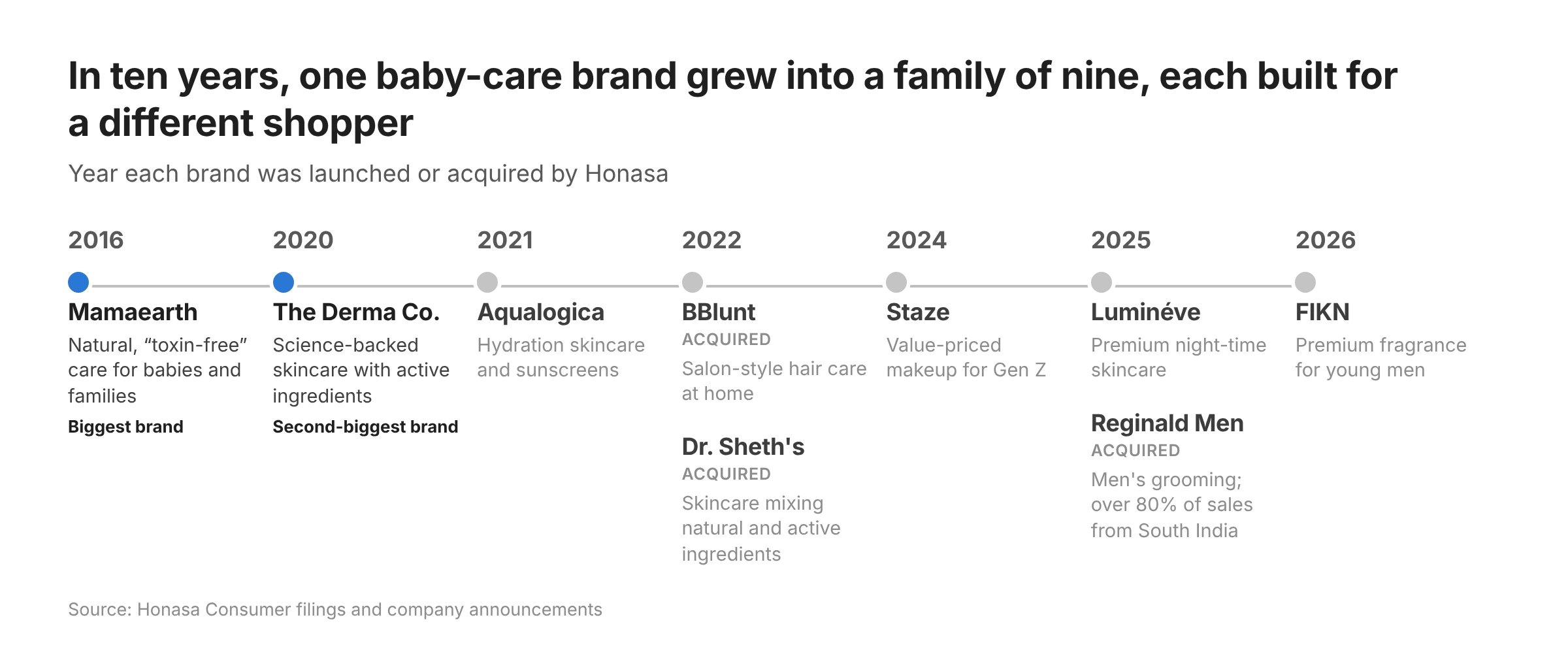
Growth came fast, then stalled, then returned
The rise
For a few years, growth seemed easy. Sales rose from ₹110 crore in FY20 to ₹1,920 crore in FY24, with a profit of ₹111 crore.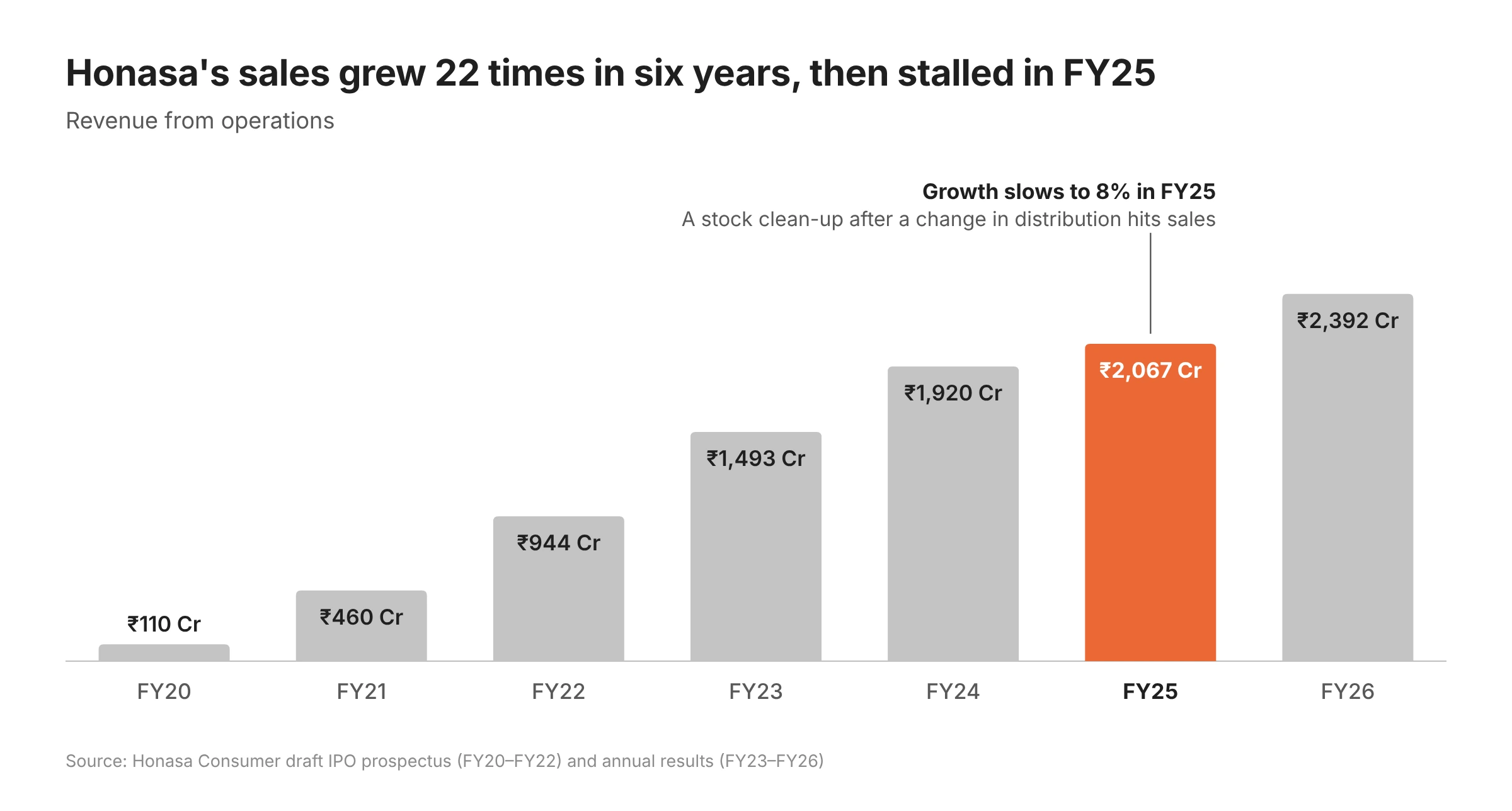
The stumble
Then it hit a wall. Under Project Neev, Honasa replaced its large wholesale distributors, known as super-stockists, with direct distributors in the top 50 cities, and found far more unsold stock in the market than it had expected. Clearing it cut about ₹63 crore from sales in July–September 2024, and Honasa posted a ₹18.6 crore loss, its first since listing. The company later said its view of stock had come from the super-stockists, not from shop shelves. FY25 closed with sales up just 8% and profit down to ₹73 crore.
The comeback
FY26 was about fixing the basics. Honasa rebuilt its distribution, billing about 1.2 lakh outlets directly, and leaned on its younger brands. Sales rose 16% to ₹2,392 crore, net profit reached ₹200 crore and the company paid its first dividend. The momentum continued in April–June 2026, with sales up 27% and profit more than doubled to ₹90 crore.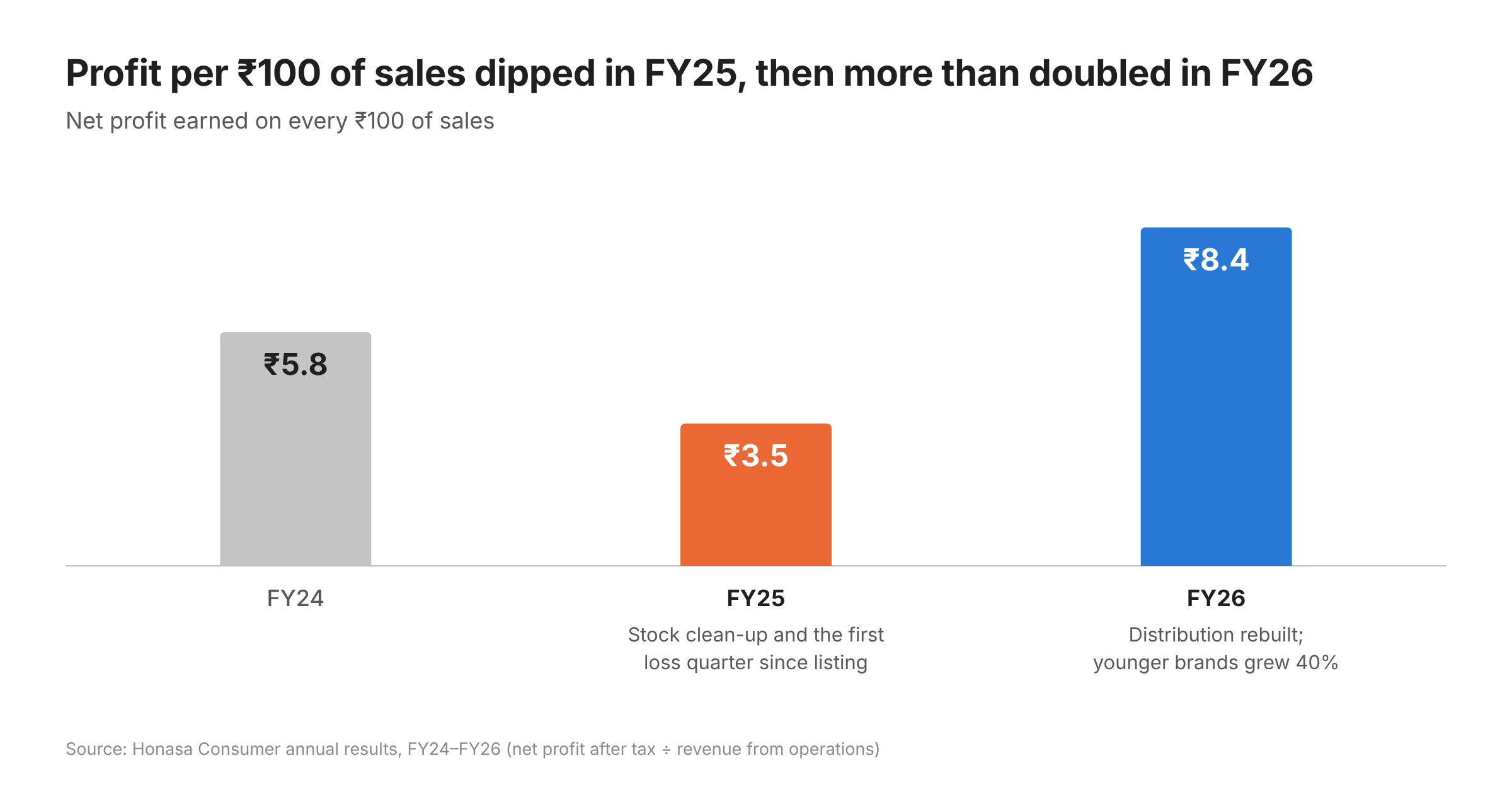 Selling more is only half the job. The other half is knowing where the stock is and how fast it really sells.
The Playbook Is No Longer Unique
Others have noticed what worked. Hindustan Unilever, India’s biggest FMCG company, paid ₹2,955 crore in 2025 for 90.5% of Minimalist, an ingredient-led skincare brand that built its following online. Nykaa has grown its own skincare brand, Dot & Key, to ₹1,790 crore in sales value in FY26. And Redseer expects more than 150 new-age beauty brands to cross ₹100 crore in revenue by 2030.
How people shop is shifting again, too. Quick-commerce apps accounted for about 15% of online beauty spending in FY2025, and Redseer expects that share to reach 30–40% by 2030. When buying takes a few taps, so does switching. Loyalty gets harder to earn, and being seen gets more expensive.

Honasa’s own targets are ambitious: sales above ₹5,500 crore by FY31, with an operating margin above 15%. Getting there depends on whether each brand can keep a clear identity of its own while the company runs them all through one shared system.
Conclusion: Growth Follows the Consumer, Profit Follows the Data
Looking back, Honasa’s best decisions came from reading people early. It spotted parents who wanted safer baby care before most of the industry did, followed shoppers into ingredient-led skincare, and moved into men’s grooming and fragrance as those needs grew.
Its worst year came from the part of the business it could see least clearly, the stretch between the warehouse and the shop shelf. The recovery came from fixing exactly that.
For any brand, in skincare or beyond, the useful questions are the ones that run through this story:
- Who is my shopper becoming, and how are they choosing?
- Which needs are we not serving yet?
- What is really happening on the shelf?
- Are our customers coming back?
Answering them well takes regular, reliable research rather than a one-off survey. This is where MaxEd’s market research and data-driven approach helps businesses understand changing consumers, see what is really happening in the market and act with confidence.
Sources
Figures in this case study are drawn from the following public sources.
Honasa Consumer: annual results FY23–FY26, quarterly results for Q2 FY25 and Q1 FY27, and earnings calls
Honasa Consumer: IPO prospectus documents (2022–2023), stock exchange filings and company announcements
Redseer Strategy Consultants: India BPC 2030 (February 2026)
Hindustan Unilever: announcement on the acquisition of Minimalist (January 2025)
Nykaa (FSN E-Commerce Ventures): FY26 results
Founder interviews in the media
About MaxEd
MaxEd is one of South India’s leading market research and consulting firms, dedicated to delivering actionable intelligence that empowers businesses to make confident, data-driven decisions. With a deep understanding of regional markets and a commitment to research excellence, MaxEd bridges the gap between complex market dynamics and clear strategic direction. From consumer insights and brand analytics to competitive intelligence and business consulting, MaxEd offers end-to-end research solutions tailored to the unique needs of each client.

